
Reviewed · COMMUNIST HISTORY TOURS
Footprints of Bucharest: History, Communism & Urban Tales
Bucharest reveals itself after dark. Footprints of Bucharest links royal buildings, communist-era scars, and Old Town lanes in a compact two-to-three-hour outing. I like the small maximum of eight people, and I like that guides such as Toni, Manuela, and Marius add personal stories rather than reciting dates. The possible drawback is that most stops are exterior views, so this is not the tour for anyone hoping to enter Bucharest’s grand buildings.
The strongest part is the human touch. Toni has shared memories of communist life, including how green bananas felt like a special Christmas treat, while Marius has helped visitors find tea, coffee, and local street food. You also get practical tips on places to eat and drink. At $72.25 per person, the price is reasonable if you value a personal guide and a fast introduction to the city, but it is less attractive if you only want a basic sightseeing walk.
In This Review
- Key things to know before you book
- Why this Bucharest tour works well for a first evening
- Starting at the Romanian Athenaeum
- Revolution Square and the end of Ceausescu’s rule
- Bucharest’s elegant central avenue
- The Central University Library and Royal Palace
- Old Town, Stavropoleos, and the city after dark
- The Palace of Parliament and communist scale
- Macca Villacrosse Passage and Lipscani
- Cărturești Carusel and Bucharest’s grand facades
- The National Art Museum and two former public buildings
- What $72.25 buys you
- Timing, walking, and practical fit
- Weather and cancellation details
- Who should book Footprints of Bucharest?
- FAQ
- How long does Footprints of Bucharest last?
- How much does the tour cost?
- Is the tour offered in English?
- What is the maximum group size?
- Where does the tour begin?
- Where does the tour end?
- Does the price include entrance fees?
- Are food and drinks included?
- Does the tour include the interior of the Palace of Parliament?
- Can I cancel for a full refund?
- Should you book it?
Key things to know before you book
- A compact look at Bucharest’s turning points: The route moves from the Romanian Athenaeum and royal landmarks to Revolution Square, communist history, and the Palace of Parliament.
- Small groups matter here: The maximum is eight people, giving you a better chance to ask questions and get help with photos.
- Night departures change the mood: Bucharest’s illuminated facades make the tour especially appealing after sunset.
- The 1989 Revolution gets real context: At Revolution Square, guides use photographs and video presentations to explain Ceausescu’s final speech and the events that followed.
- Old Town finishes the experience: You end near Union Square, close to cafes, restaurants, and the Lipscani area.
- Expect a guided overview, not interior sightseeing: Admission fees are not included, and many stops are short exterior presentations.
Why this Bucharest tour works well for a first evening
I see this experience as an orientation tour with a strong historical thread. Instead of treating Bucharest as a collection of pretty buildings, it connects the city’s royal past, communist rule, 1989 Revolution, and current cafe life.
That makes it useful near the beginning of your stay. You can learn where the main central areas are, hear the stories behind landmarks, and finish with a better sense of where you might return during daylight.
The night setting helps. The Romanian Athenaeum, Central University Library, CEC Palace, and former Royal Palace can look especially striking when lit. Darkness also softens some of Bucharest’s rougher edges, though it means you may miss architectural details that are easier to see in daylight.
The experience is offered in English and runs for roughly two to three hours. Several departure times make it easier to fit around dinner or other plans. Since the route includes many short stops, you should expect a brisk pace with frequent pauses rather than long visits at a single site.
More Historical Tours in Bucharest
- Bucharest: 3-Hour Dark History Tour with a Local
★ 4.9 · 301 reviews - Bucharest: Small Group History, Art & Secrets Tour
★ 4.7 · 152 reviews - Guided Walking Tour of Historical Bucharest
★ 5.0 · 84 reviews
Starting at the Romanian Athenaeum
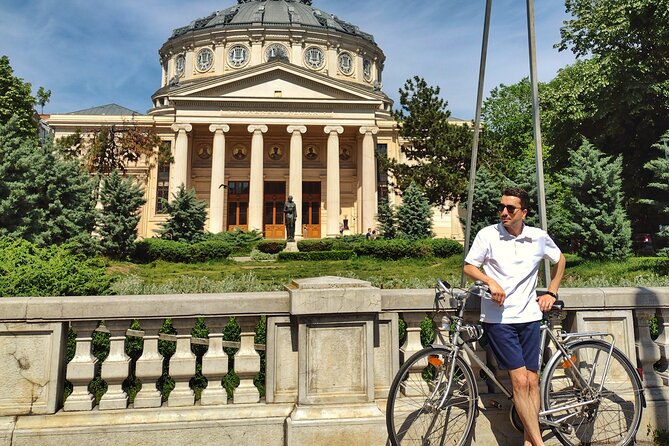
The tour begins at Strada Benjamin Franklin 2, near the Romanian Athenaeum. This is one of Bucharest’s most recognizable buildings, designed to resemble an ancient Greek temple.
You get about 15 minutes here, enough to hear why the building matters and take photographs. The stop sets the tone nicely: Bucharest is not only a city of communist-era concrete. It also has grand cultural and royal architecture from earlier periods.
The Athenaeum is an exterior stop, with no admission included. If you want to see the interior, you would need to arrange that separately. For this tour, the value comes from the guide’s explanation and from seeing the building as part of the city’s larger story.
Revolution Square and the end of Ceausescu’s rule
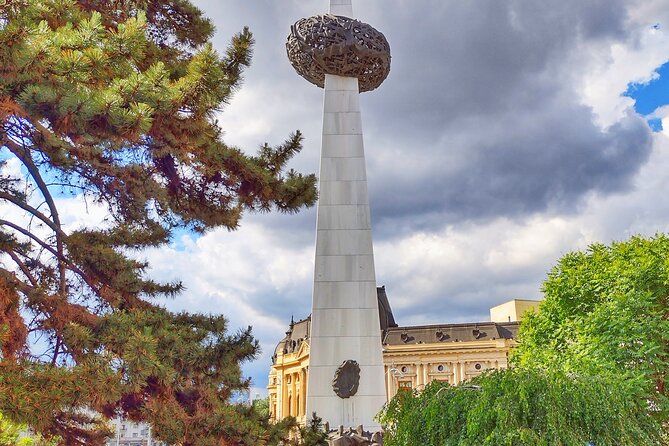
Revolution Square is the emotional center of the experience. In 1989, communist president Nicolae Ceausescu gave his last public speech here. The square is closely tied to the collapse of his regime and the Romanian Revolution.
The guide uses photographs and video presentations from the Revolution days. That visual material should help you understand the setting rather than simply hearing that an important event happened here. It gives the story a human scale.
Allow roughly 45 minutes at this part of the route, making it by far the longest scheduled stop. That is a good sign if modern Romanian history interests you. You have time for questions and for the guide to explain what you are seeing.
The communist period is one of the tour’s best subjects because guides can connect political history with ordinary life. Toni’s story about green bananas being a rare Christmas treat is the sort of detail that makes shortages and isolation easier to grasp. It is not a grand political fact, but it tells you what daily life could feel like.
You should also expect different guides to bring different personal angles. Toni has been praised for sharing childhood memories, while Manuela has been praised for patiently answering questions and allowing time for photographs. The exact style depends on who leads your departure.
Bucharest’s elegant central avenue
The route also includes what is described as the city’s most elegant avenue, lined with major buildings and monuments. This section helps connect the separate landmarks.
Rather than stopping at every facade for a long explanation, the guide can point out how the avenue reflects Bucharest’s ambition to present itself as a European capital. It is a useful transition between Revolution Square and the royal buildings.
Because the itinerary is tightly timed, you should not expect a detailed architectural lecture at each building. If you enjoy photography, keep your camera ready. The night tour is designed for broad impressions, illuminated views, and a steady flow through the center.
More communist-era history walks:
- The Real tour of Communism
★ 5.0 · 666 reviews - Life under Communism
★ 5.0 · 358 reviews - 3-Hour Guided Tour of Communist Bucharest
★ 4.9 · 303 reviews - Bucharest Essential Tour: Old Town, Calea Victoriei & Communism
★ 5.0 · 142 reviews
The Central University Library and Royal Palace
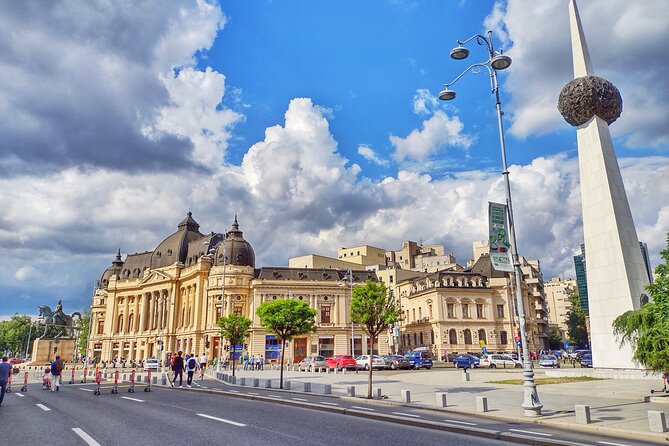
The Central University Library was built in an eclectic style by French architect Paul Gottereau, with support from King Carol I. The equestrian statue of Carol I sits in front of the building, giving the guide a chance to explain the connection between royal patronage, education, and Bucharest’s public architecture.
You spend about 10 minutes here. That is enough for a short presentation and photographs, though not enough for a full study of the building’s design.
Next comes the Royal Palace, the winter residence of Romania’s kings. The palace dates from 1937 and was built under the supervision of Queen Maria and her son, King Carol II. The stop lasts about 10 minutes and adds a royal chapter before the tour shifts toward Old Town and the communist period.
I like this contrast. You see how different political eras left their mark on the same central city. The route does not present Bucharest as a single-style capital. Instead, it shows a mix of royal, institutional, religious, commercial, and communist architecture.
Old Town, Stavropoleos, and the city after dark
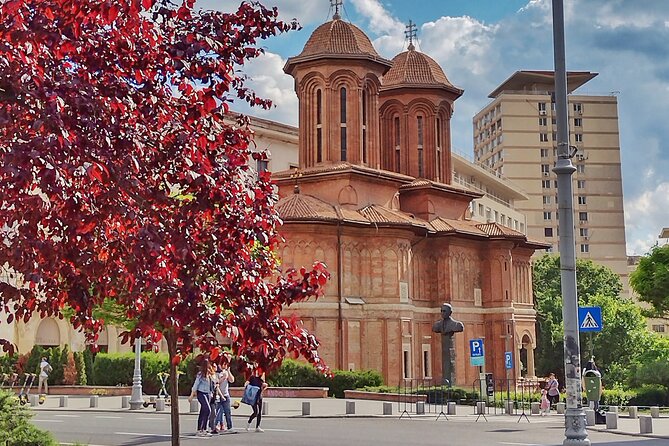
The Old Town portion offers a change of pace. You walk through a central area filled with cafes, pubs, restaurants, and 19th-century buildings. The atmosphere is livelier here, and the tour becomes less formal.
The scheduled Old Town visit lasts about 15 minutes, followed by 10 minutes at Stavropoleos Monastery. That timing tells you what to expect: a quick introduction, not an unhurried evening in the district.
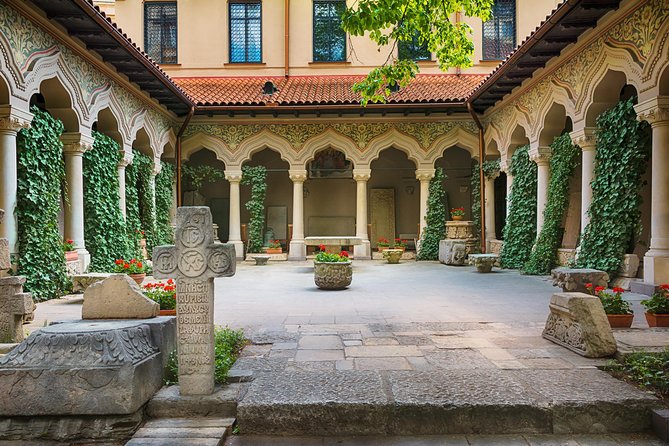
Stavropoleos Monastery is one of Bucharest’s oldest churches, dating from 1724. It is a small and visually distinctive place amid the surrounding streets. The guide can explain why it matters, but the short visit may leave you wanting to return in daylight or during a quieter period.
This is also a good point to ask for food and drink advice. Manuela has shared useful restaurant suggestions, and guides have offered practical local tips during the walk. Those recommendations may be one of the most valuable parts of the tour if you are still deciding where to eat after the experience.
The Palace of Parliament and communist scale
The exterior of the Palace of Parliament provides the tour’s biggest visual shock. Construction began in 1984, during the rule of Ceausescu. It is described as the heaviest building in the world and the third-largest administrative building in the world.
The building is often labeled a pharaonic construction because its volume exceeds that of Egypt’s Great Pyramid of Giza by 2 percent. You do not need to enter to understand its scale. The exterior alone gives the guide a powerful setting for explaining the ambition, cost, and political message behind the project.
This is another exterior presentation, and entrance fees are not part of the tour. If you want an interior visit, you would need to arrange that separately. The tour’s purpose is to place the building in the story of communist Bucharest, not to provide a full palace visit.
I consider this stop especially worthwhile for first-time visitors because it shows how ideology can reshape an entire capital. The building is not just large. It represents the power of a government that wanted architecture to project control and permanence.
Macca Villacrosse Passage and Lipscani
The Macca Villacrosse Passage brings you back to a more intimate scale. Its glass roof covers a charming passage lined with hookah cafes. You have only about five minutes here, so treat it as a quick look and photo stop.
After that, the tour continues along Lipscani, one of the Old Town’s old streets. The walk lasts roughly 10 minutes. Together, these stops show how Bucharest’s central district has shifted from historic commercial streets to modern nightlife.
Lipscani can be more atmospheric after dark, but the same timing limitation applies. You will see the street and hear its place in the city, but you will not have much time to browse shops or settle into a cafe. If you like the area, the final stop near Union Square makes it easy to return later.
Cărturești Carusel and Bucharest’s grand facades
Cărturești Carusel is a renovated bookshop known for its elegant interior and Romanian souvenirs and gifts. The tour allows about 10 minutes here.
This is one of the more useful stops for anyone looking for a small present or a visual break from monuments. Still, the visit is brief. You may have enough time to look around, but not enough for a relaxed shopping session.
The route then takes in the CEC Palace, with its 19th-century architecture and elaborate statues. The scheduled stop is only five minutes, so you will mostly admire the exterior and hear a concise explanation.
The former Royal Palace, the CEC Palace, and the Central University Library work well together. You can compare their styles and see how Bucharest used grand public buildings to express wealth, education, monarchy, and civic ambition.
The National Art Museum and two former public buildings
The National Art Museum of Romania occupies the former Royal Palace. The stop lasts about five minutes and is another exterior view.
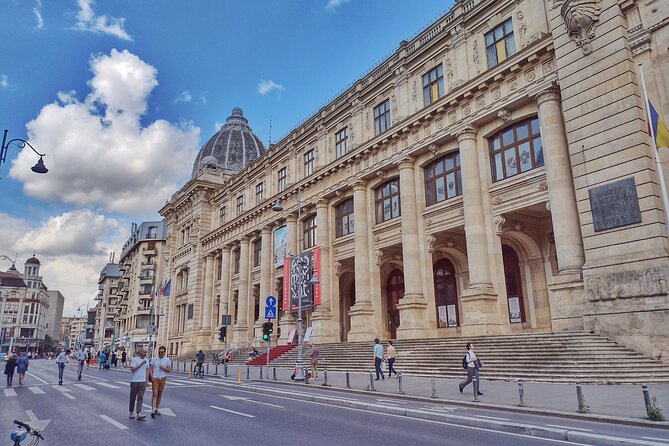
The National History Museum of Romania is housed in the former Post Office Palace, a 19th-century building. An admission fee is not included, and the scheduled visit is also about five minutes.
The route includes the National Library of Romania as well, described as an iconic palace in the Old Town area. An admission fee is not included here either.
These final stops are best understood as a quick architectural survey. You will not be touring the collections or spending serious time inside the museums. If art, archaeology, or Romanian history are high priorities for you, note the names and return independently when you have more time.
What $72.25 buys you
At $72.25 per person, this is not a bargain-priced city walk. The value depends on how much you want from the guide.
You are paying for a certified English-speaking guide, printed presentation materials, a small group capped at eight people, and a route that covers a lot of central Bucharest in two to three hours. The strongest value comes from the interpretation, especially at Revolution Square and the Palace of Parliament.
The personal service can be meaningful. Marius has communicated clearly before meeting, helped with orientation, and brought local food and drinks into the experience. Toni has sometimes provided a more private outing when only two people booked and rain changed the plan. Those extras are not guaranteed, so do not book expecting free food, private transport, or a private tour.
Food, drinks, and entrance fees are excluded. The tour does not promise interior admissions, so compare the cost with your own priorities. If you want a quick, guided overview and local advice, the price can make sense. If you prefer to walk independently and read about buildings yourself, it may feel high.
Group discounts are available, which could improve the value for a small party. The experience is booked about 31 days ahead on average, so planning early is sensible if you have fixed dates.
Timing, walking, and practical fit
The tour begins at Strada Benjamin Franklin 2 and ends at Piața Unirii, near the Old Town. That final location is useful because you can continue into the central district afterward.
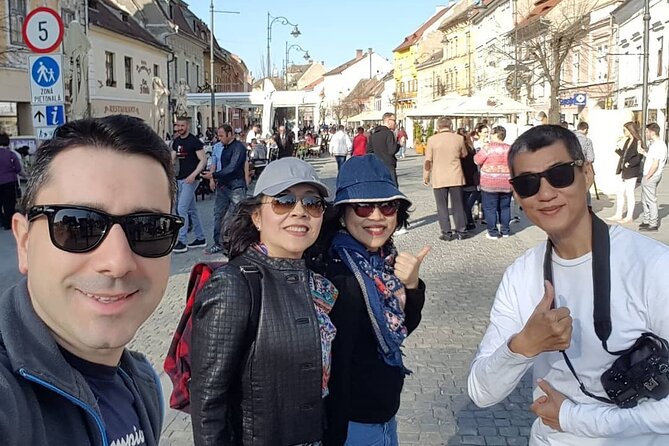
You should have a moderate level of physical fitness. The route includes walking between many central stops, standing during explanations, and frequent pauses for photos. Wear comfortable shoes and leave room in your schedule rather than trying to squeeze in a formal dinner at an exact time.
The maximum group size of eight is a major advantage. It makes it easier to hear the guide, ask about communist-era life, and request a photograph. It also means the experience may feel more personal than a large coach tour.
Service animals are allowed, and the meeting area is near public transportation. The experience is offered in English only, according to the available details.
Several guides have earned especially warm praise for their professional manner, clear English, patience, and ability to explain history. Manuela has been valued for answering questions and making time for photos. Toni has been appreciated for his patience and personal memories. Marius has been praised for communication and local food suggestions.
You cannot choose a specific guide based on the information provided, so regard those qualities as examples of the company’s guide style rather than a promise of who you will meet.
Weather and cancellation details
This experience requires good weather. If poor conditions cause cancellation, you can receive a different date or a full refund.
You can cancel for a full refund up to 24 hours before the local start time. Changes or cancellations inside that 24-hour window are not accepted for a refund.
The tour also requires a minimum number of participants. If that minimum is not reached, you will be offered another date or experience, or receive a full refund.
Who should book Footprints of Bucharest?
I would choose this tour for a first evening in Bucharest, especially if you want the city’s major stories explained in plain English. It suits people interested in royal Romania, the 1989 Revolution, communist daily life, and the dramatic scale of the Palace of Parliament.
It is also a good fit if you like asking questions. The group size and the guides’ reported patience make the experience more useful than a simple audio guide.
You may want something else if you need museum interiors, long photo stops, or a slow food tour. The itinerary covers many places, but several visits last only five or 10 minutes. Think of it as a guided framework for the city, then return to the buildings and neighborhoods that catch your attention.
FAQ
How long does Footprints of Bucharest last?
The experience lasts approximately two to three hours.
How much does the tour cost?
The listed price is $72.25 per person. Group discounts are available.
Is the tour offered in English?
Yes. The tour is offered in English.
What is the maximum group size?
The maximum is eight travelers.
Where does the tour begin?
The meeting point is Strada Benjamin Franklin 2, București 030167, Romania.
Where does the tour end?
The tour ends at Piața Unirii, near Bucharest’s Old Town area.
Does the price include entrance fees?
No. Entrance fees are not included.
Are food and drinks included?
No. Food and drinks are not included, though guides may share local suggestions and personal recommendations.
Does the tour include the interior of the Palace of Parliament?
The experience includes an exterior presentation of the Palace of Parliament. An interior visit is not included in the provided details.
Can I cancel for a full refund?
Yes. You can cancel at least 24 hours before the experience start time for a full refund. Poor weather or failure to meet the minimum number of participants can also lead to a different date or a full refund.
Should you book it?
Book Footprints of Bucharest if you want a small-group introduction that connects Bucharest’s royal buildings, communist past, Revolution Square, and Old Town nightlife. The personal stories from guides such as Toni, Manuela, and Marius add the most value, especially if this is your first visit.
Skip it if your main goal is entering museums or spending a long time at each landmark. At $72.25, the tour earns its price through the guide, the compact route, and the historical context, not through admissions or included meals. For a well-organized first look at central Bucharest, particularly after dark, it is a strong choice.
More Historical Tours
- Bucharest Jewish Heritage | Holocaust Memorial | Private Car Tour
★ 5.0 · 38 reviews - Private Bucharest: History & Food with Traditional Meal
★ 5.0 · 34 reviews - Bucharest Historical Food Tour in Old Center
★ 5.0 · 21 reviews - Half-Day Jewish Heritage Walking Tour in Bucharest
★ 5.0 · 20 reviews
Just added around Bucharest
- 4-Day Inside Transylvania & Transfagarasan Tour from Bucharest★ 5.0 · 3 reviews
- 10 hours Private Apiary Tour in Romania – From Bucharest★ 5.0 · 3 reviews
- Bucharest: Charm of the Belle Époque Private Tour★ 5.0 · 3 reviews
- Bran & Peles Castles through the Best Road in the World: Transfagarasan road★ 4.5 · 3 reviews
- 2-Day Small-Group Tour in Transylvania from Bucharest – Maximum 5 Persons★ 5.0 · 3 reviews
- Private Wine Tasting at Bucharest’s First Wine Bar★ 5.0 · 3 reviews
- Bucharest to Brasov – Fast Private Transfer★ 5.0 · 3 reviews
- Probably the Best Restaurant and Wine Cellar near Bucharest★ 4.5 · 3 reviews
Communist History Tours, compared.




Bucharest Essential Tour: Old Town, Calea Victoriei & Communism
Read our review →
Communism in Bucharest – Landmarks, Museum & Communist Appetizers
Read our review →


Browse the lists this tour appears in