
Reviewed · FOOD & DRINK
Private Bucharest: History & Food with Traditional Meal
Bucharest tells its story through lunch. This four-hour private walk links the city’s political past to its food, from a salty covrig at Revolution Square to a full Romanian meal at a historic inn. I like the way the route moves beyond postcard sights, and I like the personal pace of a private guide who can stop for questions, family stories, and photo breaks.
The history is broad but easy to follow, covering royal Bucharest, Ottoman influence, the inter-war years, Communist rule, and the city’s newer nightlife. Guides such as Elaina, Mara, Ioanna, Andra, Monica, and Dana have been praised for warmth and clear storytelling. The main consideration is food quantity: the final three-course meal is substantial, but the walk may include fewer separate tastings than the description suggests.
In This Review
- Key points to know before booking
- Revolution Square, where modern Romania changed direction
- Victory Street and Bucharest’s French-facing years
- Old Town, where East meets West
- The People’s Palace and the cost of Ceausescu’s vision
- Three courses at a traditional Bucharest hanu
- What $140 per person gets you
- Timing, walking, and practical planning
- Who will get the most from this private walk
- Should you book it?
- FAQ
- How long does the Bucharest history and food tour last?
- What language is the tour offered in?
- Is this a private tour?
- Where does the tour meet?
- What food is included?
- What drink is included with the meal?
- Is the People’s Palace interior visit included?
- Can children join the tour?
- Can I cancel for a full refund?
Key points to know before booking
- Revolution Square sets the political tone: You begin where Ceausescu gave the speech that helped trigger the 1989 Romanian Revolution.
- A covrig provides the first taste: This everyday salted snack connects Bucharest’s food culture to medieval Hapsburg or German merchants.
- Victory Street packs in major sights: You pass royal, military, religious, cultural, and inter-war landmarks on one of the city’s essential avenues.
- Old Town explains Romania’s mixed cuisine: Balkan mici, Ottoman sarmale, Russian-influenced soups, and Austro-Hungarian schnitzel all fit the city’s crossroads story.
- The meal takes place at a traditional hanu: You finish with three courses, local delicacies, and a house beer, wine, or soft drink.
- The private format suits families and first visits: The pace can be adjusted, and children under six join free when declared at booking.
Revolution Square, where modern Romania changed direction

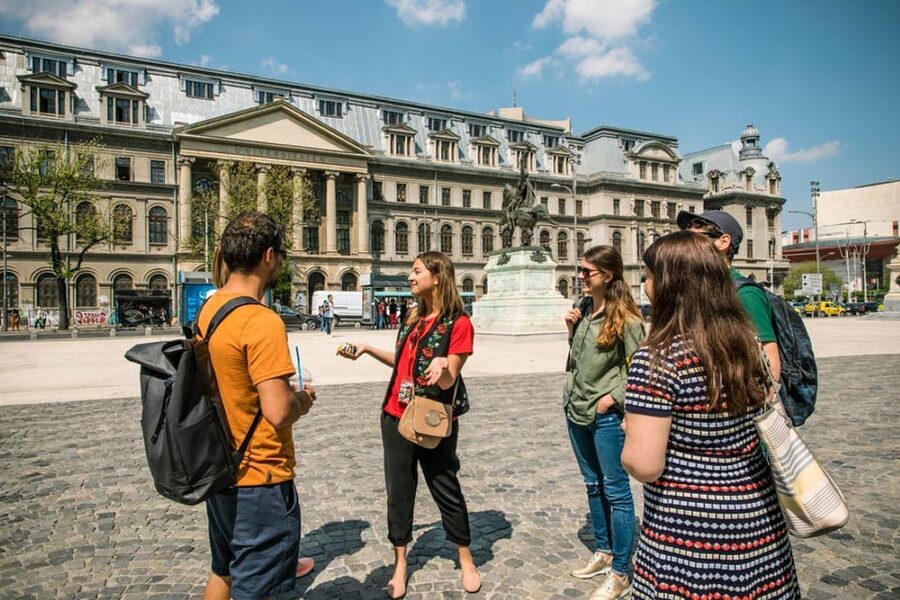
Meet your English-speaking guide by the Equestrian Statue of Carol I in Sector 1. This puts you at the edge of Revolution Square, formerly called Palace Square, and gives the tour a strong opening: Bucharest’s past is not kept behind museum glass here. It is written into the buildings and public spaces around you.
The square is tied most closely to December 1989. Ceausescu came here to address a crowd, expecting the usual show of loyalty. Instead, the gathering turned against him, helping set the Romanian Revolution in motion. That story gives the first stop real weight, especially if you know little about Romania’s Communist period.
Around the square, your guide explains the former Royal Palace, now associated with the country’s royal and artistic life, along with the Romanian Athenaeum concert hall. The Athenaeum helps show why Bucharest was once called the Paris of the East, a nickname linked to its French architectural influence and cultivated inter-war society.
You also hear about Athenee Palace, a hotel known for espionage, politics, and intrigue during the years between the two world wars. This is one of the tour’s strengths. Instead of treating Bucharest as a list of monuments, the guide connects architecture to the people who used these places.
At this point, you get a covrig, a loop of salted baked dough eaten daily by many Romanians. It is a modest snack, not a grand tasting, but that is part of its value. The story suggests it may have arrived with Hapsburg or German merchants in medieval times, giving you an early example of how migration and trade shaped local eating habits.
More Historical Tours in Bucharest
- Bucharest: 3-Hour Dark History Tour with a Local
★ 4.9 · 301 reviews - Bucharest: Small Group History, Art & Secrets Tour
★ 4.7 · 152 reviews - Guided Walking Tour of Historical Bucharest
★ 5.0 · 84 reviews
Victory Street and Bucharest’s French-facing years
From Revolution Square, the route heads south along Victory Street, one of Bucharest’s main historic avenues. Its name refers to the Romanian victory in the 1871 War of Independence, though the full union of the three Romanian principalities did not happen until 1918.
That political detail matters for food as much as for maps. Moldova, Transylvania, and Muntenia each kept distinct customs and flavors. The tour describes Moldovan cooking as sweeter, Transylvanian food as earthy, and Muntenian cooking as spicier. You are not simply told that Romanian cuisine is varied. You are given a reason for the variation.
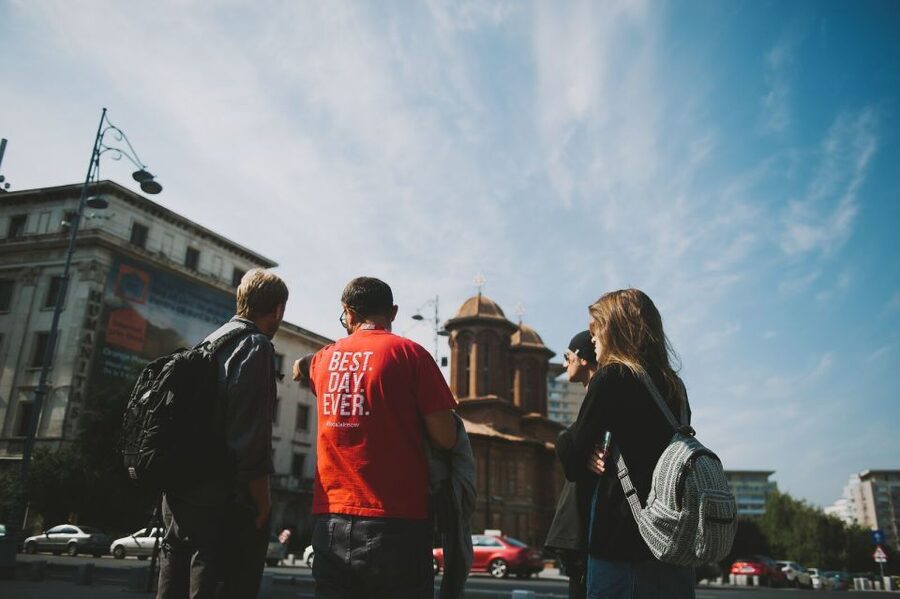
The street also brings a string of architectural stops. You might see the Telephone Palace, the Military Circle, the former National Theatre, and Kretzulescu Church. Each points to a different part of Bucharest’s development: communications, the army, public culture, religion, and the city’s inter-war building boom.
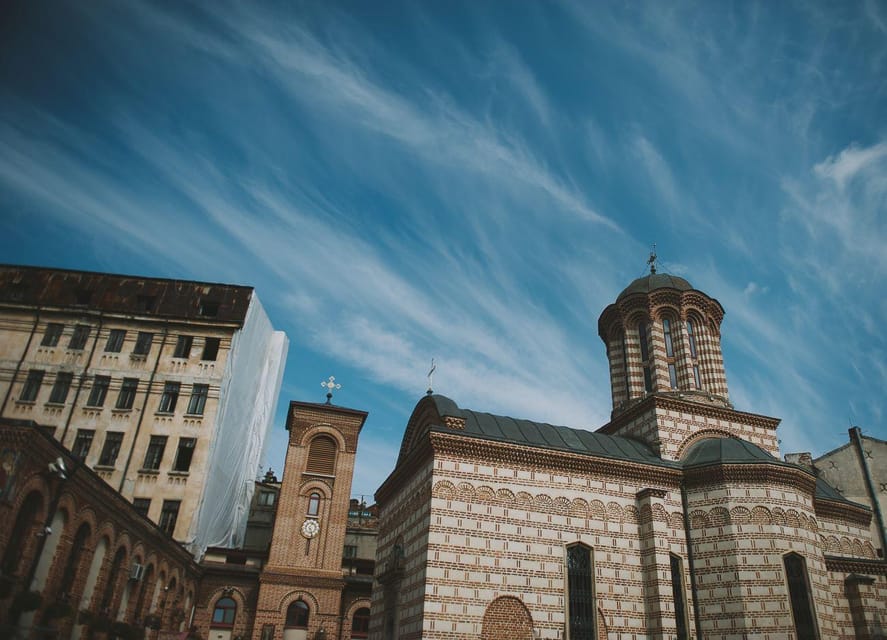
Kretzulescu Church is especially useful for understanding how much visual variety can appear within a short walk. Its red brick and ornate details contrast with the grander civic buildings nearby. Your guide can explain the church in context rather than leaving you to guess why it matters.
I would pay attention to the architecture here, even if you are mainly excited about lunch. One of the best parts of the route is the explanation of foreign influence. French styles, Austro-Hungarian connections, Ottoman rule, Balkan customs, and Russian links all appear in Bucharest, and the buildings make those connections easier to see.
Old Town, where East meets West
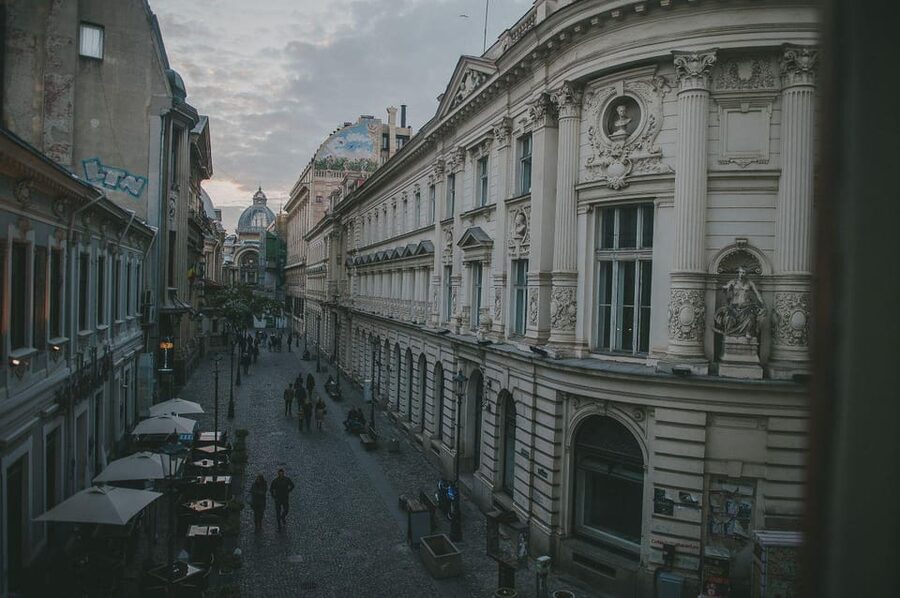
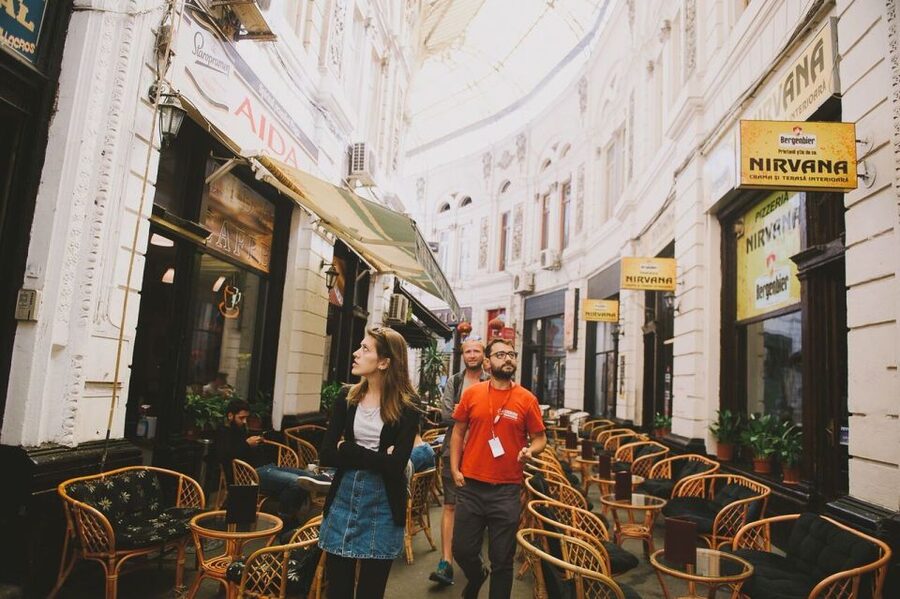
The route then turns into the lanes and passageways of Old Town. This is medieval Bucharest, and its importance comes from its position between larger cultural and political worlds. Ottoman pashas, Transylvanian princes, merchants, religious figures, and local rulers all passed through the city.
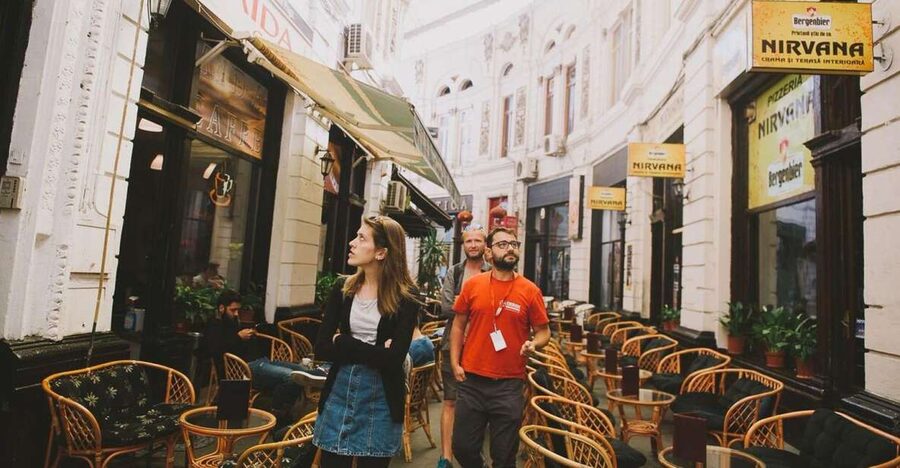
The architecture here is less orderly than the grand avenue. That is a good thing. You move through narrow routes, courtyards, churches, princely spaces, and former commercial areas rather than simply following one polished street.
Your guide may point out lavish interiors, old princely courts, an Orthodox monastery, and Hanul lui Manuc, the famous wooden inn. The inn is one of the most atmospheric places on the route and later food stop. Its traditional setting helps the meal feel connected to the city rather than tacked on after a sightseeing walk.
Old Town also provides the clearest explanation of Romanian food’s outside influences. Mici, the Balkan-style skinless sausages, show one connection. Sarmale, stuffed cabbage leaves associated with Ottoman cooking, show another. Russian influence appears in borscht and ciorba, the family of sour soups. Austro-Hungarian cuisine contributes schnitzel.
This does not mean Romanian food is simply borrowed food. The point is that Bucharest made these influences its own. A good guide can help you see how local cooks adapted outside dishes to regional tastes and available ingredients.
The private format is useful in Old Town. The passages and stories can be hard to follow in a large group, especially when the guide is explaining several centuries in one small area. With a private guide, you can ask about a church, a building detail, or a dish without waiting for the entire group to move on.
Families may also find the pace helpful. An eight-year-old was specifically included in the historical discussion, with photo pauses and a manageable rhythm. Another family appreciated Elaina’s patience while a child worked through jet lag. That does not guarantee every child will enjoy four hours of walking, but it shows why a private tour can work better than a tightly managed group outing.
The People’s Palace and the cost of Ceausescu’s vision
Before the meal, you get a look at the People’s Palace, now generally associated with the Palace of Parliament. The building was the centerpiece of Ceausescu’s plan to reshape Bucharest on a huge scale.
The building is famous for its size. It is described as the second-largest building in the world, after the Pentagon. Even from a viewpoint rather than an interior visit, it gives you a physical sense of Communist megalomania and the enormous changes forced on the city.
This part of the tour helps balance the earlier royal and inter-war architecture. Revolution Square shows the political collapse of the regime. The People’s Palace shows the ambition and damage that came before it. Together, the two stops make the modern history portion much stronger than a simple list of Communist-era facts.
Keep your expectations clear: this experience includes a look at the People’s Palace, not a stated interior tour. If entering the building is a top priority, you would need to arrange that separately or choose an experience that specifically includes admission.
More food tours:
- Taste Bucharest: A Food Lover’s Tour of Markets & Neighbourhoods
★ 5.0 · 689 reviews - Street Food’n’Culture Tour
★ 5.0 · 209 reviews - Wine Tasting in Bucharest
★ 5.0 · 183 reviews - Discover Bucharest: Private Highlights and Traditional Food Tour
★ 5.0 · 86 reviews
Three courses at a traditional Bucharest hanu
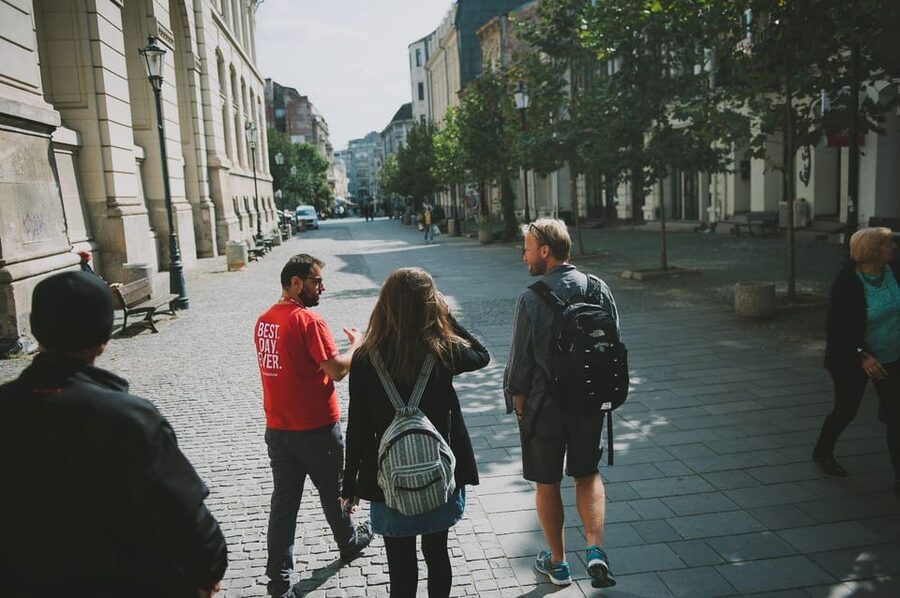
The tour finishes at a traditional hanu, or inn, described as one of Bucharest’s most beautiful. Here, the historical themes become food on the table.
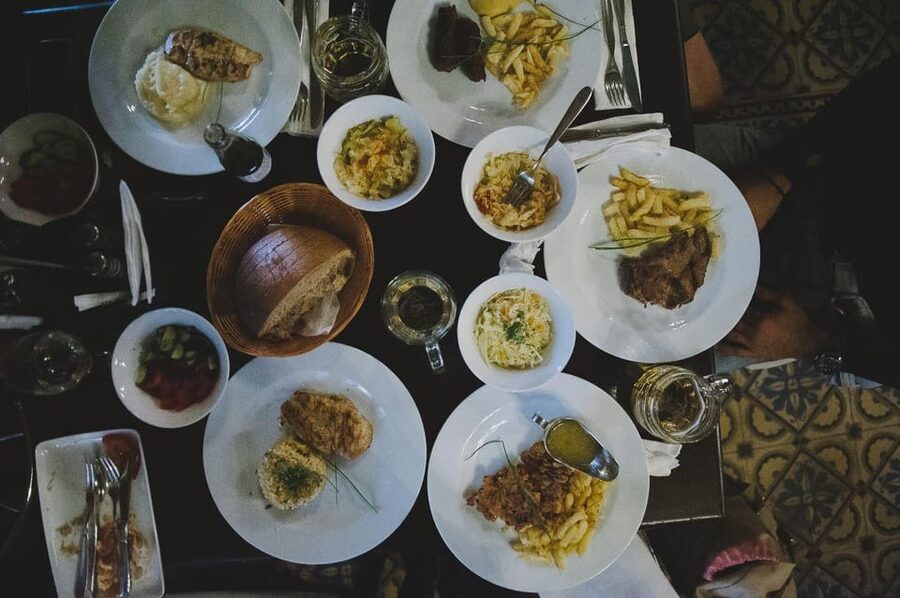
You receive a three-course Romanian meal with platters of local specialties. The exact dishes are not specified, so you should not book this expecting a fixed menu of every item named in the route description. The meal is described as delicious and plentiful, and one account specifically praised the food as a strong finish to the walk.
Your included drink is one house beer, wine, or soft drink. The Dacian story adds a light touch: the ancient Dacians supposedly drank so much wine that their leader Burebista banned wine production. The inventive response was to brew beer, so you can raise a glass to both traditions.
The meal is more than a restaurant break. It gives you a chance to taste the regional connections introduced earlier. You may encounter the general family of flavors represented by the discussion of sarmale, mici, sour soup, or schnitzel, but the supplied details do not promise each one. If you have allergies, dietary restrictions, or strong dislikes, ask the supplier before booking because no special menu information is provided.
One small weakness is worth keeping in mind. The food portion appears to focus on a single full meal plus the covrig, rather than a long series of small tastings throughout the city. If you want to stop at several markets and sample ten different snacks, this is not that kind of food tour.
If you want to understand why Romanian dishes look and taste the way they do, the format works well. You eat after the stories have given the dishes some meaning. That makes the meal feel like the final chapter of the walk, not simply an included benefit.
What $140 per person gets you
At $140 per person, this is not a bargain-priced orientation walk. You are paying for a private four-hour experience, an English-speaking guide, a three-course meal, and one included drink. The private format is the main value.
A shared tour may cost less, but it cannot offer the same control over pace or questions. If you are traveling with family, have only one day in Bucharest, or want a guide focused on your interests, the higher price can make sense. It is also useful for first-time visitors who want history and food handled together instead of booking two separate activities.
The cost is harder to justify if you mainly want inexpensive tastings or a quick introduction. The food is one substantial meal, and extra food, extra drinks, souvenirs, and personal purchases are not included.
The tour has earned a perfect rating from 34 reviews, with repeated praise for guides who are friendly, informed, and passionate about Bucharest. Andra was especially good at combining architecture, history, current city life, and food advice. Monica helped make the experience a strong first-day introduction, while Dana added restaurant tips to a solo visitor’s walk.
Those details point to the tour’s real product: a person who interprets the city for you. The sights are important, but the guide’s ability to connect them is what makes the price work.
Timing, walking, and practical planning
The activity lasts four hours, with starting times dependent on availability. You should wear casual clothing and expect to spend much of the experience walking through central Bucharest. The meeting point is the Equestrian Statue of Carol I, Sector 1, Bucharest 030167.
Because this is a private group, the schedule can likely feel more personal, though the supplied details do not promise a custom route or private vehicle. You should not assume transport between every stop. The description presents the experience as a city walk with sights encountered along the way.
English is the stated language. Children under six can join free, but you need to tell the supplier at booking. This is a useful option for families, especially because the guides have been praised for adjusting explanations and allowing photo breaks.
The tour is carbon neutral and operated by a B Corp certified company. That does not change the monuments or the meal, but it gives you a clear reason to choose this operator if responsible business practices matter to your trip.
Free cancellation is available up to 24 hours before the start for a full refund. You can also reserve now and pay later, which helps if your Bucharest schedule is still moving around.
Who will get the most from this private walk
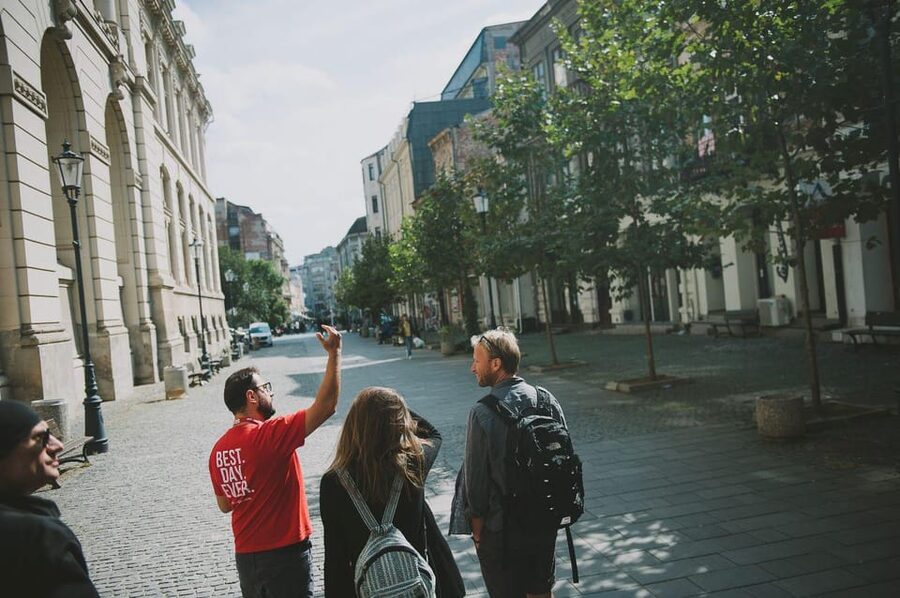
I would put this tour near the top of a first Bucharest day. You get a city overview, a lesson in Romanian political history, a look at major buildings, Old Town stories, and a traditional meal without having to arrange several bookings.
It suits couples, families, and small private groups that prefer conversation over a microphone-led tour. It also fits solo visitors who want company and local orientation without joining a large group.
Food-minded visitors will appreciate the historical approach. You learn why Romanian cuisine carries Balkan, Ottoman, Russian, Austro-Hungarian, and regional Romanian influences. The tour is less suitable if you want a market-centered experience, a cooking class, or a guaranteed checklist of individual dishes.
I also recommend it for anyone who finds Bucharest confusing at first glance. The city’s architecture can look scattered, and its political past is not always obvious from the streets. This route gives you a framework for reading what you see afterward.
Should you book it?
Book this tour if you want history with a proper sit-down meal, especially on your first day in Bucharest. The guides are the biggest reason to choose it, and the private setup gives families and curious adults room to ask questions.
Think twice if your main goal is extensive food sampling or a low-cost walking tour. For everyone else, the combination is well judged: Revolution Square for the 1989 turning point, Victory Street for royal and inter-war Bucharest, Old Town for the city’s East and West connections, the People’s Palace for Communist excess, and a traditional hanu meal to bring it all together.
FAQ
How long does the Bucharest history and food tour last?
The tour lasts four hours.
What language is the tour offered in?
The tour is offered in English with a live English-speaking guide.
Is this a private tour?
Yes. The experience is for a private group.
Where does the tour meet?
The meeting point is the Equestrian Statue of Carol I, Sector 1, Bucharest 030167, Romania.
What food is included?
The tour includes a three-course traditional Romanian meal and a covrig tasting during the route.
What drink is included with the meal?
You receive one house beer, house wine, or soft drink.
Is the People’s Palace interior visit included?
The tour includes a look at the People’s Palace, but the provided details do not state that an interior visit or admission is included.
Can children join the tour?
Yes. The tour is child-friendly, and children under six can join free of charge when you inform the supplier at booking.
Can I cancel for a full refund?
Yes. You can cancel up to 24 hours in advance for a full refund.
More Historical Tours
- Bucharest Jewish Heritage | Holocaust Memorial | Private Car Tour
★ 5.0 · 38 reviews - Bucharest Historical Food Tour in Old Center
★ 5.0 · 21 reviews - Half-Day Jewish Heritage Walking Tour in Bucharest
★ 5.0 · 20 reviews - Bucharest: Sweet Delights History and Desserts Walking Tour
★ 5.0 · 18 reviews
Just added around Bucharest
- 10 hours Private Apiary Tour in Romania – From Bucharest★ 5.0 · 3 reviews
- 4-Day Inside Transylvania & Transfagarasan Tour from Bucharest★ 5.0 · 3 reviews
- Bucharest: Charm of the Belle Époque Private Tour★ 5.0 · 3 reviews
- Bran & Peles Castles through the Best Road in the World: Transfagarasan road★ 4.5 · 3 reviews
- Private Wine Tasting at Bucharest’s First Wine Bar★ 5.0 · 3 reviews
- 2-Day Small-Group Tour in Transylvania from Bucharest – Maximum 5 Persons★ 5.0 · 3 reviews
- Probably the Best Restaurant and Wine Cellar near Bucharest★ 4.5 · 3 reviews
- Bucharest to Brasov – Fast Private Transfer★ 5.0 · 3 reviews
Food & Drink, compared.
Taste Bucharest: A Food Lover’s Tour of Markets & Neighbourhoods
Read our review →
Discover Bucharest: Private Highlights and Traditional Food Tour
Read our review →
Half-Day Private Food and Wine Walking Tour Oradea Romania
Read our review →
Browse the lists this tour appears in