
Reviewed · HISTORICAL TOURS
Guided Walking Tour of Historical Bucharest
Bucharest reveals itself one building at a time. This three-hour private walk links the Old Princely Court, grand boulevards, Orthodox churches, Communist-era monuments, and the 1989 Revolution, giving you a useful first look at a city shaped by rulers, war, dictatorship, and rapid change. I especially like the wide historical range, from the 14th-century world of Vlad the Impaler to the fall of Nicolae Ceaușescu, and the chance to see major sights without paying separate admission fees.
I also like the personal touch provided by guides such as Alina, who is praised for her energy, local experience, and ability to explain how Bucharest changed over the decades. The main caution is physical and conversational: this can mean a long day on your feet, and the guide’s strong political views may not suit everyone.
In This Review
- Key points to know before booking
- Starting at Manuc’s Inn in the Old Town
- Vlad the Impaler at the Old Princely Court
- Unirii Square and the former Socialist Victory Boulevard
- The Palace of Parliament from Constitution Square
- Churches, CEC Palace, and Victoria Avenue
- University Square and Bucharest’s civic center
- Revolution Square and the end of Ceaușescu’s rule
- Military Circle and Sărindar Fountains
- How the private format affects the experience
- Is $30.77 a fair price?
- Who should book this Bucharest walk?
- Should you book it?
- FAQ
- Where does the Bucharest walking tour start?
- Where does the tour end?
- How long does the tour last?
- What language is the tour offered in?
- Is this a private tour?
- Is hotel pickup available?
- What should I bring?
- Does the tour enter the Palace of Parliament?
- Are admission tickets included?
- Can I cancel for a full refund?
Key points to know before booking
- A private three-hour walk: Only your group takes part, so the pace and questions can be more personal than on a large group tour.
- Around 17,000 steps is possible: One guest recorded more than 17,000 steps, even without a fast pace. Wear proper shoes and bring water.
- Old Town meets Communist Bucharest: You move from old inns and churches to Unirii Boulevard, the Palace of Parliament, and Revolution Square.
- The guide is the main attraction: Alina receives repeated praise for her humor, enthusiasm, local stories, and command of Romanian history. Elena is also named in one account.
- Politics are part of the discussion: Ceaușescu, communism, the monarchy, the Cold War, and modern Romanian politics receive serious attention.
- Good value at $30.77: For a private walk lasting about three hours, the price is reasonable if you want an introduction rather than museum interiors or a relaxed café stroll.
Starting at Manuc’s Inn in the Old Town
The walk begins outside the main entrance of Manuc’s Inn, at 62 Strada Franceză. This is a useful starting point because the inn is one of Bucharest’s oldest and best-known places, with a past tied to trade, lodging, and the growth of the old city.
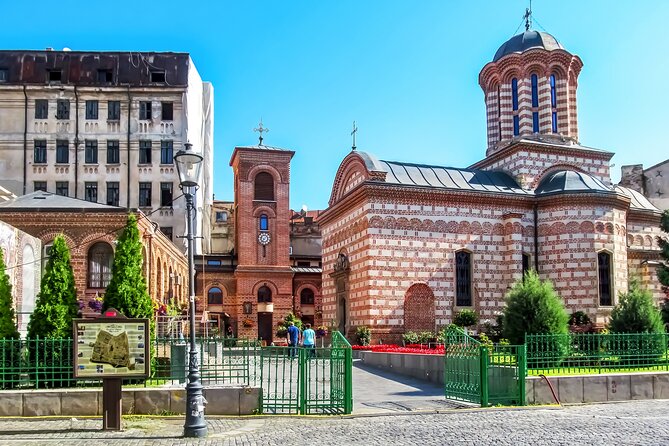
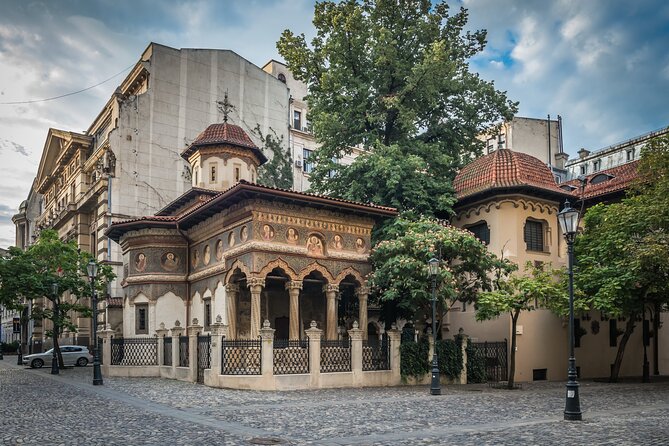
You begin with the story of the inn, then move toward St. Anton Orthodox Church. The church was once the Coronation Church for Wallachian rulers, making it an important link between religious life and political power. It sits in the middle of the Old Town, where several centuries of Bucharest can be read in a short walk.
The opening section is not only a parade of façades. You hear how the city worked, who held power, and why churches and inns mattered. If you like history told through specific buildings, this is a strong beginning.
The meeting place can be confusing because several walking tours may gather nearby. One person initially went to the wrong spot, while another group had trouble finding the guide among different tours. I would arrive a little early, check the exact entrance, and keep the organizer’s contact details handy.
More Historical Tours in Bucharest
- Bucharest: 3-Hour Dark History Tour with a Local
★ 4.9 · 301 reviews - Bucharest: Small Group History, Art & Secrets Tour
★ 4.7 · 152 reviews - Bucharest Jewish Heritage | Holocaust Memorial | Private Car Tour
★ 5.0 · 38 reviews
Vlad the Impaler at the Old Princely Court
The first named stop is the Old Princely Court, where you see the ruins of the former palace of Wallachian rulers. It is one of Bucharest’s oldest surviving sites and is linked with Vlad the Impaler, the ruler whose reputation later inspired the Dracula legend.
The stop itself is short, listed at about five minutes, with no admission charge included. That means you should not expect a long archaeological visit or an extended museum tour. Instead, the guide uses the ruins as a starting point for explaining Wallachian rule and the early development of Bucharest.
This is one place where the guide’s storytelling matters more than the size of the remains. The stones are modest compared with the Palace of Parliament later in the walk, but they connect modern Bucharest to its medieval roots.
Unirii Square and the former Socialist Victory Boulevard
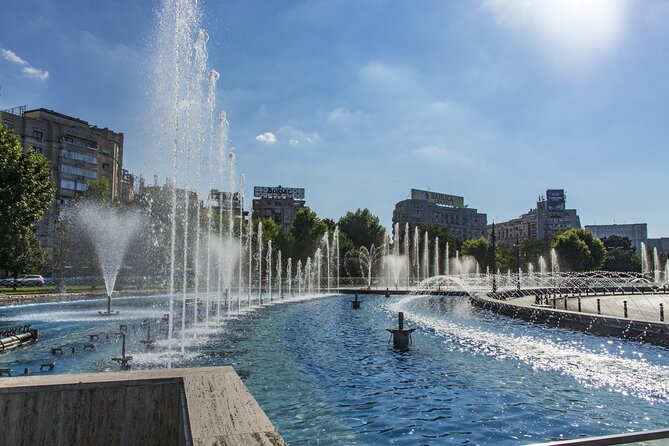
From the old court, the route reaches Piața Unirii, one of the city’s central gathering points. The refurbished fountains offer one of the better photo stops, and the broad open space helps you understand the scale of modern Bucharest.
You then walk along Bulevardul Unirii, once called the Boulevard of Socialist Victory. It is often compared with the Champs-Élysées, though the comparison tells only part of the story. The boulevard was created as a grand display of Communist power, with its width, long sight lines, and monumental planning designed to frame the Palace of Parliament.
The guide explains how Ceaușescu’s dictatorship reshaped the city. Whole areas were cleared to make way for the new civic center, and the boulevard became a symbol of the regime’s ambition. This is where architecture and politics meet most clearly.
The route is especially useful if you want to understand why Bucharest can feel visually inconsistent. Elegant older buildings, Communist blocks, restored fountains, and newer commercial spaces often sit close together. That mixture is not accidental. It reflects repeated changes in power and planning.
The Palace of Parliament from Constitution Square
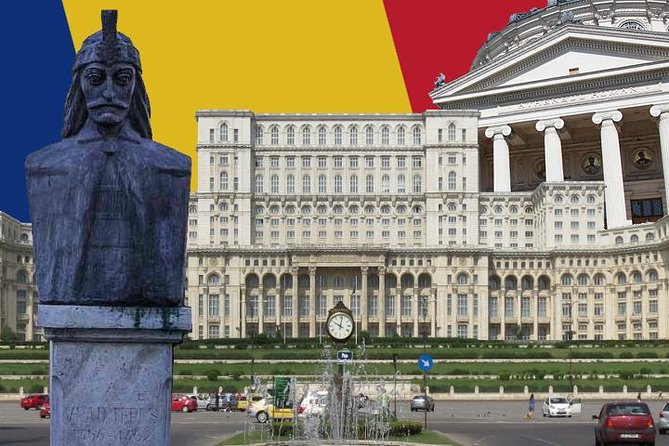
The Palace of Parliament is viewed from the outside, looking along Unirii Boulevard toward the city center. The route continues to Piața Constituției, the open square directly in front of the Parliament buildings.
This gives you strong photo opportunities and a sense of the building’s huge scale. It also provides the setting for a discussion of Ceaușescu’s rule, the costs of his urban projects, and the way the Cold War shaped Romania.
The important practical point is that this is an exterior viewing stop. The experience does not promise an interior visit to the Palace of Parliament, and the stop is listed as free. If seeing the inside is a priority, you will need to arrange that separately.
Some people will find the boulevard and palace overwhelming in a good way. Others may feel that the broad spaces are less intimate than the Old Town. I see that contrast as part of the value. In a few blocks, you move from medieval power to 20th-century dictatorship.
More Walking Tours in Bucharest
- Bucharest: City Highlights Guided Walking Tour
★ 4.9 · 1,482 reviews - Bucharest Highlights Walking Tour
★ 5.0 · 469 reviews - Bucharest: Ghost Stories & Romanian Mythology Walking Tour
★ 4.9 · 287 reviews - Bucharest: Guided Walking Tour with Romanian Snack
★ 4.9 · 228 reviews
Churches, CEC Palace, and Victoria Avenue
The walk returns toward central Bucharest, passing another church built in 1724. Its exact name is not specified in the tour details, but the guide uses it to discuss the city’s religious and architectural past.
You also hear about the CEC Palace, one of Bucharest’s grand historic buildings, then take a section of Calea Victoriei. This avenue is lined with shops and important buildings, offering a different mood from the open Communist boulevard.
Calea Victoriei is a good place to look up. The route is not only about famous landmarks. It helps you notice how commercial life, state institutions, churches, and grand residences share the same central corridor.
The tour also includes the old center, an area with more than 500 years of urban history. You enter the Macca-Villacrosse Passage, a covered passage with an unusual shape and a past connected to Bucharest’s commercial life.
You then see the National Bank of Romania and hear about its history. These stops may appeal most to people who enjoy details about institutions and civic buildings. If you prefer nonstop dramatic sights, some explanations may feel slower. If you want to understand how the capital functioned, they add useful depth.
University Square and Bucharest’s civic center
At University Square, the guide points out the University of Bucharest, founded in 1864 under Alexandru Ioan Cuza. This is one of the city’s major educational landmarks and an important place for understanding Bucharest’s modern public life.
Nearby, you see Suțu Palace, now the Bucharest History Museum and formerly the residence of Costache Suțu. The tour views the building from the outside rather than providing a museum visit.
The route continues past Colțea Hospital and its church, an important central complex, and the National Theatre of Bucharest. The theatre has gone through several design changes, which gives the guide another chance to explain how Bucharest’s public buildings have been altered over time.
This section can feel like a fast-moving lesson in urban history. You are not stopping for long at every building, so listen closely and ask questions while the guide is nearby. The private format helps here because you can request more detail about the sites that interest you most.
Revolution Square and the end of Ceaușescu’s rule
One of the most important sections of the walk comes at Revolution Square. This is where the events of December 1989 are brought into focus.
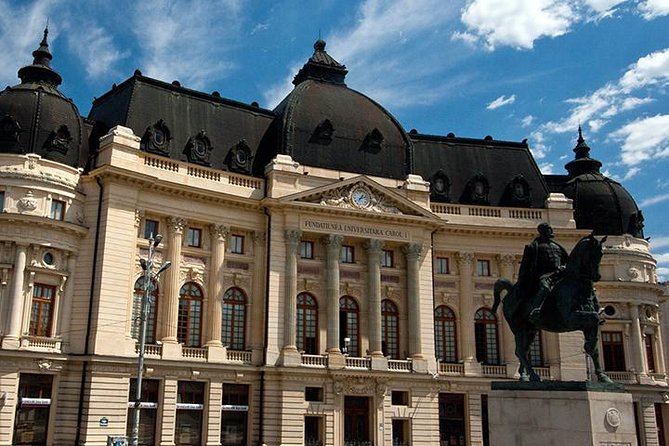
You see the area connected with the start of the Romanian Revolution, including the balcony where Nicolae Ceaușescu gave his final speech, the former Communist Party headquarters, the University Library, King Carol I’s equestrian statue, and memorials linked to the uprising.
The Memorial of Rebirth is the central named stop. This 25-meter monument commemorates the struggle and victims of the 1989 Revolution. It is a striking and sometimes controversial piece of public art, and the guide explains its place in the city rather than treating it as just another photo stop.
This part of the tour is valuable because it connects political history with physical space. You are not only hearing that the regime collapsed. You are standing where public speeches, protests, fear, and sudden change unfolded.
The subject can become personal. Alina is praised for sharing experiences connected with growing up in Romania, and that kind of local perspective can make the Communist period easier to understand. At the same time, several accounts point out that the guide expresses strong opinions about politics, government, communism, and the monarchy.
One serious complaint describes aggressive gestures, conspiracy theories, and discussion of figures such as George Soros. That account is very different from the many positive assessments, but it is still useful to know. If you want a strictly neutral presentation, ask at the start that the discussion stay focused on documented history and the sights around you.
Military Circle and Sărindar Fountains
The walk continues to the Military Circle and the Sărindar Fountains. These landmarks provide another view of Bucharest’s formal civic architecture and public spaces.
The route then reaches a historic building and gardens described as having been built for the people of Bucharest by the people of Bucharest more than 100 years ago. The exact name is not given, but the stop is presented as a pleasant final photo opportunity, with gardens and an important historic structure.
The activity ends back at the meeting point. This is useful because you finish in the Old Town, close to places to eat and continue exploring. Still, one longer account found the final orientation confusing while trying to locate a bus back to the hotel. If you plan to leave by public transport, ask the guide to point out the route before saying goodbye.
How the private format affects the experience
This is a private activity, so only your group participates. That can make a real difference. You can ask about a particular building, slow down for photographs, or request more detail about the monarchy, communism, religious life, or the revolution.
The private format also means the guide’s personality has more impact. Alina is repeatedly described as lively, funny, enthusiastic, and full of facts. One person called her presentation energetic and said she made history enjoyable. Another appreciated her food and drink suggestions for later in the day.
The drawbacks are tied to the same personal style. A fast flow of information can be hard to follow, especially for an English-only speaker. One person found the guide’s English difficult at times and had trouble getting questions understood. Another felt that personal political views took too much space.
You should also expect a brisk amount of walking. The listed duration is about three hours, but one group continued for roughly another hour because the discussion was so extensive. Bring water, especially in hot weather, and do not schedule a tight appointment immediately afterward.
Is $30.77 a fair price?
At $30.77 per person, this is a sensible price for a private introduction to central Bucharest. You cover Old Town, the former princely court, major squares, the Palace of Parliament exterior, Calea Victoriei, University Square, and the Revolution sites in one outing.
The value is strongest if you are new to Bucharest and want a framework for the rest of your stay. The walk gives you names, dates, political context, and suggestions for places to eat and drink. It can save you from wandering past important buildings without understanding them.
The value is weaker if you want a slow architectural tour, extensive interior access, or a tightly scripted presentation. Most named stops are short, often around five minutes, and the experience depends heavily on spoken explanation.
Hotel pickup and drop-off are listed as included, but the meeting details clearly identify Manuc’s Inn as the start and end point. Confirm the pickup arrangement before booking, particularly if you are staying outside the central area.
Who should book this Bucharest walk?
I would choose this tour early in a Bucharest visit, especially if you enjoy history, politics, architecture, and personal stories. It covers enough ground to help you recognize the city’s main districts and return later to the buildings that caught your attention.
It suits reasonably fit visitors who are comfortable walking for several hours. Families can join, but children must be accompanied by an adult, and the amount of political and historical discussion may be better for older children.
You may want another option if you dislike strong political opinions, need a very slow pace, or prefer a guide who focuses only on architecture. The English presentation can also vary, so clear communication at the start is worthwhile.
The tour is offered in English, uses a mobile ticket, and generally receives a high rating of 4.8 from 84 ratings, with 94 percent recommending it. It also allows free cancellation up to 24 hours before the start, while poor weather may lead to a new date or a full refund.
Should you book it?
Book it if you want a fast, personal introduction to Bucharest’s past, and you are happy to trade polished neutrality for a guide with strong opinions and plenty to say. The route covers far more than Old Town cafés, linking Vlad the Impaler, Orthodox churches, royal Romania, Ceaușescu’s city plan, and the 1989 Revolution.
I would book it near the start of your stay, wear supportive shoes, carry water, and ask in advance about pickup. For roughly thirty dollars, it offers a lot of ground and context, but you should arrive ready for a brisk walk and an outspoken guide.
FAQ
Where does the Bucharest walking tour start?
It starts outside the main entrance of Manuc’s Inn, Hanul lui Manuc, at 62 Strada Franceză in Bucharest’s Old Town.
Where does the tour end?
The activity ends back at the meeting point.
How long does the tour last?
The scheduled duration is approximately three hours. It may run longer if the guide continues the discussion.
What language is the tour offered in?
The tour is offered in English.
Is this a private tour?
Yes. Only your group participates in the activity.
Is hotel pickup available?
Hotel pickup and drop-off are listed as included. The specific meeting details identify Manuc’s Inn as the main start point, so confirm the pickup arrangement when booking.
What should I bring?
Bring comfortable walking shoes and water. The route involves a substantial amount of walking, and hot weather can make it more demanding.
Does the tour enter the Palace of Parliament?
The tour includes exterior views and photo opportunities at the Palace of Parliament and Piața Constituției. An interior visit is not specified.
Are admission tickets included?
The named stops are listed with free admission. The experience focuses mainly on outdoor sights and exterior views.
Can I cancel for a full refund?
You can cancel for a full refund up to 24 hours before the experience start time. Cancellations or changes made less than 24 hours in advance are not refunded, and poor weather may result in a different date or full refund.
More Walking Tours
- Best of Bucharest | Private Walking Tour
★ 5.0 · 199 reviews - Walking Tour- Delightful Bucharest (Highlights, Stories, Sights)
★ 5.0 · 145 reviews - 4h Bucharest Private Tour (2h by Car and 2h Walking in Old Town)
★ 5.0 · 90 reviews - Bucharest 3-hours Walking Tour (Small Groups)
★ 5.0 · 85 reviews
More Historical Tours
- Private Bucharest: History & Food with Traditional Meal
★ 5.0 · 34 reviews - Bucharest Historical Food Tour in Old Center
★ 5.0 · 21 reviews - Half-Day Jewish Heritage Walking Tour in Bucharest
★ 5.0 · 20 reviews - Bucharest: Sweet Delights History and Desserts Walking Tour
★ 5.0 · 18 reviews
Just added around Bucharest
- 10 hours Private Apiary Tour in Romania – From Bucharest★ 5.0 · 3 reviews
- 4-Day Inside Transylvania & Transfagarasan Tour from Bucharest★ 5.0 · 3 reviews
- Bucharest: Charm of the Belle Époque Private Tour★ 5.0 · 3 reviews
- Bran & Peles Castles through the Best Road in the World: Transfagarasan road★ 4.5 · 3 reviews
- 2-Day Small-Group Tour in Transylvania from Bucharest – Maximum 5 Persons★ 5.0 · 3 reviews
- Private Wine Tasting at Bucharest’s First Wine Bar★ 5.0 · 3 reviews
- Bucharest to Brasov – Fast Private Transfer★ 5.0 · 3 reviews
- Probably the Best Restaurant and Wine Cellar near Bucharest★ 4.5 · 3 reviews
Historical Tours, compared.

Bucharest Jewish Heritage | Holocaust Memorial | Private Car Tour
Read our review →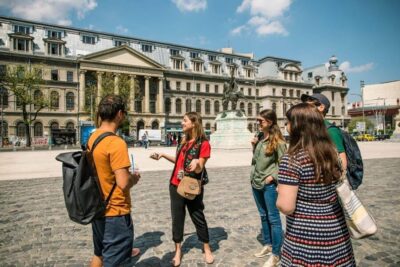
Private Bucharest: History & Food with Traditional Meal
Read our review →Historic Gems Sighișoara, Rupea and Viscri Day Tour
Read our review →
Half-Day Jewish Heritage Walking Tour in Bucharest
Read our review →
Discover Romania’s Wine Heritage in Brasov’s Historic Center
Read our review →Browse the lists this tour appears in