
Reviewed · COMMUNIST HISTORY TOURS
Bucharest Under Communism: Life, Terror & Hope
Communism left a huge footprint. This 3.5-hour Bucharest walk connects grand avenues, surviving churches, and the places where Nicolae Ceaușescu’s regime ended. I like the clear route through major landmarks, and I like the way guides such as Laura and Tamar add personal stories, old photographs, and room for questions. The main drawback is that the Palace of Parliament admission is not included, and the tour spends several hours outdoors.
You begin near Unirii Square at 4 p.m. and finish at Revolution Square, about five minutes from the Old Town. That ending is useful: you can continue into the historic center for dinner or drinks. The group can reach 15 people, though smaller groups have been reported, and the price of $23.22 per person offers good value for a focused introduction to Romania’s communist era.
In This Review
- Key points at a glance
- Why this communist Bucharest walk matters
- Starting at Unirii Square and the Victory of Socialism Boulevard
- The Palace of Parliament and the price of grandeur
- Mihai Voda Monastery, a church saved from destruction
- Revolution Square and Ceaușescu’s last public speech
- University’s Square and the cost of protest
- Guides who make a heavy subject easier to follow
- Price, timing, and practical value
- Who should book this tour?
- Should you book Bucharest Under Communism?
- FAQ
- How long does the tour last?
- What time does the tour start?
- Where does the tour begin?
- Where does the tour end?
- Is admission to the Palace of Parliament included?
- What happens if bad weather cancels the tour?
Key points at a glance
- Unirii Square reveals Ceaușescu’s grand plan: See the fountains and the broad former Victory of Socialism Boulevard, built to frame the dictator’s vision of Bucharest.
- The Palace of Parliament is viewed from several angles: Learn how its construction drained money, materials, and labor while ordinary people faced shortages.
- Mihai Voda Monastery survived demolition: This medieval church shows what Bucharest looked like before communist redevelopment.
- Revolution Square brings 1989 to life: See Ceaușescu’s former office building, the balcony of his last speech, and the memorial to those killed during the uprising.
- University’s Square adds the cost of protest: The stop focuses on the 1989 demonstrations and the people killed for demanding a free society.
- Laura and Tamar receive repeated praise: Their approach combines solid historical background with humor, photos, anecdotes, and patient answers.
Why this communist Bucharest walk matters
Bucharest can look like a city of grand boulevards and mismatched buildings until you understand what happened to it in the 1980s. Ceaușescu reshaped the capital on a vast scale, clearing neighborhoods, moving churches, widening roads, and placing government buildings at the end of ceremonial avenues.
This tour gives those changes a human frame. You do not simply look at a massive building and hear its dimensions. You learn what it cost the people who lived through its construction. You also see the quieter signs of the old city, including a medieval monastery partly concealed by later buildings.
I especially like the balance between architecture and lived experience. The tour deals with political power, but it also covers food shortages, daily restrictions, religion, public protest, and the difficult shift from socialism to democracy. That makes it useful for a first visit to Bucharest, even if you know little about Romania before arriving.
The guides also connect the communist period with the monarchy that came before it. Laura, who has been described as having a history degree, is praised for explaining the move from monarchy to communism and then to democracy. Tamar is noted for mixing historical facts with anecdotes and for answering extra questions without losing the group.
More communist-era history walks:
- The Real tour of Communism
★ 5.0 · 666 reviews - Life under Communism
★ 5.0 · 358 reviews - 3-Hour Guided Tour of Communist Bucharest
★ 4.9 · 303 reviews
Starting at Unirii Square and the Victory of Socialism Boulevard
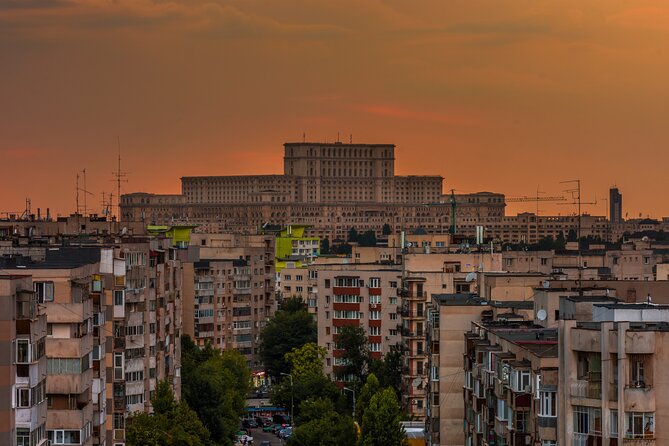
The walk starts at Piața Sfântul Anton 64, near the center of Bucharest, and moves to Unirii Square. The square was laid out during the final phase of Romanian communism and remains one of the clearest places to grasp the scale of Ceaușescu’s urban project.
The fountains give the square a more decorative feel, but the real point is the road running through it. The former Victory of Socialism Boulevard was planned as a broad approach toward the Palace of Parliament. From here, you can read the city as a piece of political theater, with space designed for ceremonies, parades, and the display of state power.
Your guide explains the megalomaniac vision behind the project and what the avenue meant in daily life. This is where the walk begins to make a useful distinction between appearance and reality. Grand architecture suggested national strength, while many households faced severe shortages during the 1980s.
Allow about 30 minutes here. The stop is free, and it helps you understand the next part of the walk before you reach the Palace of Parliament. Bring water, especially in warm weather, since the tour is conducted on foot and includes several outdoor stops.
The Palace of Parliament and the price of grandeur
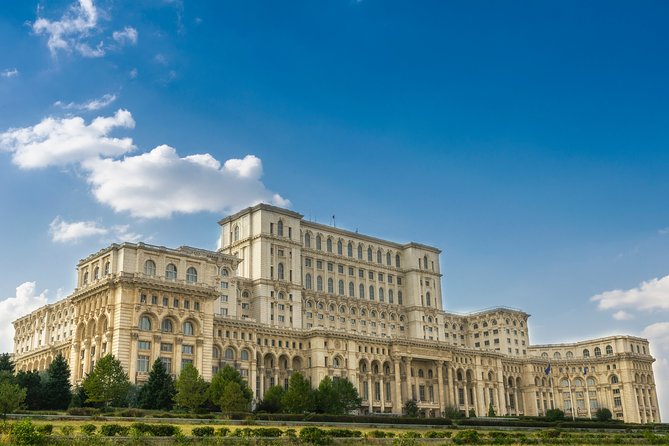
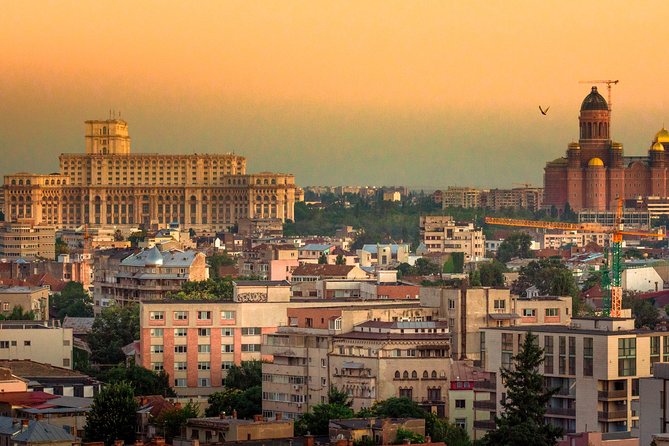
The Palace of Parliament is the tour’s biggest visual encounter. It is described as the second-largest building in the world after the Pentagon and the most expensive administrative building ever constructed. Even from outside, its scale is hard to absorb.
The important part is not only size. Your guide explains how the building required vast amounts of money, materials, and labor at a time when Romanian households were dealing with shortages. The palace became a symbol of a government that demanded sacrifice from the public while building for itself.
You view the building from different angles and hear how people in Bucharest regard it. That local perspective matters. A structure can be impressive as engineering and deeply troubling as a political symbol at the same time. This tour does not ask you to choose just one reaction.
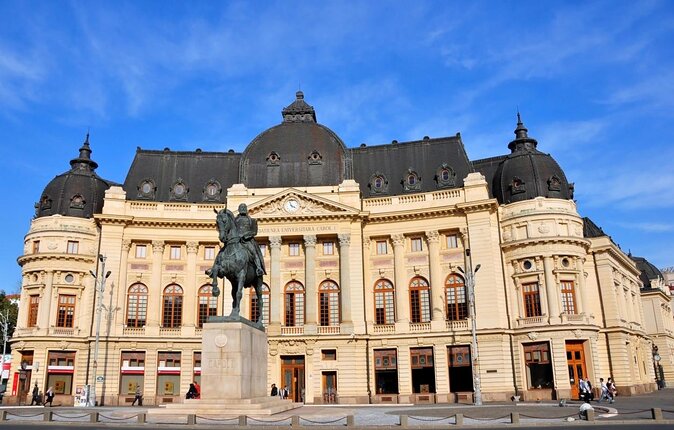
Across from the palace is the Academia Română building, another major construction in a similar style. It was intended for Elena Ceaușescu, Nicolae’s wife. That detail adds another layer to the story of how the ruling couple used architecture, institutions, and public resources.
The planned time here is about one hour. Admission to the palace is not included, so this experience is primarily an exterior visit unless you arrange an interior visit separately. That keeps the tour price low, but you should know the difference before booking. If seeing the interior is your main goal, you will need to plan for a separate ticket and visit.
The palace area can also feel like the longest open-air section of the route. Good walking shoes are sensible, and you should be ready for a steady pace between sites.
Mihai Voda Monastery, a church saved from destruction
After the monumental government district, the walk shifts tone at Mihai Voda Monastery. The church dates to the Middle Ages and survived the demolition campaign that changed large parts of Bucharest.
This stop is valuable because it shows what the capital looked like before the communist rebuilding projects. The church is also a striking example of how older religious buildings could be hidden behind utilitarian structures. From certain viewpoints, the monastery feels tucked away from the city that grew around it.
Your guide explains how some churches were destroyed and how others were saved during the communist period. The story is not simply about faith versus politics. It is also about the physical reshaping of the city and the efforts made to preserve buildings that did not fit the official plan.
The stop lasts about 30 minutes and does not require an admission ticket. It gives the walk a welcome change of scale. After the vast palace, you are looking at a place tied to medieval Bucharest and to the survival of older traditions.
A few more trips worth weighing up before you book
- Bucharest: Dracula’s Castle, Peles Castle, & Brasov Old Town
★ 4.5 · 17,858 reviews - Bucharest: Dracula Castle, Peles Castle & Brasov Old Town
★ 4.6 · 10,891 reviews - Bucharest: Dracula’s Castle, Peleș Castle & Brașov Day Trip
★ 4.5 · 5,919 reviews - Bucharest: Palace of Parliament Tickets and Guide
★ 4.3 · 3,182 reviews
Revolution Square and Ceaușescu’s last public speech
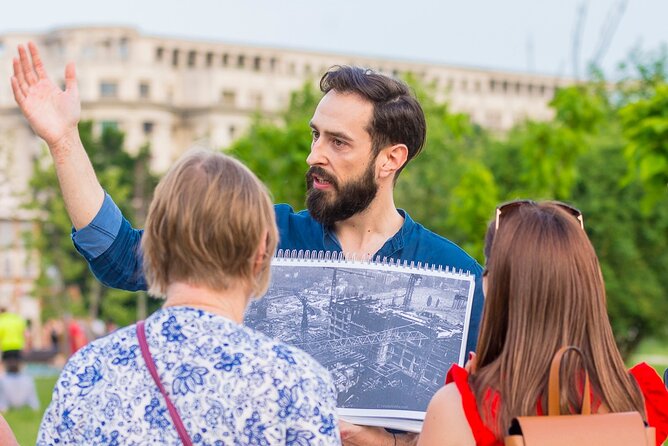
Revolution Square is the emotional center of the tour. This is where the communist regime began to crack and where public protest helped bring it down in December 1989.
You see the building that housed Ceaușescu’s office and the balcony where he delivered his last speech. The scene became one of the defining moments of the Romanian Revolution. A crowd that had gathered for a staged show of support began to turn against him, and the authority of the regime collapsed in public view.
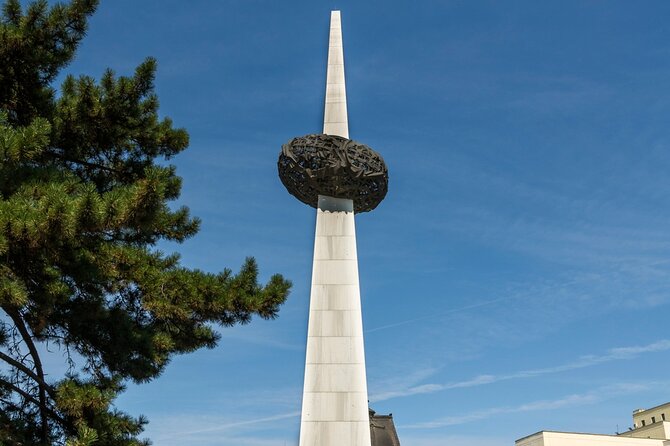
The guide explains the first mass demonstration in Bucharest, what happened to people who protested, and how the events unfolded after the dictator fled. You also learn about the memorial dedicated to those who died.
This is not a stop to rush. The planned time is about one hour, and that length makes sense. The square contains several buildings and memorials, but the key value is the explanation that links them together. Without context, you may see a balcony, an office, and a monument. With a good guide, the place becomes a sequence of decisions, fear, courage, and confusion.
The tour ends here. Because Revolution Square is close to the Old Town, you can easily continue your evening on foot. That is a practical advantage over tours that finish far from the center.
University’s Square and the cost of protest
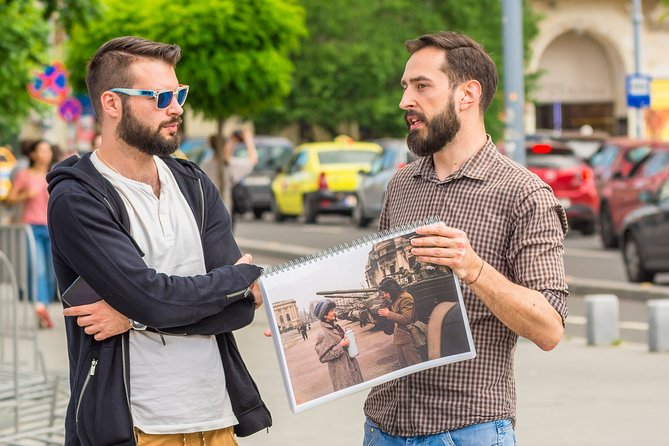
The final stop is University’s Square, another important site connected with the 1989 protests. The focus here is on the demonstrations against communism and the people killed for believing in a free society.
This stop broadens the story beyond Ceaușescu’s final speech. A revolution is not only the moment when a dictator loses power. It also includes the people who take to the streets, the risks they accept, and the violence used against them.
The planned visit lasts about 30 minutes. It is a compact stop, but it gives the tour a sobering finish. By this point, you have seen the buildings of power, the city that was cleared to make room for them, and the public places where ordinary people challenged the system.
Guides who make a heavy subject easier to follow
The strongest part of this experience is the guide. Laura receives repeated praise for her clear English, preparation, humor, and willingness to answer questions. She uses historical photos to help you compare Bucharest across different periods, and she connects political events with personal stories from the communist years.
Tamar is also praised for keeping the walk lively while covering difficult material. Her style combines facts with anecdotes, which helps prevent the tour from becoming a string of dates and names.
I would choose this walk partly for that human element. Communism can be hard to understand through monuments alone. A guide who can explain how policy affected food, housing, religion, work, and family life gives you a much better sense of the period.
The tone appears serious but not grim from beginning to end. The guides use humor where it fits, answer questions, and make an effort to include everyone. One small group described Laura as kind and attentive, taking time to give detailed answers. That suggests the experience works particularly well when the group is small, though the maximum size is 15 people.
Price, timing, and practical value
At $23.22 per person, this is a fairly priced walking tour for three and a half hours of guided sightseeing. You are paying for a clear route, historical interpretation, and access to a guide who can connect separate sites into one story.
The value is strongest if this is your first visit to Bucharest or your first serious look at the communist period. You cover Unirii Square, the Palace of Parliament, Mihai Voda Monastery, Revolution Square, and University’s Square without needing to work out the order yourself.
The price is less attractive if you mainly want to enter the Palace of Parliament. Since admission is not included, you would need to arrange that separately. Still, an exterior-focused visit has its own value because the guide can explain the building’s setting, approach, and impact on the city.
The start time is 4 p.m., and the tour ends at Revolution Square. Plan for an afternoon and early evening on foot. The route includes open public areas, so weather matters. The operator requires good weather and may offer a new date or a full refund if conditions force cancellation.
A mobile ticket makes arrival simple. The meeting point is in the city center, near public transport, and most people can take part. Service animals are allowed. Free cancellation is available up to 24 hours before the start time, but changes or cancellations inside that window are not accepted.
Who should book this tour?
I would recommend it to you if you want more than a quick photo of the Palace of Parliament. It suits history-minded visitors, first-time visitors who need city context, and anyone curious about how a political system shaped ordinary life.
It is also a good choice if you prefer a personal walking experience to a large bus tour. The route has enough landmark stops to keep things varied, while the guide’s stories add meaning to each one.
You may want something else if you dislike long walks, hot afternoon weather, or emotionally difficult subjects. You should also look for a palace interior visit if that is your main priority. This experience explains the building and its setting, but admission is separate.
Should you book Bucharest Under Communism?
Yes, if you want a clear and human introduction to Bucharest’s communist past. The combination of Unirii Square, the Palace of Parliament, a surviving medieval monastery, and the two 1989 protest sites gives you a useful picture of both state power and public resistance.
Book it early in your stay if possible. The route will help you understand what you see elsewhere in Bucharest, and the ending near the Old Town makes it easy to continue exploring. At the stated price, with strong praise for guides including Laura and Tamar, this is a sensible choice for learning how modern Bucharest was shaped.
FAQ
How long does the tour last?
The tour lasts approximately 3 hours and 30 minutes.
What time does the tour start?
It starts at 4 p.m.
Where does the tour begin?
The meeting point is Piața Sfântul Anton 64, Bucharest, Romania.
Where does the tour end?
The tour ends at Revolution Square, about five minutes from Bucharest’s Old Town.
Is admission to the Palace of Parliament included?
No. Admission to the Palace of Parliament is not included in the tour price.
What happens if bad weather cancels the tour?
If poor weather causes cancellation, you will be offered another date or a full refund. Free cancellation for other reasons is available up to 24 hours before the start time.
Just added around Bucharest
- 10 hours Private Apiary Tour in Romania – From Bucharest★ 5.0 · 3 reviews
- 4-Day Inside Transylvania & Transfagarasan Tour from Bucharest★ 5.0 · 3 reviews
- Bucharest: Charm of the Belle Époque Private Tour★ 5.0 · 3 reviews
- Bran & Peles Castles through the Best Road in the World: Transfagarasan road★ 4.5 · 3 reviews
- Private Wine Tasting at Bucharest’s First Wine Bar★ 5.0 · 3 reviews
- 2-Day Small-Group Tour in Transylvania from Bucharest – Maximum 5 Persons★ 5.0 · 3 reviews
- Probably the Best Restaurant and Wine Cellar near Bucharest★ 4.5 · 3 reviews
- Bucharest to Brasov – Fast Private Transfer★ 5.0 · 3 reviews
Communist History Tours, compared.




Bucharest Essential Tour: Old Town, Calea Victoriei & Communism
Read our review →
Communism in Bucharest – Landmarks, Museum & Communist Appetizers
Read our review →


Museum of Communism Ticket with Communist Coffee
Read our review →Browse the lists this tour appears in