
Reviewed · COMMUNIST HISTORY TOURS
Contrasts of Communism – Small Group Walking Tour in Bucharest
History feels different on foot. This three-hour Bucharest tour links the 1989 Revolution with ordinary neighborhoods, memorials, public transport, and the vast Palace of Parliament. I like the small maximum group of eight, which leaves room for questions, and I like the use of old photographs to show how places looked before and after communism. The main consideration is physical: you will walk quite a bit, use public transportation, and spend time outdoors.
The tour costs $42.05 per person and is offered in English. That is fair value if you want more than a parade of grand buildings. Guide Elena receives especially warm praise for her clear English, personal stories, friendly manner, and ability to connect Romania’s political past with life today. Bring a good breakfast, comfortable shoes, and an open mind. This is serious history, but it is not delivered like a school lecture.
In This Review
- Key points at a glance
- Why this Bucharest tour is worth your morning
- Starting at Revolution Square
- University’s Square and the first heroes of freedom
- Riding beyond the center to Eroii Revolutiei
- Remembering the dead at the Revolution Heroes Cemetery
- The hill and monument at Carol I Park
- Facing Ceausescu’s final building project
- Ending at Unirii Boulevard’s fountains
- What the $42.05 price really buys
- Practical advice before you go
- Who will enjoy this tour most
- Should you book Contrasts of Communism?
- FAQ
- How long does the Contrasts of Communism tour last?
- How much does the tour cost?
- What language is the tour offered in?
- How many people can join the tour?
- Where does the tour begin?
- Where does the tour end?
- Is admission to the stops included?
- Does the tour use public transportation?
- How physically demanding is the tour?
- What happens if bad weather cancels the tour?
Key points at a glance
- A seven-stop route with real variety: You move from Revolution Square and University’s Square to a working-class district, a cemetery, a hilltop park, Parliament, and Unirii Boulevard.
- Public transport is part of the lesson: The metro and public bus help you see Bucharest beyond its central monuments.
- Small groups change the experience: With no more than eight people, questions and conversation can shape the walk.
- Old photographs add useful context: Elena uses images to help you compare the communist-era city with Bucharest today.
- The tour connects politics to daily life: You hear about Ceausescu, the 1989 uprising, the cult of personality, and the effects on ordinary families.
- Plan for moderate exertion: Expect walking, outdoor stops, public transit, and a weather-dependent schedule.
Why this Bucharest tour is worth your morning
Many city tours show you Bucharest’s grand avenues and impressive façades without explaining why so much of the center was reshaped. Contrasts of Communism takes a different route. It asks you to look at power, protest, memory, housing, public space, and the marks left by Nicolae Ceausescu’s rule.
I like that the route does not stay in the postcard center. You see famous political sites, but you also ride public transportation to a working-class area where plain 1970s apartment blocks are being given new life through street art. That contrast gives the tour its purpose. Communism is not treated as a museum subject sealed in the past. You see how its buildings and political choices still affect Bucharest.
The small-group format matters here. A subject like this raises questions that do not fit neatly into a script. Past participants describe Elena as relaxed, warm, and willing to discuss difficult topics. She has a background in political science and can explain both the public events and the personal effects of the period. Her family stories, including the hardships experienced by her mother, add a human scale without turning the tour into a political speech.
More Walking Tours in Bucharest
- Bucharest: City Highlights Guided Walking Tour
★ 4.9 · 1,482 reviews - Bucharest Highlights Walking Tour
★ 5.0 · 469 reviews - Bucharest: Ghost Stories & Romanian Mythology Walking Tour
★ 4.9 · 287 reviews
Starting at Revolution Square
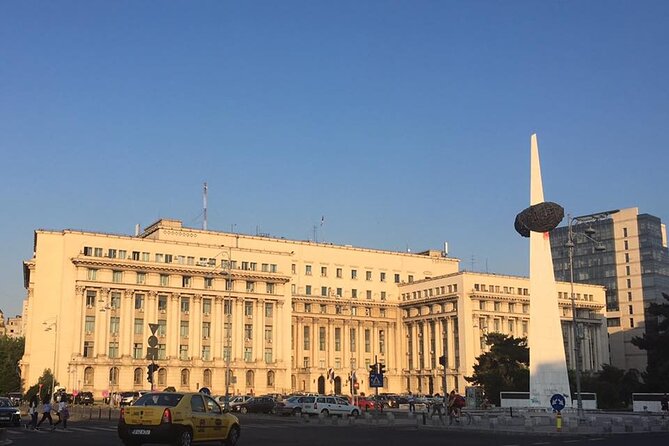
The tour begins at Boteca 13, at Strada Boteanu 3, then heads to Revolution Square. This is the right place to begin because it puts you at the point where Ceausescu gave his last public speech in 1989.
You will hear about the rise and fall of Romania’s communist dictatorship and the events that brought people into the streets. The stop lasts about 30 minutes and has no admission charge. Expect to stand outdoors while the guide explains how this space became linked with the final days of the regime.
The value of this stop is not simply the square itself. It is the chance to understand the tension between official power and public resistance. With Elena’s photographs, you can better picture the crowd, the political figures, and the dramatic change that took place here.
This is also where a strong guide earns the fee. A basic history summary is easy to find online. What you want on the spot is help reading the space and understanding why the speech mattered, how the public reacted, and what the fall of the regime meant for Romania.
University’s Square and the first heroes of freedom
The second stop is University’s Square, known on this tour as KM0 of Romanian freedom of speech. You will learn about the first people killed in Bucharest for liberty on December 21, 1989.
The visit lasts about 30 minutes and is free. It also brings the story into the present by examining Romania’s current political climate. That makes this more than a look backward. You are encouraged to consider how the memory of revolution shapes public discussion today.
I would pay close attention here. The square is a useful place to connect the fall of communism with the imperfect years that followed. Political change does not erase old habits overnight, and the tour helps explain why the revolution remains important in modern Romania.
The conversation can be especially useful if you know little about the difference between Romania’s communist experience and that of other former communist countries. Elena’s explanations focus on Romania itself rather than offering a broad, generic Eastern European story.
Riding beyond the center to Eroii Revolutiei
At Eroii Revolutiei, the tour leaves the usual central route. You use public transportation to reach a typical working-class neighborhood, with the route involving the metro and a public bus according to past participants.
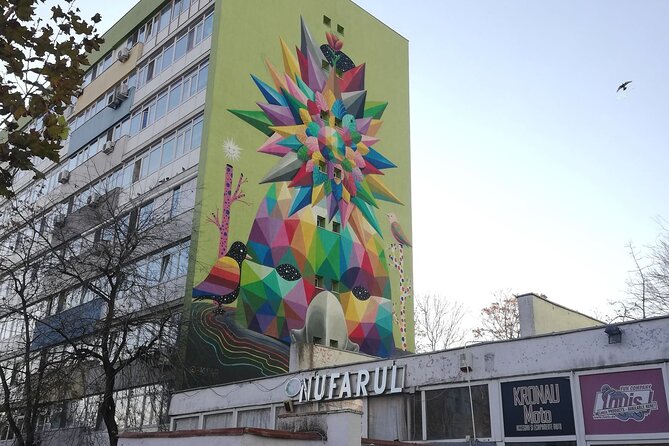
This segment lasts about 15 minutes, but its importance is greater than the short time suggests. You see gray apartment blocks from the 1970s and learn how street art is changing their appearance. The point is not to pretend the buildings have become beautiful overnight. It is to show how residents and artists are giving a different identity to places built during the communist period.
This is one of the tour’s best choices. A grand government building can tell you about a leader’s ambitions. Apartment blocks tell you about how people lived. The move from central political spaces to a working-class neighborhood makes the history more grounded.
You should also treat the public transport ride as part of the experience, not just a way to get from one stop to another. It gives you a view of everyday Bucharest and adds a small local challenge to the morning. The exact order or transport details may vary, so listen for instructions and stay with the group.
More communist-era history walks:
- The Real tour of Communism
★ 5.0 · 666 reviews - Life under Communism
★ 5.0 · 358 reviews - 3-Hour Guided Tour of Communist Bucharest
★ 4.9 · 303 reviews - Bucharest Essential Tour: Old Town, Calea Victoriei & Communism
★ 5.0 · 142 reviews
Remembering the dead at the Revolution Heroes Cemetery
The next stop is the Memorial Cemetery at Cimitirul Eroilor Revolutiei. You will walk along quiet paths dedicated to the people killed during the 1989 Revolution.
The visit takes about 30 minutes and is free. The pace here is likely to feel more reflective than at the earlier squares. Instead of focusing only on leaders and dates, Elena shares personal stories about those who died.
That shift is important. Political history can become abstract when it is reduced to speeches and institutions. A cemetery brings the cost of change into view. It also helps you understand that the revolution was not a clean, bloodless transfer of power.
Wear shoes that work on a walking route and be ready for a quieter stretch. This is not a stop for rushing through photographs. The cemetery is included to make the human consequences of 1989 impossible to overlook.
The hill and monument at Carol I Park
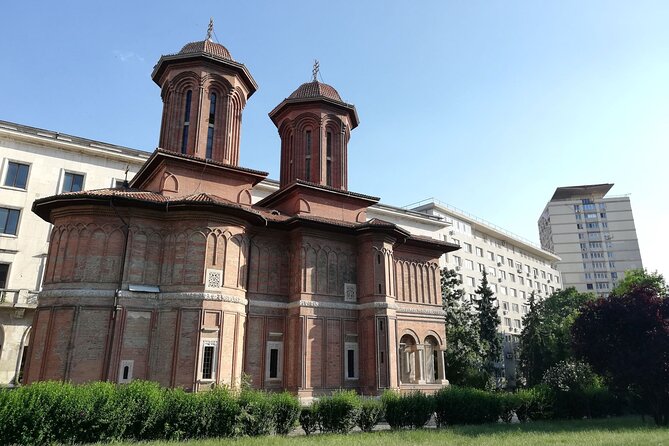
Parcul Carol I provides one of the higher viewpoints in Bucharest. From the park, you will discover the Monument of the Heroes for the Freedom of the Motherland, built in honor of communist party leaders.
The stop lasts roughly 30 minutes and has no admission charge. It offers a visual break from the streets and another chance to discuss the way public monuments express political power.
The monument is especially useful because it carries a complicated message. It was built to honor communist leaders, while the tour as a whole asks you to examine the damage caused by the system they represented. That tension is part of the experience. You are not simply shown a monument and told to admire it.
The hill also helps you see Bucharest in a broader way. After hearing about apartment blocks, demonstrations, cemeteries, and state projects, the view lets you think about how all these pieces fit into one city.
Facing Ceausescu’s final building project
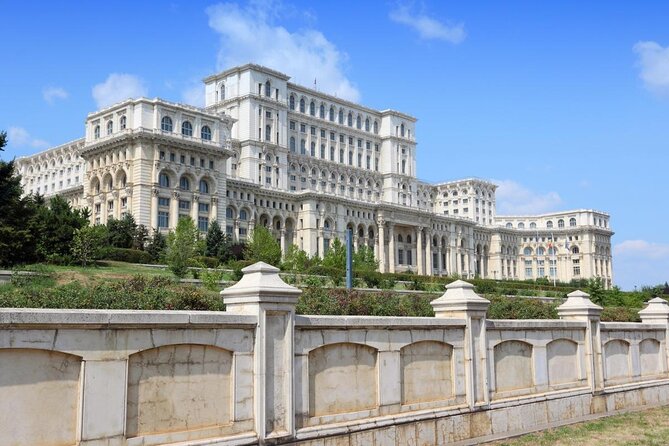
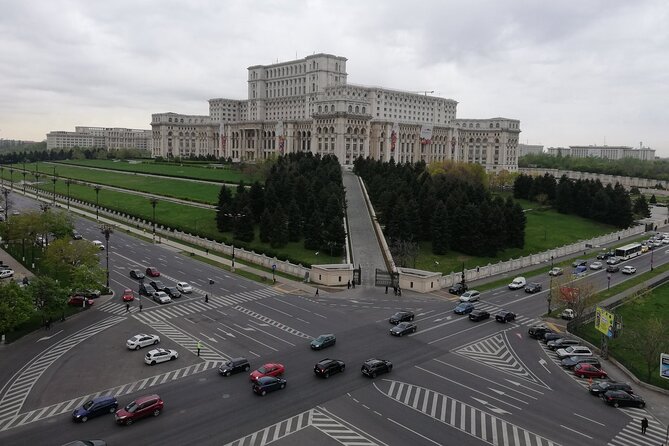
The tour returns toward the center for its most famous stop, the Palace of Parliament. You stand outside the second-largest administrative building in the world, presented here as Ceausescu’s final grand whim.
The stop lasts about 30 minutes. Admission to the building is not included, so this experience is about the exterior and the surrounding setting rather than an interior visit.
The Palace is an essential part of any serious look at communist Bucharest. Its scale tells you something about the regime’s priorities: enormous state power, monumental display, and the reshaping of the capital around one leader’s vision. A guide can also help you look past the sheer size and consider what that project required from the city and its people.
I appreciate that the palace comes late in the route. If you saw it first, it could become only a giant photo stop. By this point, you have already discussed repression, housing, protest, memorials, and communist symbolism. The building then feels like the climax of a political story rather than an isolated attraction.
If you want to tour the interior, you will need to arrange and pay for that separately. Do not assume the $42.05 tour price covers entry.
Ending at Unirii Boulevard’s fountains
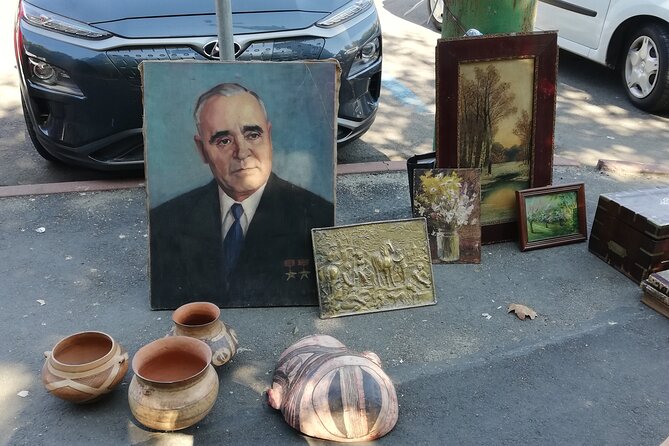
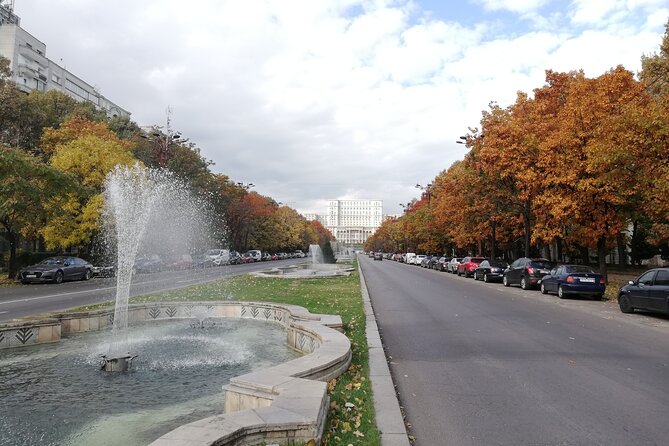
The walk ends at Bulevardul Unirii, near the dancing fountains and close to Parliament and Bucharest’s Old Town. The final stop lasts around 15 minutes and is free.
The boulevard was designed as a kind of home-court advantage for humbling visiting world leaders. That idea captures the theatrical side of Ceausescu’s urban planning. Wide avenues, monumental scale, and carefully staged public spaces were meant to project authority.
Ending here works well because you can compare the boulevard with the quieter cemetery and the ordinary apartment blocks visited earlier. The same political system produced both the monumental center and the practical housing districts.
The location is convenient after the tour. You can continue toward Parliament or Old Town, depending on your plans. Elena is also praised for offering restaurant and city suggestions, which can be useful if this is your first morning in Bucharest.
What the $42.05 price really buys
At $42.05 per person, this is not the cheapest way to spend three hours in Bucharest. It is also not an inflated price for a small-group experience that covers seven locations and uses public transportation to reach parts of the city many visitors would skip.
The value comes from the connections. You are not paying simply to look at Revolution Square or the Palace of Parliament. You are paying for someone to explain why these locations belong in the same story, and to answer questions as the story develops.
The maximum of eight people is a real advantage. Large groups often turn a serious subject into a wait-and-listen routine. Here, the format is better suited to discussion. Several accounts describe the experience as intimate, unrushed, and flexible, with time for rest stops and questions.
The price makes less sense if you only want major landmarks or prefer to explore at your own pace. You can see some of the central sites independently. The cemetery, working-class neighborhood, public transport route, and historical interpretation are the parts that add the most value.
Practical advice before you go
You will need moderate physical fitness. The tour combines walking, standing, stairs or transit connections, and outdoor time. One useful piece of advice is to eat breakfast before setting out, since there is no indication that food is included and the route covers a lot of ground.
Wear comfortable shoes and carry water. The tour requires attention as well as energy, so do not schedule it after an exhausting late night if you want to make the most of the discussion.
The meeting point is Boteca 13, Strada Boteanu 3, Bucharest 010027. The tour ends at Bulevardul Unirii 25, near Parliament and Old Town. It is offered in English and uses a mobile ticket.
Confirmation is sent within 48 hours, subject to availability. The tour requires good weather. If poor weather causes cancellation, you will be offered another date or a full refund. You can cancel for a full refund up to 24 hours before the start time, but changes or cancellations inside that window are not accepted.
Service animals are allowed, and the meeting and route are near public transportation. Since the itinerary includes walking and transit, ask about any specific mobility concern before booking rather than assuming the route will suit you.
Who will enjoy this tour most
I would choose this tour if you want to understand modern Romania rather than simply collect Bucharest sights. It suits anyone interested in political change, twentieth-century Europe, memorials, architecture, or the daily effects of dictatorship.
It is also a strong first activity in Bucharest. The tour gives you context for buildings and neighborhoods you will see later, and Elena’s local recommendations can help shape the rest of your stay.
Solo visitors may particularly appreciate the small group and conversational format. The guide has been praised for helping people traveling alone and for making the walk feel personal without losing focus.
You should think twice if you dislike serious historical subjects, outdoor walking, or public transportation. This is not a light sightseeing loop. It deals with deaths, repression, political power, and difficult family experiences.
Should you book Contrasts of Communism?
Yes, if you want an honest introduction to Bucharest’s communist past and the 1989 Revolution. The strongest reasons to book are Elena’s personal, clear approach; the use of old photographs; the small group; and the route beyond the central monuments.
I would book it early in your stay, ideally with enough time afterward to continue exploring Parliament or Old Town. At $42.05, it offers good value for a three-hour experience that combines guiding, history, public transit, and places you might not reach alone.
Skip it only if you want a purely architectural walk or a short, easy route. For anyone curious about how communism shaped Romania and how its effects remain visible today, this is a thoughtful and unusually grounded choice.
FAQ
How long does the Contrasts of Communism tour last?
The tour lasts approximately three hours.
How much does the tour cost?
The listed price is $42.05 per person.
What language is the tour offered in?
The tour is offered in English.
How many people can join the tour?
The maximum group size is eight people.
Where does the tour begin?
It begins at Boteca 13, Strada Boteanu 3, București 010027, Romania.
Where does the tour end?
It ends at Bulevardul Unirii 25, near Parliament and Bucharest’s Old Town.
Is admission to the stops included?
The listed stops are free except for the Palace of Parliament, where admission is not included. The tour description focuses on standing outside the building.
Does the tour use public transportation?
Yes. The route includes public transportation to Eroii Revolutiei, and past participants describe using the metro and a public bus.
How physically demanding is the tour?
A moderate level of physical fitness is recommended. The experience includes considerable walking and outdoor stops.
What happens if bad weather cancels the tour?
You will be offered a different date or a full refund if poor weather causes cancellation. Free cancellation for a full refund is also available up to 24 hours before the start time.
More Walking Tours
- Bucharest: Guided Walking Tour with Romanian Snack
★ 4.9 · 228 reviews - Best of Bucharest | Private Walking Tour
★ 5.0 · 199 reviews - Walking Tour- Delightful Bucharest (Highlights, Stories, Sights)
★ 5.0 · 145 reviews - 4h Bucharest Private Tour (2h by Car and 2h Walking in Old Town)
★ 5.0 · 90 reviews
Just added around Bucharest
- 4-Day Inside Transylvania & Transfagarasan Tour from Bucharest★ 5.0 · 3 reviews
- 10 hours Private Apiary Tour in Romania – From Bucharest★ 5.0 · 3 reviews
- Bucharest: Charm of the Belle Époque Private Tour★ 5.0 · 3 reviews
- Bran & Peles Castles through the Best Road in the World: Transfagarasan road★ 4.5 · 3 reviews
- 2-Day Small-Group Tour in Transylvania from Bucharest – Maximum 5 Persons★ 5.0 · 3 reviews
- Private Wine Tasting at Bucharest’s First Wine Bar★ 5.0 · 3 reviews
- Bucharest to Brasov – Fast Private Transfer★ 5.0 · 3 reviews
- Probably the Best Restaurant and Wine Cellar near Bucharest★ 4.5 · 3 reviews
Communist History Tours, compared.




Bucharest Essential Tour: Old Town, Calea Victoriei & Communism
Read our review →
Communism in Bucharest – Landmarks, Museum & Communist Appetizers
Read our review →


Browse the lists this tour appears in