
Reviewed · COMMUNIST HISTORY TOURS
Communist Era Bucharest Tour
Communism still shapes Bucharest’s streets. This private walking tour connects grand avenues, political monuments, and ordinary life under Nicolae Ceaușescu, giving you more than a quick look at imposing buildings. I like the personal guide service, especially the chance to ask direct questions about daily life in Communist Romania. I also like the route’s focus on Revolution Square and Parliament Palace, two places that explain much of the city’s recent past.
The tour costs about $30.72 per person and lasts roughly three hours. That is good value for a private experience, particularly if you want history explained at your pace. The main caution is that the route covers a lot of ground quickly, and one piece of feedback noted some difficulty understanding the guide’s English. Interpretations of the communist period can also differ, so keep an open mind and ask questions.
In This Review
- Key points before you book
- Why this tour is worth your time in Bucharest
- Starting at Manuc’s Inn and Piata Unirii
- Walking Bulevardul Unirii, the former Socialist Victory boulevard
- Parliament Palace and Ceaușescu’s colossal project
- Victoria Avenue and the buildings of everyday power
- University Square and the Intercontinental Hotel
- Revolution Square and the final days of 1989
- Iuliu Maniu and the Memorial of Rebirth
- The final historic building and the tour’s walking pace
- The guides and the value of personal memory
- Price, timing, and who gets the best value
- Who should book this Bucharest walk?
- Should you book the Communist Era Bucharest Tour?
- FAQ
- How long does the Communist Era Bucharest Tour last?
- What language is the tour offered in?
- Is this a private tour?
- Where does the tour begin?
- Can I be picked up from my hotel?
- Where does the tour end?
- Is Parliament Palace visited inside?
- Does the tour include Revolution Square?
- Are admission tickets required for the listed stops?
- What should I bring?
- Can I cancel for a refund?
Key points before you book
- Private walking format: Only your group takes part, so the guide can adjust the pace and answer personal questions.
- Personal stories from the communist era: Guides including Alina and Claire have shared first-hand memories of growing up under the regime.
- Revolution Square is the emotional center: You see the balcony linked to Ceaușescu’s final speech and memorials to the 1989 uprising.
- Parliament Palace puts the scale into perspective: You learn why Casa Poporului is regarded as the heaviest building in the world.
- Morning or afternoon departures: You can fit the tour around your Bucharest plans.
- Hotel pickup may be available: You can meet at a centrally located hotel or outside Manuc’s Inn in the Old Centre.
Why this tour is worth your time in Bucharest
Bucharest can be hard to read at first. A grand nineteenth-century building may sit beside a communist apartment block, while a broad boulevard leads toward a structure built through forced demolition and political ambition. Without a guide, the city’s recent past can feel scattered.
This tour gives those pieces a clear order. You begin in the Old Centre near Manuc’s Inn, then move through the planned spaces of Communist Bucharest, the government buildings connected to the old regime, and the places tied to the 1989 revolution. You finish with a better sense of how Romania moved from monarchy to dictatorship, and then toward the country you see today.
I especially like the focus on ordinary life. The strongest guiding style here is not simply a list of dates and leaders. It explains what shortages, political control, public ceremonies, and changing religious practices meant for families. Claire, one of the guides associated with the tour, has spoken about her own childhood and adolescence during the communist years. Alina has also been praised for placing events in context and explaining both the positive and negative views people may hold.
That personal approach makes the tour more useful than a standard building-by-building walk. You can ask questions that do not fit neatly into a museum label.
More communist-era history walks:
- The Real tour of Communism
★ 5.0 · 666 reviews - Life under Communism
★ 5.0 · 358 reviews - 3-Hour Guided Tour of Communist Bucharest
★ 4.9 · 303 reviews
Starting at Manuc’s Inn and Piata Unirii
The meeting point is outside the main entrance of Manuc’s Inn, at 62 Strada Franceza, in the center of Bucharest. Pickup from a centrally located hotel is also offered, which is helpful if you are still getting your bearings in the city.
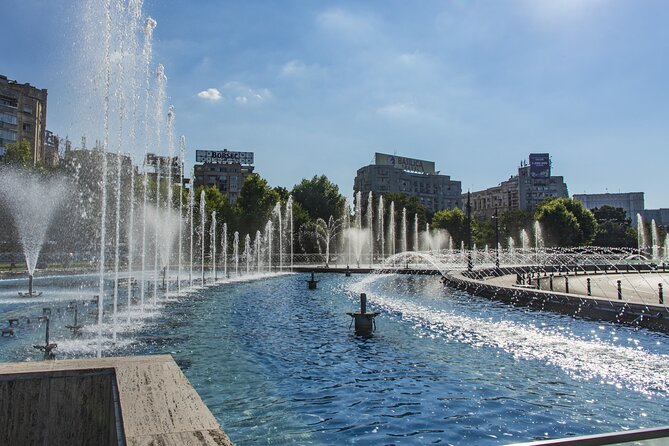
From there, the walk reaches Piata Unirii, one of Bucharest’s key central spaces. The square was reshaped as part of the communist modernization program, and today it has been regenerated as a major city center. Its restored Unirii fountains provide an easy visual introduction to the scale of state planning.
You spend about ten minutes here, with no admission charge. That short stop is enough to explain the square, but it is not a long historical visit. If you want time for detailed photographs or a closer look at the fountains, you may need to keep moving with the group and return later on your own.
Piata Unirii helps you see one of the central tensions of Bucharest’s communist legacy. The authorities wanted wide, controlled spaces that could display state power. The modern city has kept much of that scale but uses it for everyday public life.
Walking Bulevardul Unirii, the former Socialist Victory boulevard
Bulevardul Unirii was once known as the Boulevard of Socialist Victory. It was designed on a grand scale and is often compared with the Champs-Elysees in Paris, although the mood and history are very different.
The boulevard includes 17 artesian fountains decorated around the four seasons. You only spend about five minutes on this part of the route, so the guide’s explanation matters more than the stop itself. Look along the axis toward the Parliament Palace and notice how the road directs your eye toward the seat of power.
This is one of the clearest places to understand the ambition behind Ceaușescu’s Bucharest. The boulevard was not built simply to improve traffic. It was part of a carefully planned ceremonial setting, intended to display the strength and order of the state.
For me, the value lies in hearing how the architecture affected the people who lived nearby. The broad avenue and monumental scale tell only half the story. The other half involves the homes, churches, and older streets that were removed to make room for this new capital.
Parliament Palace and Ceaușescu’s colossal project
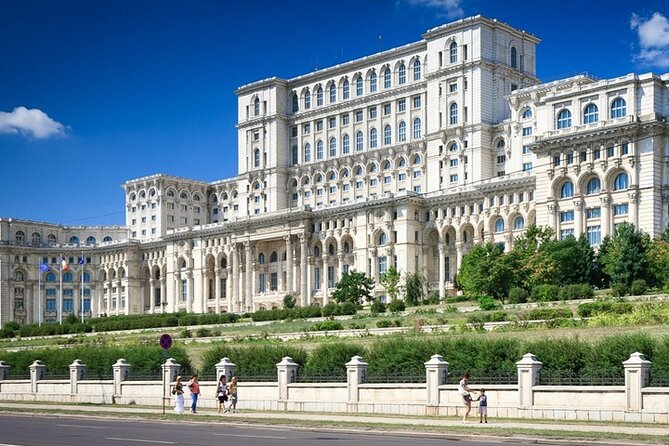
Casa Poporului, now known as Parliament Palace, is the tour’s biggest physical landmark. The building looms over central Bucharest and was commissioned under Nicolae Ceaușescu as the House of the People.
The guide explains its unusual place in world architecture, including why it is regarded as the heaviest building in the world. You also hear about the political purpose behind its construction and the sweeping changes made to the city around it.
Do not expect this walking tour to replace an interior visit. The itinerary provides an outside look and historical commentary rather than a dedicated admission visit inside the palace. That distinction matters if you want to see the enormous halls and rooms indoors. You would need to arrange that separately.
Still, seeing the building with a guide gives you something a solo photograph cannot. Its size is not accidental. It reflects a period when the state could reshape the capital on a vast scale, regardless of the cost to neighborhoods and residents.
The palace is also a useful point for discussing Ceaușescu himself. The tour’s strongest feature is its attempt to explain how a leader could present monumental construction as a national achievement while imposing severe hardship on the population. You are encouraged to consider the contradictions rather than receive a simple heroic or villainous story.
A few more trips worth weighing up before you book
- Bucharest: Dracula’s Castle, Peles Castle, & Brasov Old Town
★ 4.5 · 17,858 reviews - Bucharest: Dracula Castle, Peles Castle & Brasov Old Town
★ 4.6 · 10,891 reviews - Bucharest: Dracula’s Castle, Peleș Castle & Brașov Day Trip
★ 4.5 · 5,919 reviews - Bucharest: Palace of Parliament Tickets and Guide
★ 4.3 · 3,182 reviews
Victoria Avenue and the buildings of everyday power
The walk continues along part of Victoria Avenue, one of Bucharest’s important historic streets. Today, it is lined with shops and handsome buildings. During the communist years, its role and appearance were tied to a very different political and economic system.
This part of the tour adds needed variety. Parliament Palace and Bulevardul Unirii show official power from a distance. Victoria Avenue lets you consider how the regime affected commercial life, institutions, and the ordinary use of the city center.
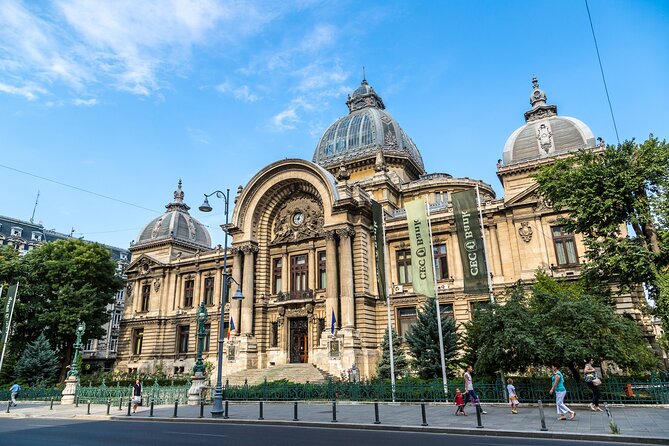
The route passes the CEC Bank, described as the bank of the people during the communist years. It also reaches the National Bank of Romania, whose history gives the guide another chance to discuss the country’s financial institutions and changing political order.
These are short exterior stops, not interior tours. Their importance comes from the explanation. If you enjoy architecture alone, you may find the pauses brief. If you want to understand how public buildings functioned within the communist system, they help fill in the gaps between the better-known monuments.
University Square and the Intercontinental Hotel
University Square brings the tour into another important Bucharest setting. You see the city’s oldest and largest university and hear about the Intercontinental Hotel Bucharest, completed and opened in 1971.
The hotel was a notable modern building in a city otherwise marked by older architecture and large state projects. Its history gives you a way to think about the image Romania wanted to project during the communist period. The National Theatre of Bucharest is also included, with an explanation of its many design changes over a relatively short history.
This section can feel more like an urban history walk than a narrowly focused dictatorship tour. That is a strength if you want a broader picture of Bucharest. It is less ideal if you want every minute devoted to repression, secret police activity, or the 1989 uprising.
The guide may also connect these sites with the post-Ottoman era, the work of King Carol I, the years between the world wars, and Romania’s communist takeover. That wider timeline is useful because communism did not appear in isolation. It changed an existing capital with royal, commercial, and national traditions.
Revolution Square and the final days of 1989
Piata Revolutiei, or Revolution Square, is the most important stop for understanding the fall of the regime. This is where the 1989 revolution began, and the square contains several sites tied to those life-changing events.
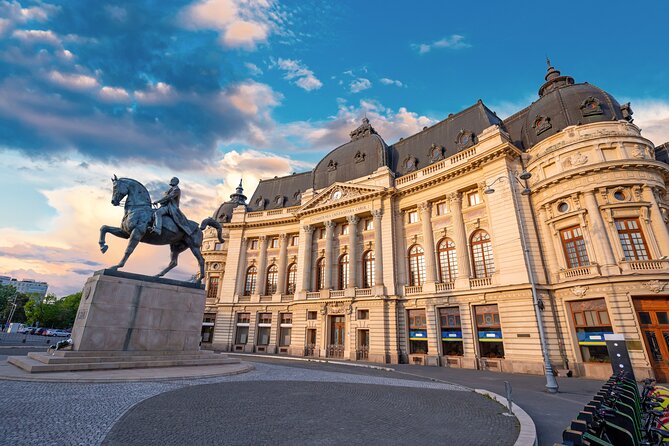
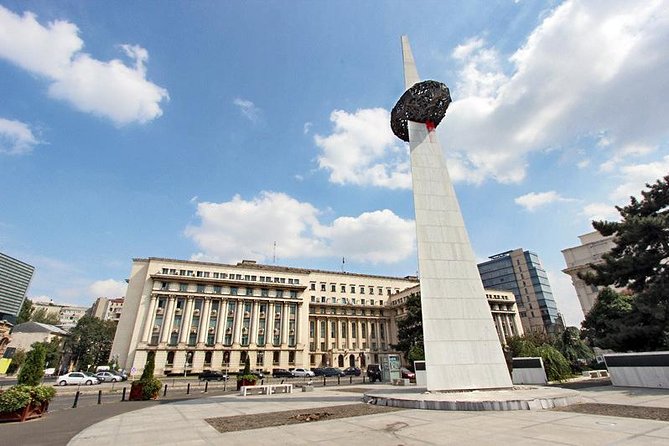
You see the balcony where Ceaușescu gave his final speech, the former headquarters of the Communist Party, the Memorial of Rebirth, the equestrian statue of King Carol I, and the university library. The stop lasts about ten minutes and offers strong photo opportunities.
The square is worth slowing down for, even if the official timing is short. Ceaușescu’s final public appearance here is one of the defining scenes of modern Romanian history. A speech meant to display control instead revealed that his authority was collapsing.
The former party headquarters makes the story more concrete. This was not an abstract government somewhere far away. The political center was right here, beside public spaces where people gathered and challenged the regime.
A useful feature of a private tour is the freedom to ask about the sequence of events and the human cost of the uprising. Several guides connected with this experience have been praised for explaining what life was like for ordinary Romanians, not only what happened to national leaders.
Iuliu Maniu and the Memorial of Rebirth
The Iuliu Maniu statue provides a different historical angle. Maniu served three times as prime minister and became an important figure in the struggle during the early communist years.
This five-minute stop reminds you that opposition to communism involved more than the dramatic events of 1989. Earlier political figures and institutions were also pulled apart or suppressed as the new regime consolidated power.
Nearby, the 25-meter Memorial of Rebirth commemorates the struggles and victims of the December 1989 revolution. Its unusual design has attracted debate, but that is part of its interest. The monument asks you to think about memory, grief, and how a country chooses to represent a difficult political break.
You may find the memorial more striking in person than in photographs because its scale is easier to judge beside the surrounding square. The guide’s explanation is important here, since the monument’s meaning is not immediately obvious.
The final historic building and the tour’s walking pace
The route also includes a building created for the people of Bucharest more than 100 years ago, surrounded by gardens and offering good photo opportunities. The provided details do not identify the building by name, so your guide’s explanation will supply the missing context during the walk.
By this point, you will have covered a broad section of central Bucharest. The walk is not described as strenuous, but comfortable shoes are recommended, and you should have a moderate level of physical fitness. The tour ends back at the meeting point, so plan your next activity from the Old Centre rather than from the final sightseeing stop.
The three-hour schedule is an approximate length. Some private groups have spent longer talking with their guide, including one reported four-and-a-half-hour outing. Do not assume that extra time is guaranteed, but the private format may allow more conversation when schedules permit.
The guides and the value of personal memory
The tour’s most praised feature is the guiding. Alina has been described as animated, thorough, and able to explain Romania’s past in context. Claire has been praised for combining national history with personal memories from growing up under communism.
That distinction matters. A guide who lived through the period can explain small details that a textbook misses, such as how families understood official celebrations, religion, public life, and the shift after 1989. At the same time, personal memory is one viewpoint, not the entire historical record.
You should ask questions if an interpretation feels different from what you have read or heard elsewhere. One piece of feedback specifically questioned a presentation that seemed less negative about the communist period than another guide’s account. Another visitor objected strongly to what they saw as an overly sympathetic interpretation of Ceaușescu.
This is not necessarily a reason to avoid the tour. It is a reason to treat it as a conversation with a local perspective rather than a final verdict on Romanian history. The strongest accounts appear to present good and bad elements and leave room for questions.
English is the stated language. Most comments describe the guides as clear and well informed, though one person had some trouble understanding the guide. If precise spoken detail is important to you, confirm your ability to communicate comfortably at the start.
Price, timing, and who gets the best value
At $30.72 per person, the tour offers solid value if you are traveling with one or two companions and want a private guide. A shared group tour may cost less, but it will not usually give you the same freedom to ask about family memories, politics, or specific buildings.
The price is especially fair when hotel pickup is useful. You can meet at a centrally located hotel or at Manuc’s Inn, and the tour is offered in the morning or afternoon. That makes it easy to fit around a museum visit, meal, or evening plan.
The tour does not include admission tickets for the listed outdoor stops. The main limitation is that Parliament Palace is seen from outside rather than explored as a dedicated interior visit. You are paying for explanation, route planning, and a private conversation, not a full palace admission package.
Free cancellation is available if you cancel at least 24 hours before the start time. Changes or cancellations made later are not accepted for a refund.
Who should book this Bucharest walk?
I would recommend it to you if you:
- Want a clear introduction to Romania’s communist period
- Prefer a private guide to a large group
- Like connecting architecture with political history
- Want personal stories about daily life under the regime
- Are comfortable walking through central Bucharest
- Have only a short time in the city and want several major sites linked together
It may not suit you if you want a museum-heavy experience, a full interior tour of Parliament Palace, or a firmly academic account with no room for personal interpretation. It is also less suitable if you find it difficult to walk for about three hours or prefer not to discuss politically sensitive subjects.
Should you book the Communist Era Bucharest Tour?
Book it if you want Bucharest’s grand avenues and monuments explained by a local guide rather than viewed as isolated photo stops. The private format, central pickup options, and personal accounts from guides such as Alina and Claire give the tour real value.
Go in ready to ask questions, especially about the contrasting ways Romanians remember Ceaușescu’s rule. If you want to enter Parliament Palace, arrange that separately. For a compact, thoughtful introduction to Bucharest’s communist past and the 1989 revolution, this tour is a strong choice at its price.
FAQ
How long does the Communist Era Bucharest Tour last?
The tour lasts approximately three hours. The exact duration may vary, particularly on a private tour where you may spend more time discussing sites and questions.
What language is the tour offered in?
The tour is offered in English.
Is this a private tour?
Yes. Only your group participates, allowing the guide to adjust the discussion and answer individual questions.
Where does the tour begin?
The meeting point is outside the main entrance of Manuc’s Inn, Hanul lui Manuc, at Strada Franceza 62 in Bucharest’s Old Centre.
Can I be picked up from my hotel?
Pickup is offered from a centrally located hotel. You can also meet at Manuc’s Inn.
Where does the tour end?
The activity ends back at the meeting point.
Is Parliament Palace visited inside?
The tour includes Casa Poporului, or Parliament Palace, as a major sightseeing stop and explains its history. The provided tour details do not state that an interior admission visit is included.
Does the tour include Revolution Square?
Yes. The route includes Piata Revolutiei, where you see the balcony connected with Ceaușescu’s final speech, the former Communist Party headquarters, and the Memorial of Rebirth.
Are admission tickets required for the listed stops?
The stated outdoor stops, including Piata Unirii, Bulevardul Unirii, and Revolution Square, have no admission charge. The tour information does not list an included admission ticket for Parliament Palace.
What should I bring?
Comfortable walking shoes are recommended. You should also have a moderate level of physical fitness for the walking route.
Can I cancel for a refund?
Yes. You can cancel at least 24 hours before the experience start time for a full refund. Cancellations or changes made less than 24 hours before the start time are not accepted for a refund.
Just added around Bucharest
- 10 hours Private Apiary Tour in Romania – From Bucharest★ 5.0 · 3 reviews
- 4-Day Inside Transylvania & Transfagarasan Tour from Bucharest★ 5.0 · 3 reviews
- Bucharest: Charm of the Belle Époque Private Tour★ 5.0 · 3 reviews
- Bran & Peles Castles through the Best Road in the World: Transfagarasan road★ 4.5 · 3 reviews
- 2-Day Small-Group Tour in Transylvania from Bucharest – Maximum 5 Persons★ 5.0 · 3 reviews
- Private Wine Tasting at Bucharest’s First Wine Bar★ 5.0 · 3 reviews
- Bucharest to Brasov – Fast Private Transfer★ 5.0 · 3 reviews
- Probably the Best Restaurant and Wine Cellar near Bucharest★ 4.5 · 3 reviews
Communist History Tours, compared.




Bucharest Essential Tour: Old Town, Calea Victoriei & Communism
Read our review →
Communism in Bucharest – Landmarks, Museum & Communist Appetizers
Read our review →


Browse the lists this tour appears in