
Reviewed · COMMUNIST HISTORY TOURS
Bucharest: Tour of Old Town, Calea Victoriei & Communism
Bucharest’s past is never far away. This 2.5-hour walking tour links the city’s royal buildings, medieval lanes, Belle Époque streets, and Communist-era landmarks in one compact route. I like the strong historical range, from Vlad Dracula’s connection to Bucharest to Nicolae Ceaușescu’s final days. I also like the clear focus on central sights, including the Romanian Athenaeum, Revolution Square, Calea Victoriei, Stavropoleos Church, and Manuc’s Inn.
The main consideration is the pace. You cover a lot of ground on foot, with stops ranging from 15 to 60 minutes, so comfortable shoes matter. The route is wheelchair accessible, but cobblestones in the Old Town may still affect comfort. The tour takes place rain or shine, so bring weather protection.
The English or Spanish-speaking local guide gives the tour its human touch. Laura received especially warm praise for being professional, friendly, and generous with Romanian history. At $21 per person, this is a good-value introduction to central Bucharest, especially if you want history and orientation before exploring alone.
In This Review
- Key points at a glance
- Why this short Bucharest tour works well
- Starting at the Romanian Athenaeum
- Revolution Square and Ceaușescu’s final chapter
- Calea Victoriei and the city’s Belle Époque face
- Macca-Villacrosse Passage, a compact change of scale
- Old Town streets, inns, and merchant houses
- Stavropoleos Church, a quiet stop in the center
- Manuc’s Inn and the end of the walk
- Guide style, languages, and practical comfort
- Who should book this $21 walking tour?
- Should you book it?
- FAQ
- Where does the Bucharest walking tour start?
- Where does the tour finish?
- How long does the tour last?
- What languages are available?
- Is the tour wheelchair accessible?
- What should I bring?
- Are food and drinks included?
- Can I cancel for a full refund?
Key points at a glance
- Start beneath the Romanian Athenaeum’s grand columns: The meeting point puts you beside one of Bucharest’s finest neoclassical buildings and close to the former Royal Palace, University Library, and Athenee Palace Hotel.
- See where Romania’s Communist regime ended in bloodshed: Revolution Square connects Ceaușescu’s dictatorship with the first revolution broadcast live on television.
- Walk Bucharest’s grandest avenue: Calea Victoriei brings together Belle Époque hotels, Art Deco design, the Telephone Palace, and the Military Club.
- Enter the Old Town through its layers of history: Cobblestone streets lead past the History Museum, CEC Palace, Manuc’s Inn, and the Macca-Villacrosse Passage.
- Pause at Stavropoleos Church: This colorful active monastery offers a quiet change from the busy center.
- Expect a walking tour, not a food tour: Food and drinks are not included, and the route focuses on buildings, events, and stories.
Why this short Bucharest tour works well
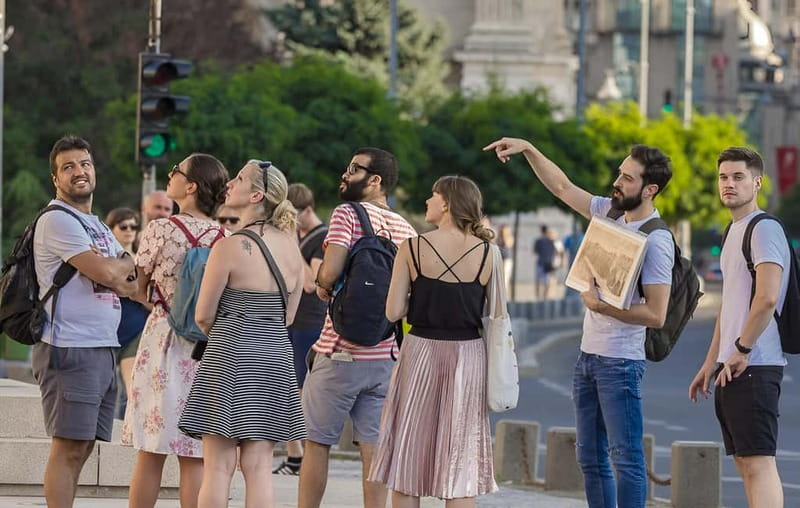
Bucharest can feel confusing at first. Its center mixes royal architecture, Communist blocks, Orthodox churches, elegant commercial buildings, and rougher urban corners. That contrast is part of the city’s appeal, but it is easier to understand with someone explaining what you are seeing.
This tour gives you that framework in 2.5 hours. You do not spend half a day inside one museum. Instead, you move from district to district and see how Bucharest changed under different rulers and political systems.
I especially like the way the route moves backward and forward through time. You begin with the royal and cultural heart of the city, then confront the Communist period at Revolution Square. After that, Calea Victoriei introduces the city’s polished interwar years before the Old Town brings you into medieval stories, merchant houses, inns, and religious architecture.
At $21, the value is strong if you want a broad introduction. A guide can point out details you might miss while walking alone, such as the relationship between the former Communist headquarters and the square where the regime collapsed. You also receive a map of Bucharest, which is useful after the tour when you continue exploring by yourself.
The tradeoff is depth. You will hear many stories, but you will not have time for long interior visits or extended museum stops. Think of this as a well-organized city walk with historical explanation, not a specialist tour of Romanian art, Communist architecture, or Dracula.
More communist-era history walks:
- The Real tour of Communism
★ 5.0 · 666 reviews - Life under Communism
★ 5.0 · 358 reviews - 3-Hour Guided Tour of Communist Bucharest
★ 4.9 · 303 reviews
Starting at the Romanian Athenaeum
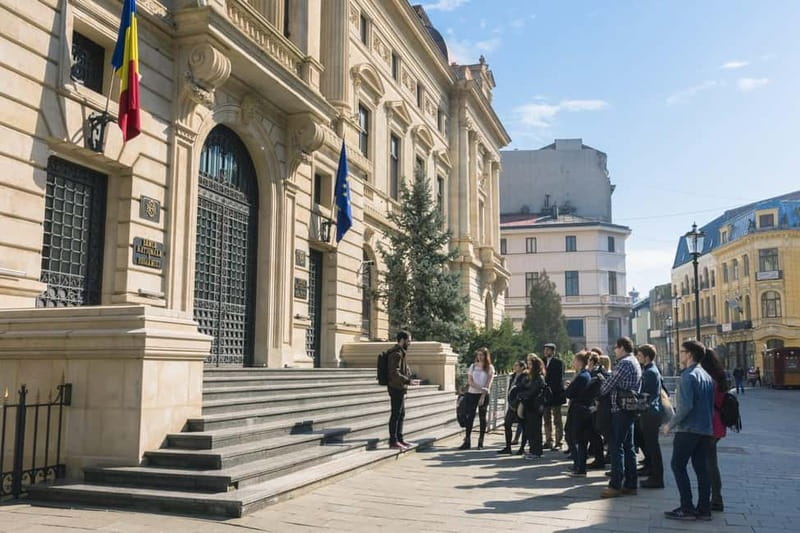
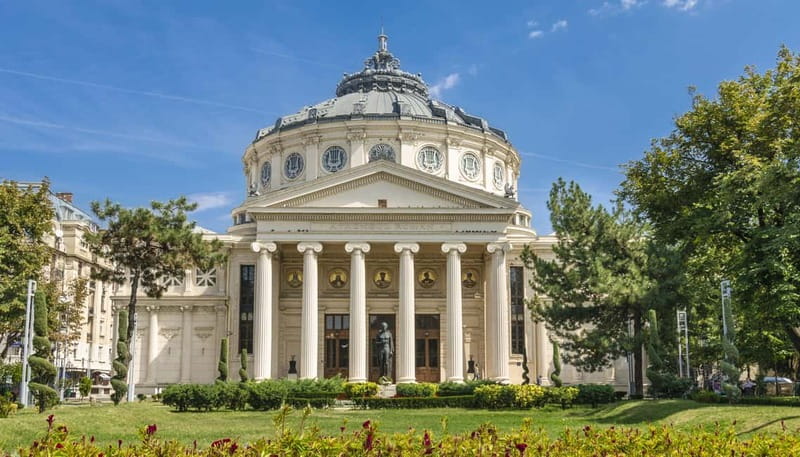
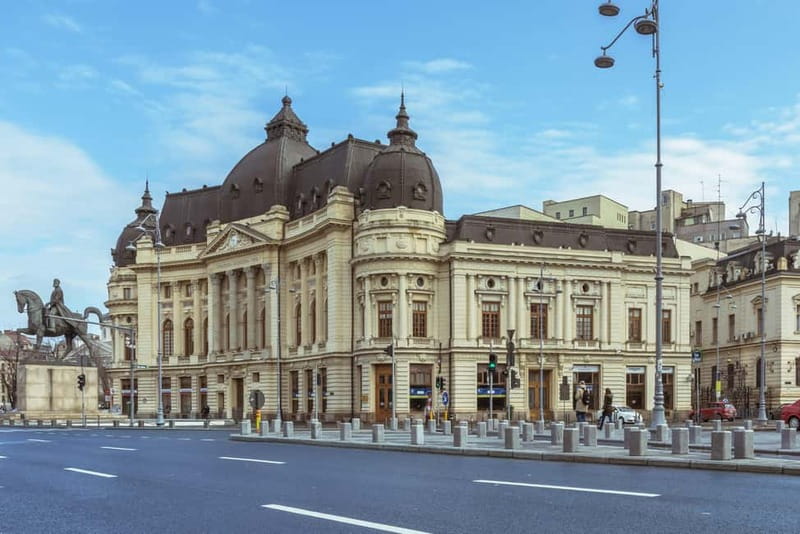
The tour begins in front of the Romanian Athenaeum, with the guide waiting on the steps by the columns and wearing a name tag. This is a practical meeting point in a visually impressive part of central Bucharest.
The Athenaeum is a marvelous neoclassical concert hall. Its presence sets the tone for the first part of the walk, which focuses on the royal period and the city’s French-inspired architecture. Nearby are the former Royal Palace, the University Library, and the Athenee Palace Hotel.
You may already know Bucharest by its nickname, Paris of the East. The opening section helps explain why that label took hold. Grand façades, formal public buildings, and elegant avenues reflect a period when the Romanian capital looked toward Western Europe for style and prestige.
I like beginning here because the setting gives you an immediate visual contrast with the Communist architecture seen later. You are not simply hearing that Bucharest passed through different political eras. You are seeing those eras placed close together.
The first section also brings in kings and the two world wars, told in the shadow of King Carol’s statue. That makes the opening more than an architecture lesson. It connects buildings with the people and conflicts that shaped modern Romania.
Revolution Square and Ceaușescu’s final chapter
The move to Revolution Square changes the mood. The surrounding royal-era structures give way to a site tied directly to Communist power and political control.
Here you hear about the former headquarters of the Communist Party, where major decisions were made from 1950 to 1989. This is the right place to discuss Nicolae Ceaușescu, not as an isolated dictator, but as the central figure in a system that affected daily life across Romania.
The tour explains Communist oppression and the way the regime ended in bloodshed. It also covers Romania’s first revolution broadcast live on television. That television connection is a powerful detail because it shows how quickly events moved from controlled public messaging to a national audience watching history unfold.
I value this section because it gives the tour emotional weight. Bucharest’s beautiful buildings can tempt you to focus only on architecture, but Revolution Square reminds you that the city’s recent past is painful and close. You are not looking at a distant medieval event. You are standing at a place tied to a political system that ended within living memory.
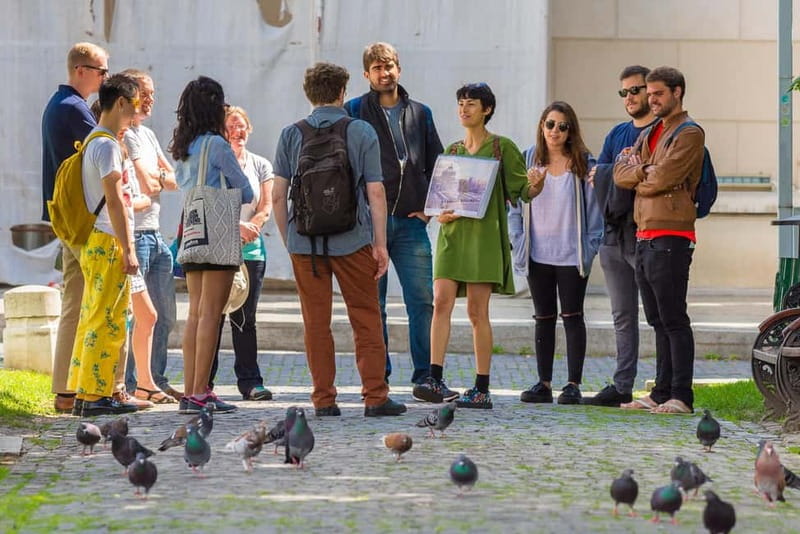
The guide’s storytelling matters here. The information is serious, and a clear explanation helps you connect the location, the dictator, and the wider story of Communist Romania. Laura’s praised approach, friendly but professional, sounds especially suited to this part of the walk.
Calea Victoriei and the city’s Belle Époque face
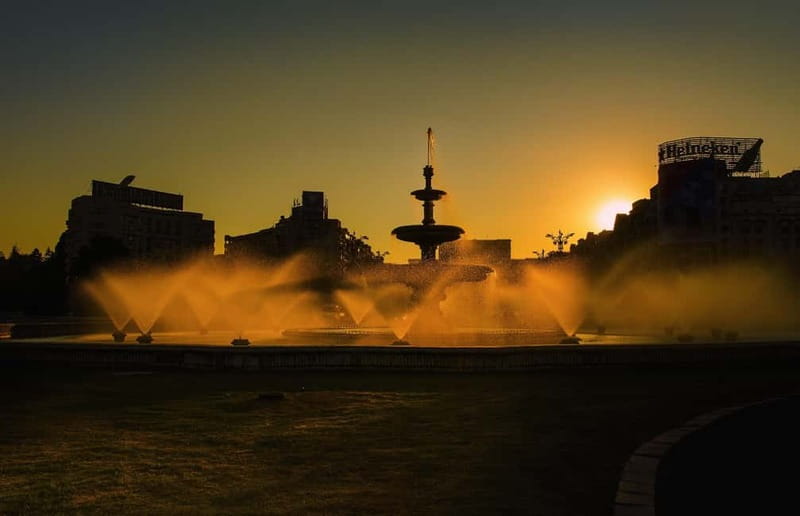
Calea Victoriei is Bucharest’s most famous and extravagant street, and the tour gives it about an hour. That is the longest scheduled section, which makes sense. This avenue gathers many of the city’s most polished buildings and provides a strong look at interwar Bucharest.
You see the Grand Hotel Continental, the Telephone Palace, and the Military Club. These buildings reflect the bourgeois life of the period, when hotels, offices, clubs, and public institutions gave the avenue a cosmopolitan air.
The Telephone Palace is particularly useful for understanding the city’s Art Deco side. It does not belong to the same visual language as the neoclassical Athenaeum, and that difference helps you read the street as a record of changing taste.
I like this section because it avoids treating Bucharest as a city with one single style. The route shows French-inspired royal buildings, Art Deco design, and later Communist structures without trying to smooth away the contradictions. Bucharest is more interesting when you see the odd joins.
You should expect a guided walk rather than a series of lengthy building entries. The value is in the connections: how the avenue developed, who used it, and how the architecture reflects the city’s ambitions. If your main goal is interior access, this tour may feel limited. If you want to understand the street while seeing its key façades, the hour is well spent.
More old town wanders:
- Bucharest: Dracula’s Castle, Peles Castle, & Brasov Old Town
★ 4.5 · 17,858 reviews - Bucharest: Dracula Castle, Peles Castle & Brasov Old Town
★ 4.6 · 10,891 reviews - Bucharest: Peles Castle, Bran Castle, & Brasov Old Town Tour
★ 4.5 · 1,035 reviews - Bucharest Pub Crawl in the Old Town
★ 5.0 · 462 reviews
Macca-Villacrosse Passage, a compact change of scale
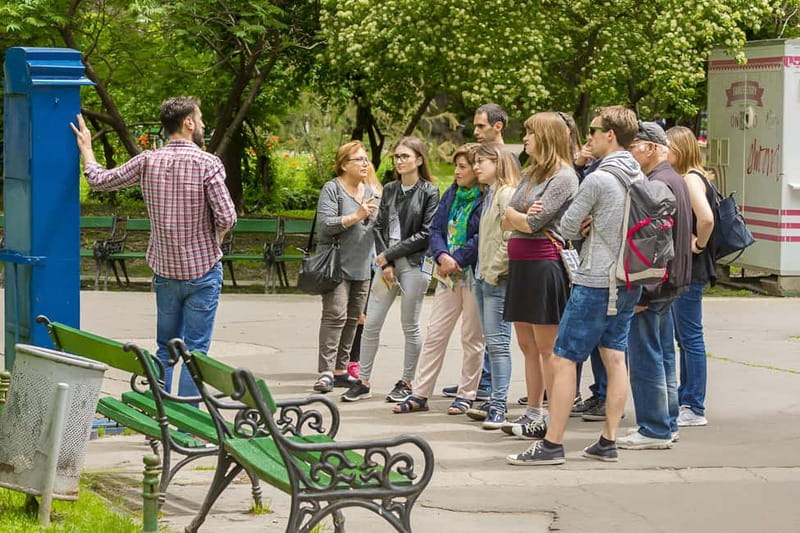
The Macca-Villacrosse Passage receives a shorter visit of about 15 minutes. After the broad avenue and formal buildings of Calea Victoriei, this intimate passage changes the scale of the walk.
Its covered setting and merchant-era character fit the Old Town’s mix of small commercial buildings, narrow routes, and hidden corners. The stop is brief, but it gives you a useful pause before the tour moves deeper into the historic quarter.
I would not expect a long architectural study here. The passage works best as a quick visual stop and a reminder that Bucharest’s center was shaped not only by kings and major institutions, but also by merchants and everyday commerce.
Old Town streets, inns, and merchant houses
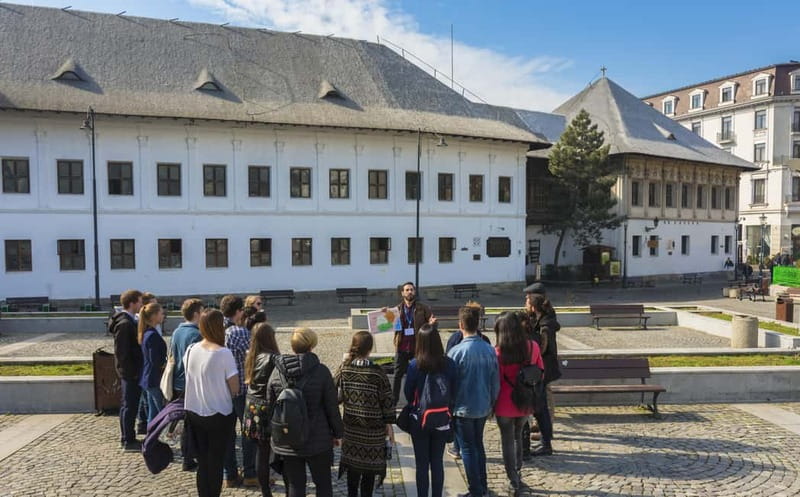
The Old Town is where the walking becomes more tactile. Cobblestone streets replace the grand avenue, and the buildings feel closer together. The route brings in medieval Oriental inns, small 19th-century merchant houses, and imposing palaces.
This mixture is one of the tour’s strongest features. You get a sense of Bucharest as a trading city, not just a capital decorated with official buildings. The old inns point toward the city’s role as a meeting place between different commercial and cultural worlds.
The Old Town is also where good footwear becomes essential. You should be ready for uneven cobblestones and steady walking. The route is wheelchair accessible, but the surface may still be less comfortable than the smoother streets near the Athenaeum and Calea Victoriei.
The walking route includes several essential sights. The History Museum provides a useful link to Romania’s wider past. The CEC Palace brings you back to grand civic architecture. Manuc’s Inn connects the Old Town with the old commercial life of the city.
The route does not include food or drinks, so plan accordingly. You may find cafés and places to eat in the central area, but refreshments are your responsibility. Since the tour lasts 2.5 hours, a drink before or after the walk may be enough for many people.
Stavropoleos Church, a quiet stop in the center
Stavropoleos Church receives about 30 minutes, giving it more time than the passage or Manuc’s Inn. That extra time is welcome.
This active monastery is described as a colorful building and a calm corner in central Bucharest. Its religious setting provides a strong contrast with Revolution Square and the grand commercial buildings of Calea Victoriei.
I like the placement of this stop. After hearing about royal power, Communist control, and commercial ambition, you reach a place associated with worship and quiet. It helps show that Bucharest’s identity is not only political or architectural.
Because it is an active monastery, respectful behavior is important. The supplied information does not promise a particular interior program or religious service, so you should treat the visit as a guided stop rather than assume a long private viewing.
Manuc’s Inn and the end of the walk
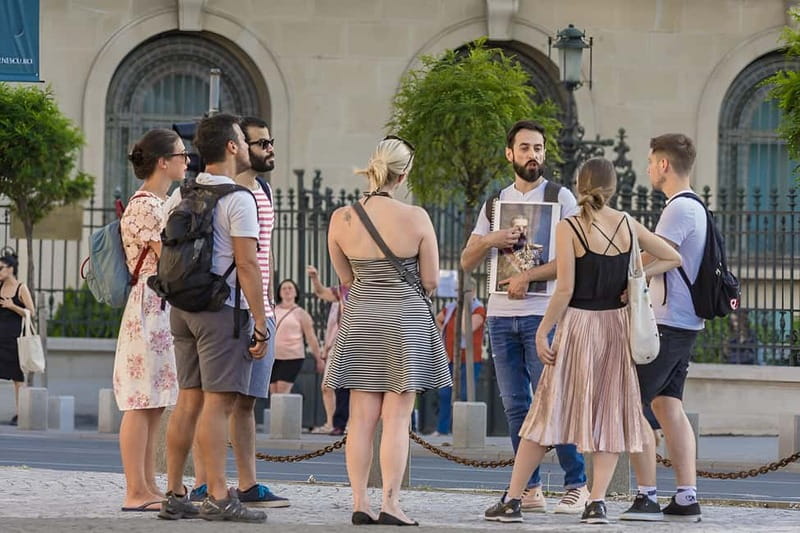
Manuc’s Inn is both a historical sight and a planned photo stop. It brings together the Old Town’s themes of trade, travel, and old Bucharest.
The inn is a fitting place to finish because it leaves you in a part of the center where you can continue walking on your own. The listed route ends at Manuc’s Inn. The tour description also refers to finishing near the fountains in Unirii Square, so confirm the exact final point with the guide at the beginning, especially if you have a restaurant booking or a timed departure afterward.
That small point is worth checking because the route otherwise has a clear shape, from the Athenaeum through Revolution Square and Calea Victoriei into the Old Town. Knowing where you will be released helps you plan your next stop.
Guide style, languages, and practical comfort
The tour includes a professional local guide in English or Spanish. A local guide is particularly useful for Bucharest because much of the story depends on political context and changing names, not just what appears on a building façade.
The strongest praise attached to the experience goes to Laura. Her combination of professionalism, kindness, and detailed Romanian history gives you a good idea of the intended tone. The high rating of 4.9 from 15 reviews also points to a consistently positive response, though the sample is small.
The tour is wheelchair accessible, but accessibility does not remove every practical issue. The Old Town’s cobblestones can be demanding, and the route is on foot. Wear comfortable shoes, carry water if you like, and bring an umbrella or rain jacket because the walk operates in all weather.
There is no hotel pickup or drop-off. You need to reach the Romanian Athenaeum independently and meet the guide at the columns on the steps. The map included after the tour adds value because it can help you retrace the central sights or plan further walks.
The activity lasts 2.5 hours, with starting times available when you check the date. That length suits a first morning or afternoon in Bucharest. It is long enough to give you context, but short enough to leave room for a museum, meal, or independent exploration.
Who should book this $21 walking tour?
I would recommend this tour to first-time visitors who want a strong introduction to central Bucharest without committing to a full-day program. It also suits anyone interested in the connection between architecture and politics, since the route moves from royal buildings to Communist power and then into the older commercial quarter.
History-minded visitors will get the most from it. The tour covers Dracula’s influence on Bucharest, kings, world wars, interwar society, Communist oppression, and the 1989 revolution. That is a lot of ground, but the walk gives each era a real location.
It is also a good choice if you prefer a human guide to a self-guided map. You receive the map, but the explanations are the main reason to book.
I would be more cautious if you dislike walking on cobblestones, need long periods of rest, or want extensive interior visits. Food is not included, and the route may feel brisk for anyone hoping to linger at every building.
Should you book it?
Book this tour if you want Bucharest’s main central stories in one affordable walk. The combination of the Athenaeum, Revolution Square, Calea Victoriei, Stavropoleos Church, and Manuc’s Inn gives you a useful first picture of the city, while the Communist history adds substance beyond the usual sightseeing route.
At $21, the price is reasonable for 2.5 hours with a local guide and a Bucharest map. Wear comfortable shoes, prepare for rain or sun, and confirm the final meeting point if your schedule is tight. For a first look at Bucharest, this is a practical and historically focused choice.
FAQ
Where does the Bucharest walking tour start?
The tour starts in front of the columns on the steps of the Romanian Athenaeum. The guide will wear a name tag with their name.
Where does the tour finish?
The listed route finishes at Manuc’s Inn. The tour description also mentions finishing near the fountains in Unirii Square, so confirm the exact endpoint with the guide at the start.
How long does the tour last?
The tour lasts 2.5 hours.
What languages are available?
The live guide is available in English or Spanish.
Is the tour wheelchair accessible?
Yes, the activity is listed as wheelchair accessible. The Old Town includes cobblestone streets, which may affect comfort.
What should I bring?
Bring comfortable shoes. The tour is a walking experience and takes place rain or shine.
Are food and drinks included?
No. Food and drinks are not included in the tour price.
Can I cancel for a full refund?
Yes. You can cancel up to 24 hours in advance for a full refund. You can also reserve now and pay later.
Just added around Bucharest
- 4-Day Inside Transylvania & Transfagarasan Tour from Bucharest★ 5.0 · 3 reviews
- 10 hours Private Apiary Tour in Romania – From Bucharest★ 5.0 · 3 reviews
- Bucharest: Charm of the Belle Époque Private Tour★ 5.0 · 3 reviews
- Bran & Peles Castles through the Best Road in the World: Transfagarasan road★ 4.5 · 3 reviews
- 2-Day Small-Group Tour in Transylvania from Bucharest – Maximum 5 Persons★ 5.0 · 3 reviews
- Private Wine Tasting at Bucharest’s First Wine Bar★ 5.0 · 3 reviews
- Bucharest to Brasov – Fast Private Transfer★ 5.0 · 3 reviews
- Probably the Best Restaurant and Wine Cellar near Bucharest★ 4.5 · 3 reviews
Communist History Tours, compared.




Bucharest Essential Tour: Old Town, Calea Victoriei & Communism
Read our review →
Communism in Bucharest – Landmarks, Museum & Communist Appetizers
Read our review →


Browse the lists this tour appears in