
Reviewed · MARAMURES TOURS
3 Day Tour of Maramures
Maramures keeps its old ways in plain sight. This three-day private tour pairs famous sights with visits to working villages, family workshops, and local homes, so you see more than polished monuments. I especially like the time spent with craftspeople in Botiza and Sacel, and the chance to meet villagers through a trusted local guide such as Teo. The main drawback is the long road time from Cluj-Napoca, with a fairly full schedule and only two nights away.
I also like the range of the program. You get the Merry Cemetery, wooden monasteries, Holocaust and communist history, traditional farming, wool weaving, pottery, and water-powered machinery. The price of $763.34 per person is not cheap, but private transport, a professional guide, two nights in three-star lodging, breakfasts, and entrance fees are included. You still pay for meals, drinks, insurance, tips, and personal purchases.
In This Review
- Five reasons this Maramures tour deserves your attention
- Why Maramures feels different from a standard Romania tour
- Day one: painted crosses and difficult memory
- Day two: wooden monasteries and living craft
- Day three: Breb, Sarbi, and a final oddity in Budesti
- The guide is central to the experience
- What the $763.34 price really covers
- Practical details that affect your choice
- Who should book this three-day trip
- Should you book the Maramures tour?
- FAQ
- Where does the tour start?
- What time does the tour begin?
- Where does the tour end?
- How long is the tour?
- Is this a private tour?
- Is the tour offered in English?
- What accommodation is included?
- Are meals included?
- What is included in the price?
Five reasons this Maramures tour deserves your attention
- Merry Cemetery in Sapanta: Painted wooden crosses turn local memory into colorful folk art, with verses that praise, tease, and remember the dead.
- Real village encounters: Botiza, Sacel, Breb, and Sarbi bring you close to craftspeople, farmers, poets, and families at work.
- Strong historical range: The former prison at Sighet and the Elie Wiesel Memorial House add serious depth to the rural scenery.
- Wooden architecture: Barsana Monastery and Sapanta-Peri Monastery show two very different sides of Maramures woodcraft.
- A private three-day format: Your own group travels by private transport with an English-speaking local guide, rather than following a large coach tour.
- Useful inclusions: Accommodation, breakfasts, transport, taxes, and admission fees are covered, which makes the total cost easier to judge.
Why Maramures feels different from a standard Romania tour
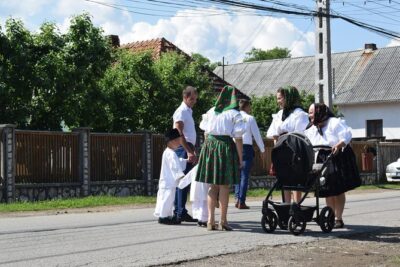
Maramures is not simply a collection of scenic churches and pretty villages. The appeal comes from the way traditional work remains part of ordinary life. A rug weaver is still making rugs. A potter is still shaping unglazed vessels. Water-powered machinery still serves a village community.
That makes this tour a good match for you if you want direct contact with local culture instead of a fast parade of viewpoints. The guide matters greatly here. English opens the door, but translation and local trust help you understand what you are seeing and allow conversations in private homes and workshops.
The program also gives you a useful balance. The first day deals with memory, death, religion, communism, and the Holocaust. The next two days shift toward craft, farming, village customs, and community life. It is a serious trip, but not a gloomy one.
You should expect a moderate level of physical fitness. The schedule includes walking through cemeteries, monasteries, museums, villages, and workshop areas. Exact road times are not provided, but Cluj-Napoca is the starting and ending point, while Maramures is spread across northern Romania. You will spend a meaningful amount of time in the vehicle.
More Maramures trips:
- Maramures best, full day tour from Cluj
★ 5.0 · 33 reviews - From Cluj-Napoca: Maramures Day Tour
★ 5.0 · 19 reviews - Two days tour to Maramures: local experiences and culture
★ 5.0 · 9 reviews
Day one: painted crosses and difficult memory
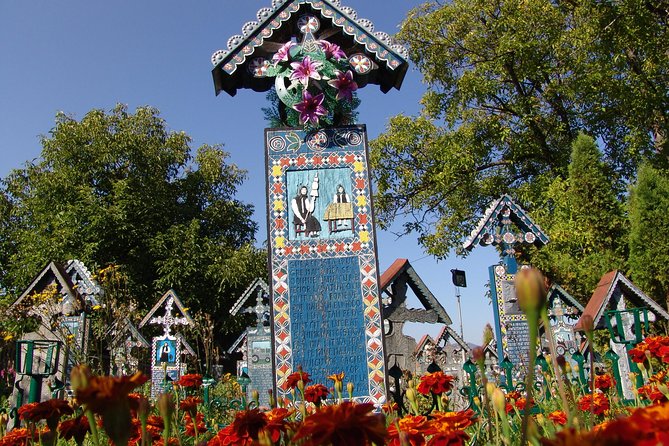
The first stop is the Merry Cemetery in Sapanta, with about 90 minutes to look around. This is not a quiet cemetery in the usual sense. Its carved wooden crosses use bright paint, especially the distinctive blue associated with Sapanta, and each cross carries an image and a verse about the person buried there.
Some epitaphs celebrate a person’s good qualities. Others admit to faults or poke gentle fun at village life. Taken together, the crosses form a record of the community, told in short poems rather than formal plaques.
I would not rush this stop. At first, the color catches your eye. Then the words become the main attraction. If you do not read Romanian, ask your guide to explain the meaning of selected epitaphs. Without that help, you may see the artwork but miss much of the humor and personality.
Next comes Sapanta-Peri Monastery, with 30 minutes included. Its wooden church reaches 75 meters and is described as the tallest wooden church in the world. The short visit makes sense as a contrast with the cemetery. You get the architecture, the setting, and time for photographs, but not a long religious or architectural study.
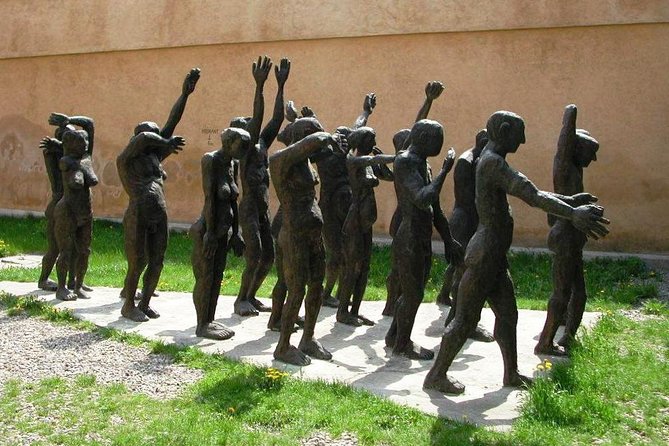
The day then turns sharply serious at the Memorial of the Victims of Communism and of the Resistance in Sighet. The museum occupies a former prison, with cells used as exhibition rooms. For 90 minutes, you follow Romania’s recent past from 1945 through the fall of the Berlin Wall in 1989.
This is likely to be the most emotionally demanding stop. The museum examines political repression, totalitarian rule, and the way communism shaped Romanian life. It is also one of the places where a local guide can add useful context, though you should allow the exhibits to speak for themselves.
The final stop is the Elie Wiesel Memorial House, which takes about 30 minutes. Wiesel was born in Sighet and later won the Nobel Peace Prize and wrote Night. The house now presents the Jewish culture of Maramures, with much of the display focused on the Holocaust.
The visit can also include the Sephardic Synagogue, the Jewish Cemetery, and the Holocaust Monument. The supplied schedule gives 30 minutes for the main stop, so ask your guide how much of the additional material can fit. This day offers a valuable warning: Maramures is not only a story of preserved village traditions. It is also a place marked by persecution, war, and the destruction of Jewish life.
Day two: wooden monasteries and living craft
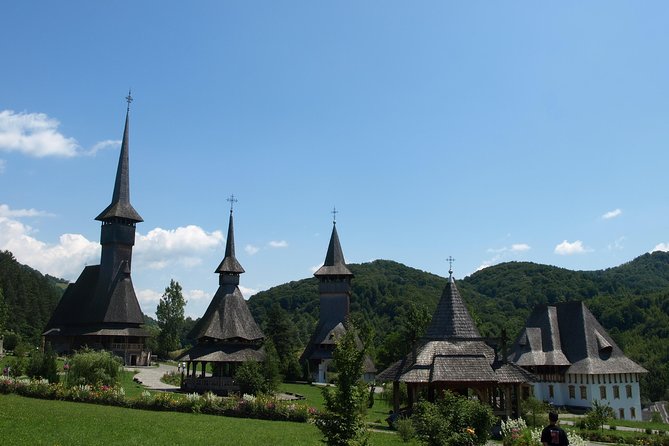
Barsana Monastery begins the second day with 90 minutes. It is presented as the most impressive monastery complex in Northern Transylvania, built almost entirely from wood and surrounded by flowers and attractive scenery.
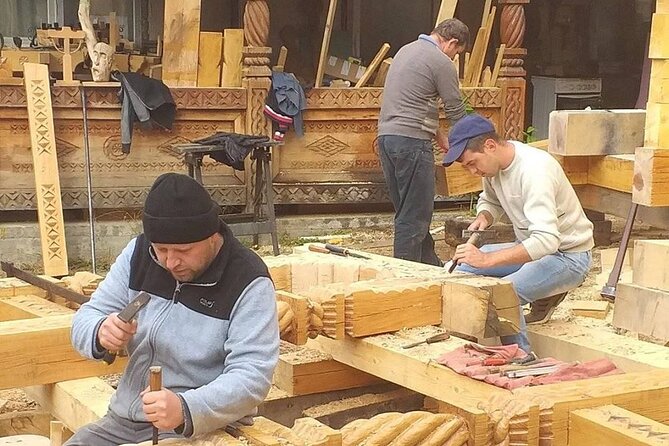
The scale of the complex gives you more to see than a single church. Look at the woodwork, proportions, and relationship between the buildings. In the same village, you visit the largest wood-carving workshop. That pairing is useful: first you see finished religious architecture, then you see the kind of handwork that keeps the local tradition alive.
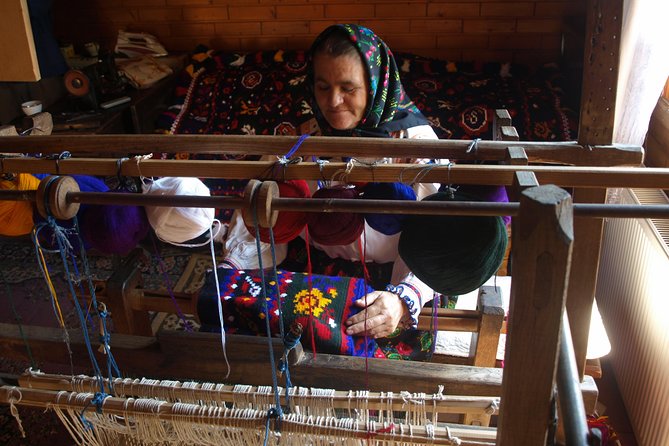
Botiza changes the pace. You spend about an hour with a woman who weaves wool rugs using plant-based dyes and old motifs. This wall-carpet craft was added to UNESCO’s Representative List of the Intangible Cultural Heritage of Humanity in 2016.
The important point is not just that the rugs are attractive. You see a process, a material, and a set of patterns passed through generations. The visit also includes people working in the fields and a mineral spring. These details help you see Botiza as a functioning community rather than a staged folk display.
The stop in Sacel lasts about 90 minutes and brings several personal stories together. You visit the only ceramist there who still makes Dacian-style unglazed pottery. If available, you may also meet someone who makes wool and sheepskin ritual masks, a wood carver, and a woman living in a 100-year-old wooden house.
Because these meetings depend on availability, the exact experience can vary. That is not necessarily a weakness. It means the tour is connected to real people and working schedules, not just fixed museum hours. Still, you should keep your expectations flexible. A private tour can arrange access, but it cannot guarantee that every craftsperson will be free on the day.
Day two is probably the strongest match for you if you care about traditional skills. You are not just looking at objects behind glass. You are seeing how wool, wood, clay, and local knowledge fit into village life.
Day three: Breb, Sarbi, and a final oddity in Budesti
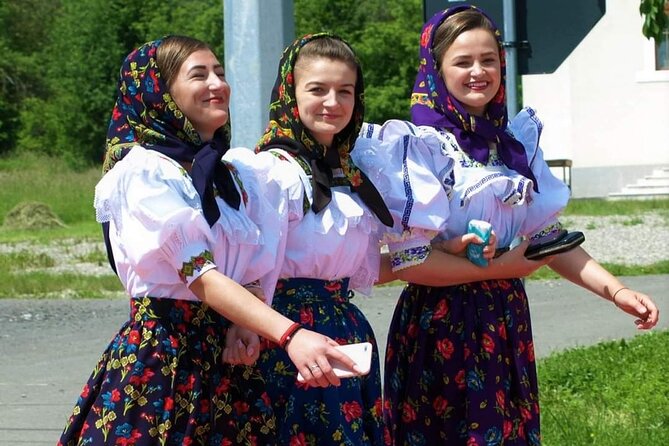
Breb is the first stop on day three, with roughly 70 minutes. You meet local people, including the village poet, and visit a crafts workshop. The stop is short, so I would treat it as a personal introduction rather than a full village study.
The charm here comes from conversation and character. Meeting a poet gives you a different view of village identity, while the workshop keeps the visit grounded in practical work. Your guide’s translation skills can make a major difference, especially when a conversation moves beyond basic greetings.
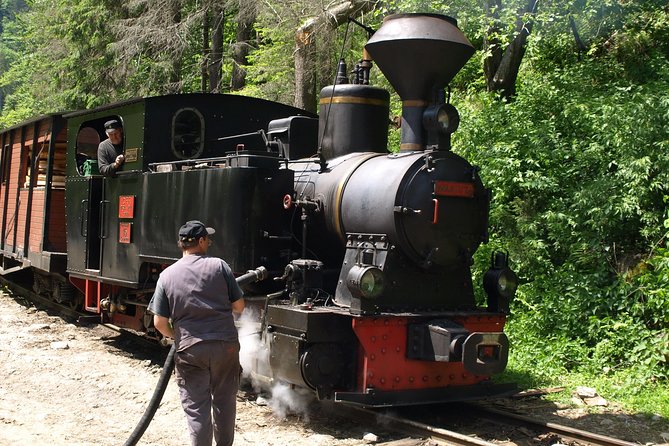
Sarbi provides one of the most unusual stops of the entire tour. You see farm machines powered by water and still used for community needs: a fulling mill, a carding mill, a whirlpool, and an alcohol distillery.
This is the kind of place that can be easy to miss if you travel alone. The machines show how local communities used water, shared equipment, and solved practical problems before modern systems replaced many of these methods. The one-hour visit is enough for an introduction, though anyone interested in rural technology may wish for more time.
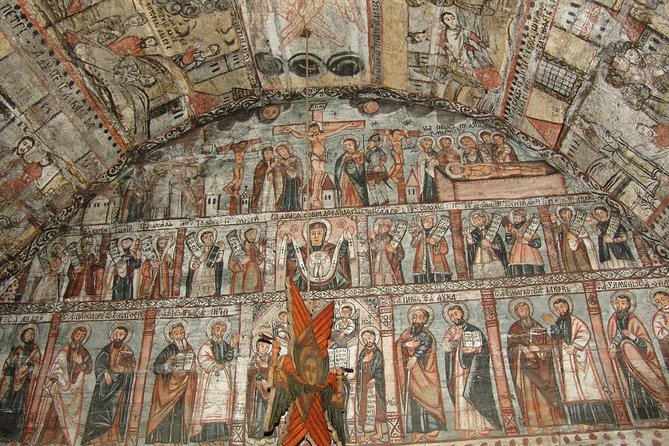
The final stop is Budesti. You see what the program calls Romania’s most unusual optical illusion, along with a fine medieval wooden church. The precise nature of the illusion is not explained in the tour details, so consider it a small surprise rather than the main reason to book.
After Budesti, you return to Cluj-Napoca and finish at the original meeting point. Since the tour starts at 9:30 a.m. from Piața Unirii 15 and ends back there, you should avoid booking a tight onward connection on the final evening. A return time is not specified, and road conditions or time spent with local people can affect the schedule.
A few more trips worth weighing up before you book
- 3-Day Medieval Transylvania Package Tour
★ 4.7 · 31 reviews - 3-Day Explore Transylvania from Bucharest
★ 5.0 · 17 reviews - 3-Day Tour of Transylvania’s Landmarks from Bucharest
★ 5.0 · 16 reviews - 3-Day Private Tour of Medieval Transylvania from Bucharest
★ 5.0 · 15 reviews
The guide is central to the experience
A private tour gives you more than a smaller vehicle. It lets your group spend time where the conversation is useful and move on when a stop has given you enough. The local guide is also the bridge between you and the residents you meet.
Teo is specifically praised for his role as a native guide, translator, and trusted connection to local people. The value here is practical. You may be welcomed into homes and workshops, but without help with language and local customs, those encounters could remain brief and awkward.
A guide can also explain the difference between a site built for visitors and a place that still serves its community. That distinction matters at Sarbi, Botiza, Sacel, and Breb. The strongest part of the tour is not merely seeing traditional objects. It is understanding who makes them, why they still matter, and how village life continues around them.
Because this is a private activity, only your group participates. That suits you if you want a quieter pace, have particular interests in craft or history, or prefer asking questions without holding up a busload of people. It also means the cost is higher than a basic shared excursion.
What the $763.34 price really covers
At $763.34 per person, this is a substantial purchase. Its value depends on how much you want included and how much you value private access.
The price covers private transportation, all fees and taxes, two nights of three-star accommodation, a professional local guide, two breakfasts, and admission tickets for the listed paid attractions. You are paying for three days of transport across a broad area, not simply for entry to the Merry Cemetery and museums.
You must budget separately for lunches, dinners, drinks, snacks, travel insurance, tips, souvenirs, and other personal expenses. The meals are not included beyond breakfast, so the final cost will be higher than the advertised amount.
For you, the tour makes better financial sense if you would otherwise need to arrange a car, lodging, a driver, museum admissions, and local introductions separately. It makes less sense if you only want the famous cemetery and monasteries, since those can be approached through a shorter visit.
The group-discount option may help if you are booking with several people. Since it is a private tour, ask for the exact group pricing before you commit. The available information confirms group discounts but does not give the reduced rates.
Practical details that affect your choice
The meeting point is Piața Unirii 15 in Cluj-Napoca, with a 9:30 a.m. start. The tour is offered in English and uses mobile tickets. Booking confirmation normally arrives at once, unless you book within two days of departure. In that case, confirmation may take up to 48 hours and depends on availability.
You can cancel for a full refund if you do so at least three full days before the start time. Cancellations or changes made later are not accepted for a refund. The cut-off follows local time, so check the clock carefully if you are booking from another country.
Pack for varied visits. You will move between outdoor sites, museums, monasteries, workshops, and village homes. Comfortable shoes are sensible because moderate fitness is required, though no specific accessibility details are provided.
The schedule is full but not frantic on paper. Most individual stops last 30 to 90 minutes. The real question is the driving. Since the tour begins and ends in Cluj-Napoca and covers several Maramures communities, you should be comfortable with substantial time on the road.
Who should book this three-day trip
I would recommend it most strongly to you if you value:
- Personal contact with local people
- Rural crafts and working traditions
- Wooden churches and religious architecture
- Romania’s communist and Holocaust history
- A private guide rather than a large group
- A structured trip with transport and lodging arranged
It is less suitable if you want a relaxed hotel holiday, a food-centered tour, nightlife, or a short sightseeing loop. The schedule has emotional weight as well as cultural interest. The Sighet prison museum and Holocaust displays are important, but they are not light stops between photo opportunities.
Families with older children may appreciate the variety, especially if they can handle museum visits and vehicle time. Art, history, architecture, and folk-craft enthusiasts will find the best value here. You should also be ready to accept some uncertainty around personal meetings in Sacel and other villages, since people may be unavailable.
Should you book the Maramures tour?
Book it if you want to meet the people behind Romania’s traditional village culture. The greatest strength is the combination of private transport and local access, especially with a guide such as Teo who can translate and build trust. The tour gives you famous sights, but its best moments are likely to come from ordinary work: weaving, pottery, carving, farming, and water-powered machinery.
Think twice if you dislike long road journeys or prefer to control every hour of a trip. At $763.34 per person before most meals and personal costs, this is not a budget outing. For the right visitor, though, it offers something difficult to arrange alone: a connected view of Maramures, from painted cemetery crosses and painful twentieth-century memory to homes, workshops, and living village customs.
FAQ
Where does the tour start?
It starts at Piața Unirii 15, Cluj-Napoca 400394, Romania.
What time does the tour begin?
The stated start time is 9:30 a.m.
Where does the tour end?
The activity ends back at the original meeting point in Cluj-Napoca.
How long is the tour?
The tour lasts approximately three days and includes two nights of accommodation.
Is this a private tour?
Yes. Only your group participates in the activity.
Is the tour offered in English?
Yes. The tour is offered in English.
What accommodation is included?
Two nights of three-star accommodation are included.
Are meals included?
Two breakfasts are included. Lunches, dinners, drinks, and snacks are not included.
What is included in the price?
Private transportation, all fees and taxes, two nights of three-star accommodation, a professional local guide, two breakfasts, and admission fees for the included attractions are covered. Travel insurance, tips, souvenirs, and other personal expenses are not included.
Just added around Cluj Napoca
- Two days tour to Bucovina & UNESCO Painted Monasteries★ 5.0 · 3 reviews
- Cluj – walking city tour★ 5.0 · 3 reviews
- Transylvania’s Trail: Sibiu, Bran Castle, Brasov, Sighisoara★ 4.6 · 3 reviews
- CJ05 – Mysteries of Transylvania: Bran Castle & Sighisoara★ 4.8 · 3 reviews
- Sighisoara, UNESCO & wine tasting (1 day, from Cluj)★ 5.0 · 4 reviews
- CJ01 – Explore Cluj-Napoca: A Vibrant City Tour in English★ 5.0 · 4 reviews
- Sighisoara & wine tasting (from Cluj)★ 5.0 · 4 reviews
- Cluj: Private City Walking Tour★ 4.4 · 4 reviews
Maramures Tours, compared.
Classic Romania Tour – small group in 8 days: Transylvania and Maramures
Read our review →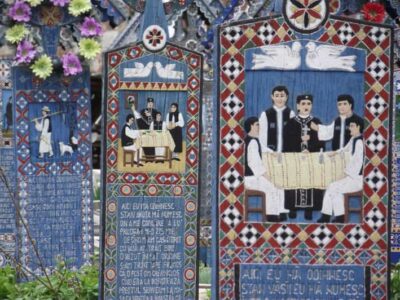
Two days tour to Maramures: local experiences and culture
Read our review →
A Journey Back in Time: Countryside from Transylvania and Maramures – 15 Days
Read our review →
Your rendez-vous with Europe’s past: time-travel to Maramures, Transylvania
Read our review →Browse the lists this tour appears in