
Reviewed · HISTORICAL TOURS
SB02-Half day Surroundings of Sibiu:Saxon Heritage &Villages
Mountain roads meet medieval stonework. This half-day outing links Bâlea Lake and the Transfăgărășan Road with two Saxon fortified churches near Sibiu, giving you a sharp contrast between wild Carpathian scenery and carefully preserved village heritage. I like the route because it covers three very different sides of the region, and I like that an English-speaking guide and driver can explain details you could easily miss on your own. The main concern is the timing: the tour is advertised as four hours, but the published schedule runs from 9:00 AM to 4:00 PM, so you should confirm the actual duration before paying.
You meet at Sala Thalia Hall parking area in Sibiu, ride in an air-conditioned car or van, and travel in a private group. The $88 per-person price is reasonable if you value a dedicated guide, transport, parking, road taxes, and interpretation, but entrance fees, food, drinks, and personal purchases are extra.
In This Review
- Key points to know before booking
- Why this route works so well from Sibiu
- The 9:00 AM departure from Sala Thalia
- The Transfăgărășan Road and Bâlea Lake
- Cisnădie and its fortified church
- Cisnădioara and the hilltop Michelsberg church
- What the guide adds to the day
- Price, inclusions, and the real value
- Timing, season, and practical cautions
- Who should book this Sibiu excursion
- Should you book this tour?
- FAQ
- Where does the tour begin?
- What time does the tour depart?
- What places does the tour visit?
- How long is the tour?
- In which months does it operate?
- Which days are departures available?
- Is transportation included?
- Is a guide included?
- Are entrance fees included?
- What should I bring?
Key points to know before booking
- Bâlea Lake is the scenic centerpiece: You reach a glacial lake high in the Făgăraș Mountains, with time to look around and take photographs.
- The Transfăgărășan is more than a pretty road: DN7C was built as a military route in the 1970s and is now one of Romania’s best-known mountain drives.
- Cisnădie offers working medieval defenses: Its church began as a 12th-century Romanesque basilica and later gained fortifications and a notable mechanical clock.
- Cisnădioara provides the quieter church visit: Its hilltop Romanesque church is older in character, simpler in design, and surrounded by broad views.
- The guide can add real local context: Past tours have been praised for clear English, safe driving, and explanations ranging from history and architecture to rural life and the modern Romanian economy.
- Check the schedule carefully: The listed duration, operating season, and sample timetable do not fully match, so confirmation matters.
Why this route works so well from Sibiu
Sibiu is an excellent base for a short excursion because the city itself has strong Saxon character, while the surrounding county gives you a wider view of Transylvania. This route moves from high mountain scenery to fortified village churches without asking you to organize several separate trips.
I especially like the balance. Bâlea Lake gives you a dramatic natural setting, while Cisnădie and Cisnădioara slow the pace and put local history into physical form. You are not simply looking at pretty villages. You are seeing how medieval communities used churches as places of worship, refuge, and defense.
The experience also benefits from a guide who can connect subjects that may seem unrelated. One praised guide, Ilie, was able to discuss churches, hydroelectric power, Roma life, rural customs, and current economic conditions in a clear and entertaining way. Mihai was also praised for explaining nature protection, Romanian society, monuments, and local heritage in excellent English. Those details suggest that the best part of the outing may be the conversation between stops, not just the stops themselves.
More history-led tours:
- SB11 : A Taste of History & Gastronomical Local Experiences
★ 4.1 · 14 reviews - Bucharest: 3-Hour Dark History Tour with a Local
★ 4.9 · 301 reviews - Bucharest: Small Group History, Art & Secrets Tour
★ 4.7 · 152 reviews
The 9:00 AM departure from Sala Thalia
The meeting point is the parking area at Sala Thalia Hall in Sibiu. Departure is scheduled for 9:00 AM, so you will want to arrive with your ID or passport and be ready for a full day if the stated return time of 4:00 PM is correct.
Transport is by modern air-conditioned car or van. Parking charges and road taxes are included, which removes several small costs that can otherwise complicate a self-drive outing. You also receive a map of Romania, a modest extra but a useful souvenir if you are planning more independent exploring.
The private-group format is appealing if you prefer questions and conversation over a large coach. It can also make the ride more comfortable on a mountain road. The published terms say a minimum of two participants is needed for guaranteed departure. Solo visitors can ask about availability, but a single-person booking is not guaranteed.
The Transfăgărășan Road and Bâlea Lake
The first major section follows the Transfăgărășan Road, also called DN7C. It cuts through the Făgăraș Mountains, the highest mountain range in the Carpathians, and was built in the 1970s under Nicolae Ceaușescu as a strategic military route.
Today, the road is famous for its steep mountain setting, bends, and high views. The road itself is part of the attraction. You are not just using it to get somewhere else. The guide can explain how the route was built and point out features along the way, giving the drive more meaning than a quick photo stop.
The schedule allows about 90 minutes for the Transfăgărășan section, including Bâlea Waterfall and Bâlea Lake. That is enough time for a scenic stop, but not for a long mountain walk or a full day of outdoor activities. Plan to enjoy the setting at a relaxed but limited pace.
Bâlea Waterfall adds a second natural feature before the lake. At Bâlea Lake, you get free time in an alpine setting surrounded by Făgăraș peaks. The lake is glacial, and its position among the mountains gives the stop a very different feel from the villages near Sibiu.
This part of the trip is highly weather-dependent. A visit in clear weather can bring wide mountain views, while cloud, rain, or wintry conditions may reduce visibility and make the stop feel colder and less comfortable. One October outing had wintry conditions, yet the guide adapted well and helped the group notice natural features that would have been easy to overlook. That is a useful reason to value a local guide here: weather can change the experience quickly.
Bring practical layers, even if Sibiu feels warm when you leave. The information does not specify walking distances or facilities at the lake, so comfortable shoes and a jacket are sensible choices rather than guarantees of a particular activity.
Cisnădie and its fortified church
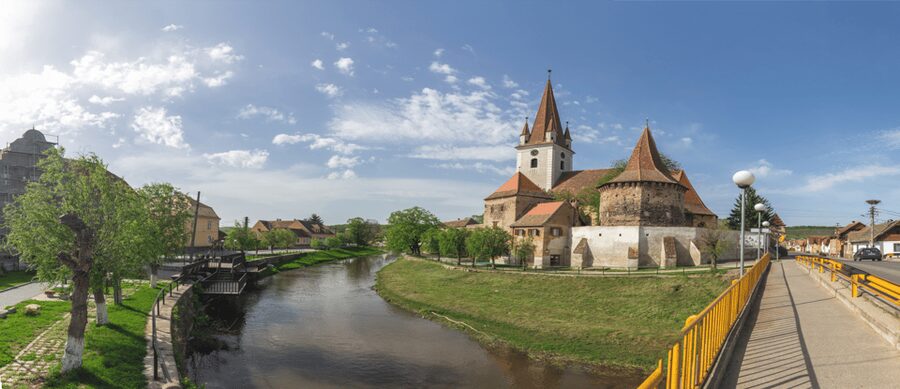
After the mountain section, the route turns toward Cisnădie. The church here began in the 12th century as a Romanesque basilica and was fortified in the 15th century as the community faced the danger of invasion.
That dual purpose is the key to understanding the building. It was a church, but it also formed part of the village’s defensive system. Towers, heavy walls, and fortified features tell you something about everyday life in medieval Transylvania. Religious buildings were not always peaceful refuges. In uncertain times, they could become places where local people protected themselves.
The church is also associated with one of Transylvania’s earliest mechanical clocks, installed in the 14th century. That detail gives the visit a human scale. You are not only looking at masonry and defensive structures. You are also seeing early technology used to regulate community life.
The scheduled visit lasts about an hour, which should give the guide time to explain the church’s origins, later fortifications, and Saxon background. Entrance fees are not included, so ask ahead about the current admission cost and payment method. Photo fees may also apply.
Cisnădie is the more substantial of the two church visits. If medieval architecture interests you, this is likely to be the stop where you want to listen closely rather than rush through photographs.
A few more trips worth weighing up before you book
- Sibiu: Daily Sightseeing Guided Tour
★ 4.7 · 247 reviews - From Sibiu: Day Tour to Brasov and Dracula’s Castle
★ 4.7 · 120 reviews - SB01 – City Tour Sibiu: Exploring the Heart of Transylvania
★ 4.8 · 99 reviews - Sibiu Old Town Exploration Game and Self-Guided Tour
★ 4.5 · 82 reviews
Cisnădioara and the hilltop Michelsberg church
The final cultural stop is Cisnădioara, known in German as Michelsberg. Its fortified church dates to the 12th century and is one of the oldest Romanesque-style churches in Transylvania.
The church is built of stone and retains a plain, sturdy Romanesque form. Compared with more decorated religious buildings, its appeal comes from proportion, age, and setting. The hilltop position gives the church a commanding view of the surrounding area, making the approach part of the experience.
You have about 30 minutes here. That is enough for a short visit and a look at the views, but it is not a long exploration period. If you want extensive photography, a detailed architectural study, or time to wander through the village, you may find this stop rushed.
Cisnădioara also helps explain the cultural importance of the Saxon communities that once lived across this part of Transylvania. The church remains a visible reminder of that settlement pattern and of the way village identity was tied to a central fortified building.
The contrast with Cisnădie is useful. Cisnădie gives you more time and more defensive detail. Cisnădioara offers a simpler church, a hilltop setting, and a quieter sense of age.
What the guide adds to the day
The guide is central to the value of this trip. Without interpretation, the road is scenic and the churches are attractive, but some of their meaning stays locked behind dates and stone walls.
The strongest guide feedback focuses on four qualities: safe driving, clear English, flexibility, and broad local knowledge. Ilie was praised for a relaxed driving style and an easy sense of humor. Mihai was praised for adapting to the group’s needs and discussing subjects well beyond standard monument facts.
That wider view matters. You may hear about environmental protection around the mountain area, the role of hydroelectric facilities, Romanian economic conditions, village life, and the experience of Roma communities. These subjects can turn a sightseeing drive into a better understanding of the region as it is now, not only as it appeared in the medieval period.
Guide names have varied, including Mihai, Ilie, Alex, and Marius. Your actual guide is not guaranteed by the available details, but the repeated praise for English communication and personal attention is encouraging.
Price, inclusions, and the real value
At $88 per person, the trip sits above a basic shared transfer but below the cost of arranging a private car, driver, and specialist guide independently. The price includes transport, an English-speaking guide and driver, parking taxes, road taxes, and a Romania map.
The value is strongest for two or more people who want a private setting and do not want to drive the Transfăgărășan themselves. Mountain roads demand attention, and letting someone else handle the driving means you can watch the scenery and ask questions.
The price does not include entrance fees, food, drinks, photo fees, or souvenirs. You should budget for those separately. No meal is listed, so do not assume lunch is included. One older account describes a local meal during a related outing, but that is not part of the stated inclusions for this experience.
The cost is less attractive if you only want a quick drive to Bâlea Lake. In that case, the church visits may feel like added stops. It is a better purchase if you want the full mix of mountains, Saxon heritage, and guided context.
Timing, season, and practical cautions
The operating period is listed as June through October, with departures on Monday, Wednesday, Friday, and Saturday. However, the supplied schedule creates a clear inconsistency. It describes the experience as four hours, yet gives a 9:00 AM departure, visits from roughly 11:00 AM to 3:30 PM, and a 4:00 PM return.
The driving distances alone make the four-hour label difficult to reconcile with the timetable. Treat the 9:00 AM to 4:00 PM schedule as the more useful planning guide, but confirm this directly before booking. You should also confirm road access to Bâlea Lake, since mountain conditions can affect the route.
The published operating season is also worth checking against availability. Some dated feedback refers to January, February, March, and October outings, including one with winter conditions. That does not prove every winter date is available, so ask the provider rather than relying on old departure patterns.
Cancellation is free up to 24 hours before departure, and you can reserve now and pay later. Smoking is not allowed in the vehicle, and alcohol and drugs are prohibited. The experience is not considered suitable for people over 95, according to the supplied conditions.
Who should book this Sibiu excursion
I would recommend this trip to you if:
- You have limited time in Sibiu but want more than the city center.
- You enjoy scenic drives and medieval architecture in equal measure.
- You prefer a private group to a large bus.
- You want an English-speaking guide who can discuss present-day Romania as well as old buildings.
- You would rather admire the Transfăgărășan than concentrate on driving it.
- You are comfortable with a busy schedule and short visits.
I would hesitate if you want long walks, a leisurely village afternoon, or a guaranteed four-hour outing. The route covers a lot, and that means each stop receives a set amount of time. Bâlea Lake can also be cold or cloudy, and the church entrances cost extra.
Should you book this tour?
Book it if you want a compact but varied introduction to the countryside around Sibiu. The strongest reasons are the Transfăgărășan drive, the glacial setting of Bâlea Lake, and the chance to understand Saxon fortified churches with a guide rather than simply photograph them.
Before booking, ask two direct questions: Is the actual departure-to-return time four hours or 9:00 AM to 4:00 PM, and is Bâlea Lake accessible on your chosen date? If the answer suits your schedule, $88 is fair for private transport, a local English-speaking guide, and a route that combines mountain scenery with serious cultural interest.
FAQ
Where does the tour begin?
It begins at the Sala Thalia Hall parking area in Sibiu.
What time does the tour depart?
The scheduled departure time is 9:00 AM.
What places does the tour visit?
The route includes the Transfăgărășan Road, Bâlea Waterfall, Bâlea Lake, the fortified church in Cisnădie, and the fortified church in Cisnădioara.
How long is the tour?
The experience is advertised as four hours, but the detailed schedule runs from 9:00 AM until about 4:00 PM. Confirm the actual duration before booking.
In which months does it operate?
The stated operating period is June through October.
Which days are departures available?
Departures are listed for Monday, Wednesday, Friday, and Saturday.
Is transportation included?
Yes. Transport is provided in a modern air-conditioned car or van.
Is a guide included?
Yes. An English-speaking guide and driver are included.
Are entrance fees included?
No. Entrance fees are not included, and photo fees may also apply.
What should I bring?
Bring a passport or ID card. You may also want practical clothing for changeable mountain weather.
Just added around Sibiu
- Private Transfagarasan&Balea Lake★ 5.0 · 3 reviews
- From Sibiu: day trip to Dacian Fortress, Hunyadi Castle and Alba Iulia Citadel★ 5.0 · 3 reviews
- SB05 – Carpathian Heights: Hiking to Bâlea Cascada & Lake★ 5.0 · 4 reviews
- Private Walking Tour of Alba Iulia Citadel with Wine Tasting★ 5.0 · 4 reviews
- Explore the Beauty of Sibiu with Full-Suspension E-Bikes!★ 5.0 · 5 reviews
- Transfagarasan, Vidraru and Poenari Fortress Tour from Sibiu★ 4.5 · 5 reviews
- Tour of Sibiu – Church in Cristian – Village of Sibiel★ 5.0 · 7 reviews
- Exclusive tour: Sighisoara, Medias and Biertan tour from Sibiu★ 5.0 · 9 reviews
Historical Tours, compared.

Bucharest Jewish Heritage | Holocaust Memorial | Private Car Tour
Read our review →
Private Bucharest: History & Food with Traditional Meal
Read our review →Historic Gems Sighișoara, Rupea and Viscri Day Tour
Read our review →
Half-Day Jewish Heritage Walking Tour in Bucharest
Read our review →Browse the lists this tour appears in