
Reviewed · CITY TOURS
Walking Tour of Bucharest City Center – Private Tour
Bucharest reveals itself on foot. This three-hour private walk links grand avenues, royal landmarks, communist-era sites, and the lively Old Town, giving you a useful first look at Romania’s capital without wasting time finding your way between sights. I especially like the private format, which lets your guide adjust the pace and focus, and the hotel pickup and drop-off, a real help when you are still getting oriented.
The route also handles Bucharest’s difficult history with care. You move from monarchy to dictatorship to the 1989 anti-communist revolution, then into streets where medieval trade and modern nightlife meet. The main consideration is the price: at $112.29 per person, this makes the most sense for a small group that values personal attention, rather than for someone seeking the cheapest introduction to the city.
In This Review
- Five useful things to know before booking
- Why this three-hour route works well
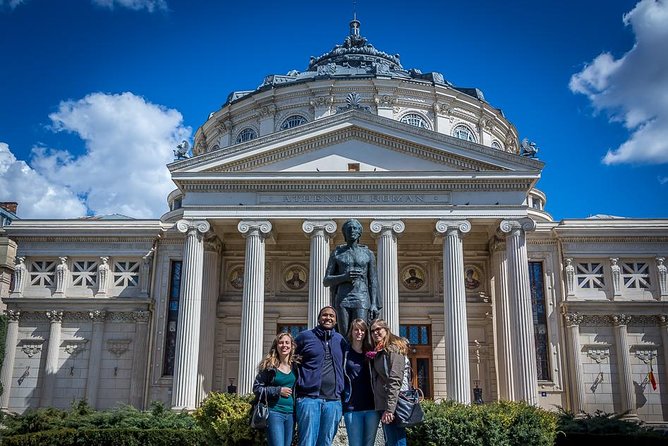
- Inside the Romanian Athenaeum
- Walking Calea Victoriei, Bucharest’s grand avenue
- Revolution Square and the 1989 turning point
- The Royal Palace and Romania’s monarchy
- Old Town: Princely Court, Manuc’s Inn, and Lipscani Street
- The Palace of Parliament and the cost of dictatorship
- Private attention, transfers, and group value
- What is included and what you still need to budget
- Who should book this Bucharest walk?
- Should you book the private Bucharest city-center tour?
- FAQ
- How long does the Bucharest walking tour last?
- Is this a private tour?
- Is hotel pickup and drop-off included?
- Is the tour conducted in English?
- Is admission to the Romanian Athenaeum included?
- Are meals and travel insurance included?
Five useful things to know before booking
- The Athenaeum may include an interior visit, where painted scenes around the Great Hall help explain Romanian history.
- Calea Victoriei is the city’s grand historic artery, lined with the CEC building, Capsa House, the Military Circle, and the Telephone Palace.
- Revolution Square gives the clearest look at communist-era Bucharest, including the place where the 1989 uprising began.
- The Old Town combines several centuries in one walk, from the 16th-century Princely Court to Manuc’s Inn and Lipscani Street.
- The Palace of Parliament is viewed from outside, with the guide explaining its construction and Nicolae Ceausescu’s impact on the city.
- This is a private activity with a licensed English-speaking guide, bottled water, and round-trip hotel transfer included.
Why this three-hour route works well
Bucharest is spread out, and its major sights do not all sit in one tidy historic quarter. A private walking tour solves that problem by giving you a clear sequence: royal culture, grand architecture, revolution history, medieval trade, and communist power.
The three-hour length is efficient rather than leisurely. You will spend about 30 minutes at each of the first four stops, an hour in the Old Town, and another 30 minutes at the Palace of Parliament. That is enough time for context and questions, but not enough for long museum visits or an unhurried meal.
I like this structure for a first day in Bucharest. You get your bearings quickly, then receive practical recommendations from a local guide for the rest of your stay. Since the activity is private, you can ask for more explanation at the sites that interest you most, though the exact pace will depend on your group.
You should expect a moderate amount of walking. The tour is not designed for someone who wants to remain seated or see the city only through a vehicle window. Wear comfortable shoes, carry only what you need, and keep some flexibility in your schedule in case an interior visit takes longer than expected.
More City Tours in Bucharest
- Bucharest: City Highlights Guided Walking Tour
★ 4.9 · 1,482 reviews - Bucharest: 2-Hour City Highlights Bike Tour
★ 4.8 · 269 reviews - Bucharest Tuk Tuk city tour
★ 5.0 · 188 reviews
Inside the Romanian Athenaeum
The Romanian Athenaeum is a fine place to begin. Its rounded facade and formal design make it one of Bucharest’s best-known buildings, and it remains closely linked with the country’s musical life.
The tour allows about 30 minutes here. If access is available, admission to the interior is included. That matters because the inside offers more than a quick photo stop. Your guide can point out the painted scenes around the Great Hall and use them to explain key parts of Romanian history.
The interior visit is not guaranteed, so you should treat it as a valuable possibility rather than the central promise of the tour. If the doors are closed, the exterior still provides a strong introduction to the city’s cultural ambitions and its connection with the Romanian monarchy.
A guide who can explain the artwork is especially useful here. One of the strongest comments about this experience praised the guide’s ability to answer questions about churches and explain the meaning of religious artwork. That suggests this tour is at its best when you ask questions instead of simply following the route from one photo stop to the next.
Walking Calea Victoriei, Bucharest’s grand avenue
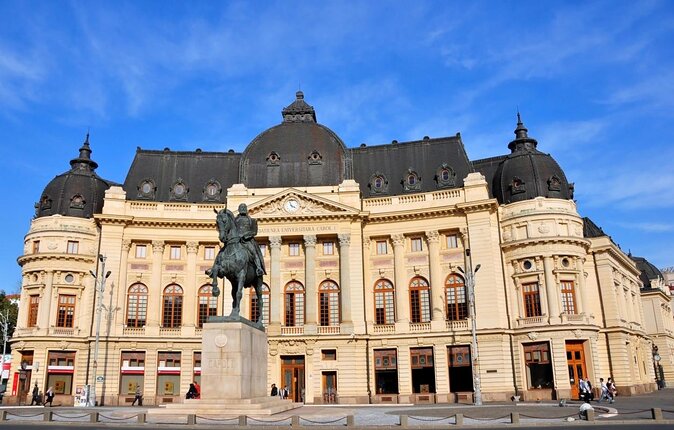
Calea Victoriei, or Victory Avenue, gives you a compact lesson in Bucharest’s changing fortunes. It was the first street in the city to be paved, and wealthy merchants and other prominent residents built impressive houses and public buildings along it.
The 30-minute walk focuses on architecture and urban stories. You will hear about the CEC building, the Palace of the National Military Circle, Capsa House, the Athenaeum, and the Telephone Palace. These buildings represent different periods and purposes, so the route avoids the common problem of looking at grand facades without knowing why they matter.
The mention of small passages linking Calea Victoriei with nearby streets is a nice touch. Bucharest is not only a city of monumental buildings. Its character also appears in the side routes, narrow connections, and less obvious spaces between the major landmarks.
This portion is free, but that does not mean it is filler. It connects the Athenaeum with Revolution Square and gives you a readable picture of how the city center developed. I would pay attention to the guide’s explanations here, since the value comes from seeing the relationship between the buildings rather than simply ticking them off.
Revolution Square and the 1989 turning point
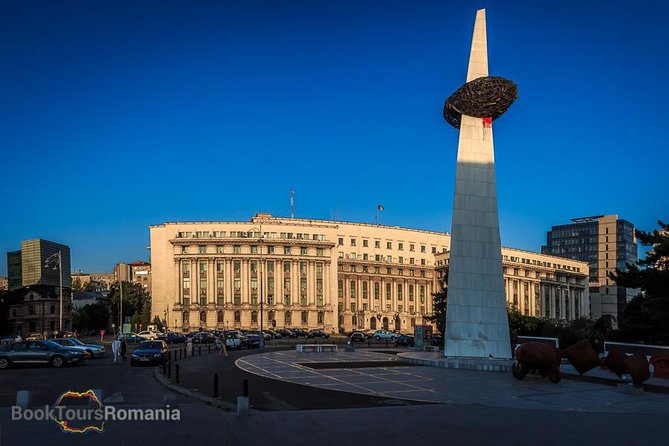
Revolution Square is the emotional center of the route. In December 1989, Romania’s anti-communist revolution began here, and the square remains one of the clearest places to discuss the final days of Nicolae Ceausescu’s rule.
You will spend about 30 minutes learning how communist power shaped Bucharest and how the revolution unfolded. This is not just a stop for architecture. It is where the tour shifts from royal ceremony and public culture to political fear, protest, and change.
The private format is useful at a place like this. You can ask direct questions about daily life under communism, the role of the dictator, and how the city changed after 1989. The experience promises personal explanation from a local who understands the effects of that era on Romanian people, so this should be one of the most valuable sections for anyone interested in modern European history.
The subject can be heavy, and the time is limited. You will not receive a full political history of Romania in half an hour. Instead, expect a focused introduction that gives you enough background to understand the buildings and public spaces you encounter later.
More Walking Tours in Bucharest
- Bucharest Highlights Walking Tour
★ 5.0 · 469 reviews - Bucharest: Ghost Stories & Romanian Mythology Walking Tour
★ 4.9 · 287 reviews - Bucharest: Guided Walking Tour with Romanian Snack
★ 4.9 · 228 reviews - Best of Bucharest | Private Walking Tour
★ 5.0 · 199 reviews
The Royal Palace and Romania’s monarchy
The Royal Palace follows naturally from Revolution Square. Here, the focus turns to the Romanian monarchy and the role it played in shaping modern Romania.
The stop lasts around 30 minutes and is listed as an exterior visit. Your guide will explain how the royal family influenced the country and how political changes altered its future. This makes the palace more than another formal building on Calea Victoriei.
I like the order of these stops. You first learn about royal power, then see how communism replaced it, and finally walk toward the Old Town, where older forms of authority and trade remain visible. Bucharest can otherwise feel like a collection of disconnected buildings. This sequence gives the city a clear story.
Do not expect a long palace tour or access to every interior space. The value here comes from the setting and the explanation. If royal history interests you, ask your guide how the monarchy fits into the wider story of modern Romania.
Old Town: Princely Court, Manuc’s Inn, and Lipscani Street
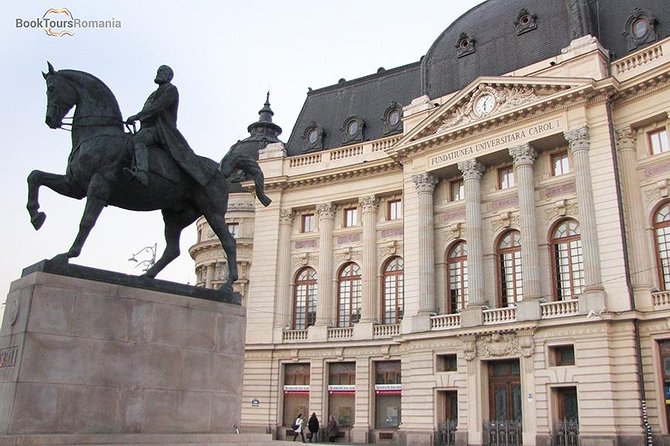
The Old Town receives the longest portion of the tour, about one hour, and rightly so. This is where the route gains its most varied sense of place.
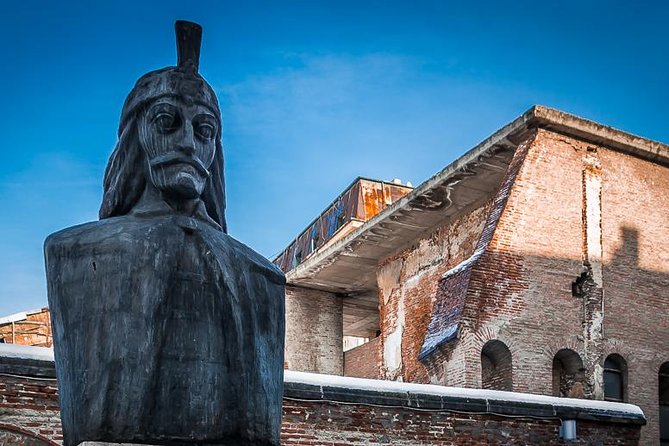
You begin with the Princely Court, parts of which date to the 16th century and remain open for visits. The site is tied to the story of Vlad the Impaler, the ruler commonly connected with the Dracula legend. The tour explains why a statue of Dracula guards the court, giving you a chance to separate historical Vlad from later fictional versions of the character.
Next comes Manuc’s Inn, described as the last caravanserai in southeastern Europe. Its design reflects the old role of inns as places where merchants could stay, trade, and meet. This is an especially useful stop because it connects Bucharest with the wider commercial routes that once crossed the region.
The route then follows Lipscani Street, once one of the city’s most important commercial areas from the Middle Ages through the early 19th century. The district begins near a small square marked by the Capitoline Wolf, the statue of a she-wolf feeding Romulus and Remus.
Lipscani is also where you will see the city’s more social side. Cafes and restaurants fill many of the streets, and Caru cu Bere is included as a stop. It is known as one of the most beautiful restaurants in Bucharest, so your guide can help you appreciate the building even if you do not eat there during the tour.
This hour is likely to be the most enjoyable part if you want atmosphere as well as history. It is also the section where the group’s pace matters most. You will be walking over city streets, pausing at several sites, and listening to stories that range from medieval rulers to modern urban life.
Meals are not included, so plan lunch or dinner separately. If you want to eat at Caru cu Bere, ask the guide about timing rather than assuming the tour includes a meal.
The Palace of Parliament and the cost of dictatorship
The final major stop is the Palace of Parliament, viewed from the outside. It is one of Bucharest’s defining structures and is described here as the heaviest building in the world.
The guide uses the building to explain how communism reshaped Bucharest and Romania. You will hear about its construction, Ceausescu, and the consequences of building such a massive seat of power in the city.
This is an important distinction: the tour does not promise an interior visit to the Palace of Parliament. The 30-minute stop is an outdoor explanation from the building’s footsteps. That can still be worthwhile, since the scale of the structure is difficult to understand from photographs alone.
The guide’s local perspective is central here. A standard audio description might tell you when the building was made and how large it is. This experience aims to explain what its construction meant for ordinary Romanian people and how the communist period affected the city.
For me, that human context is more useful than a list of measurements. Bucharest’s grand buildings can look impressive while hiding the cost of their creation. This stop helps connect the architecture with the political system behind it.
Private attention, transfers, and group value
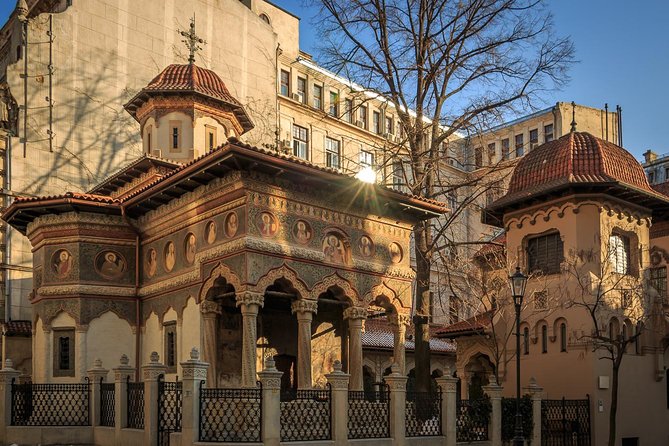
The private setup is the main reason to consider this experience instead of a larger city walk. Only your group participates, and the licensed guide can respond to your questions and adjust the emphasis. If your party wants more time on communist history, royal Romania, churches, or architecture, you have a better chance of getting it.
Hotel pickup and drop-off are included, along with bottled water. This makes the tour easier at the start of a Bucharest visit, especially if you are unfamiliar with the city center. The published meeting information says the activity begins and ends in Bucharest, so you should confirm the pickup details for your accommodation when booking.
The price is $112.29 per person. That is a serious amount for three hours, but the calculation changes with group size. For a couple or small family, you are paying for a private licensed guide, transfers, and a focused route through several major areas. Group discounts may improve the value for a larger party, provided you choose the tour option that matches your group size.
If you are comfortable using public transport or walking independently, a private tour will cost more than creating your own route. If you have only a day or two in Bucharest, the time saved and the ability to ask questions may justify the difference.
What is included and what you still need to budget
The experience includes:
- Hotel pickup and drop-off
- A licensed English-speaking guide
- Bottled water
- Admission to the Romanian Athenaeum interior if it is available
Meals are not included. You also pay any photo or video tax required at a site, and travel insurance is not part of the package.
The tour operates daily from 8:00 a.m. to 4:00 p.m. during the stated 2025 season, from January 1 through December 30. Confirmation is sent within 48 hours of booking, subject to availability, so avoid assuming the reservation is final until you receive confirmation.
Free cancellation is available if you cancel at least 24 hours before the start time. Changes or cancellations made inside that 24-hour window are not accepted for a refund.
Who should book this Bucharest walk?
I would recommend this tour to first-time visitors who want a fast but thoughtful introduction to Bucharest. It suits couples, families, and friends who prefer to keep the group private and ask plenty of questions.
It is also a good choice if communist history is a major reason for your visit. Revolution Square and the Palace of Parliament receive enough attention to give you a useful starting point, while the Royal Palace and the Athenaeum add political and cultural balance.
You may want something else if you prefer long museum visits, a relaxed food tour, or a route built around one neighborhood. The itinerary covers a lot of ground in three hours, and the Palace of Parliament is seen from outside. You should also reconsider if moderate walking is difficult for you.
Should you book the private Bucharest city-center tour?
Book it if you have limited time and want the city’s major themes explained in one well-organized walk. The best reasons are the private guide, the combination of royal, communist, and medieval sites, and the chance to ask detailed questions about art, churches, and Romanian history.
The price is easier to justify for a group, especially with the available group discounts. For a solo visitor, it is a larger investment. Still, hotel transfers and a licensed English-speaking guide add practical value.
I would treat the possible Athenaeum interior visit as a bonus, not a guarantee, and remember that the Palace of Parliament is an exterior stop. If those limits fit your plans, this is a strong first look at Bucharest, with enough historical context to make the rest of your time in the city more rewarding.
FAQ
How long does the Bucharest walking tour last?
The tour lasts approximately three hours.
Is this a private tour?
Yes. Only your group participates in the activity, and you should select the option that matches your group size.
Is hotel pickup and drop-off included?
Yes. Hotel pickup and drop-off are included, and the activity begins and ends in Bucharest.
Is the tour conducted in English?
Yes. The tour includes a licensed English-speaking guide.
Is admission to the Romanian Athenaeum included?
Admission is included if the interior is available to visit. The tour allows about 30 minutes at the Athenaeum.
Are meals and travel insurance included?
No. Meals, travel insurance, and any required photo or video tax are not included.
More Walking Tours
- Walking Tour- Delightful Bucharest (Highlights, Stories, Sights)
★ 5.0 · 145 reviews - 4h Bucharest Private Tour (2h by Car and 2h Walking in Old Town)
★ 5.0 · 90 reviews - Bucharest 3-hours Walking Tour (Small Groups)
★ 5.0 · 85 reviews - Guided Walking Tour of Historical Bucharest
★ 5.0 · 84 reviews
Just added around Bucharest
- 10 hours Private Apiary Tour in Romania – From Bucharest★ 5.0 · 3 reviews
- 4-Day Inside Transylvania & Transfagarasan Tour from Bucharest★ 5.0 · 3 reviews
- Bucharest: Charm of the Belle Époque Private Tour★ 5.0 · 3 reviews
- Bran & Peles Castles through the Best Road in the World: Transfagarasan road★ 4.5 · 3 reviews
- Private Wine Tasting at Bucharest’s First Wine Bar★ 5.0 · 3 reviews
- 2-Day Small-Group Tour in Transylvania from Bucharest – Maximum 5 Persons★ 5.0 · 3 reviews
- Bucharest to Brasov – Fast Private Transfer★ 5.0 · 3 reviews
- Probably the Best Restaurant and Wine Cellar near Bucharest★ 4.5 · 3 reviews
City Tours, compared.


Bucharest Panoramic Sightseeing – Private City Tour
Read our review →
SB01 – City Tour Sibiu: Exploring the Heart of Transylvania
Read our review →
City Tour Sighisoara Legends & Landmarks A Walk Through Time
Read our review →Browse the lists this tour appears in