
Reviewed · CITY TOURS
City Tour Sighisoara Legends & Landmarks A Walk Through Time
Sighișoara rewards slow looking. This two-hour walk makes the medieval citadel easier to understand, pairing colorful burgher houses and old guild towers with the stories behind them. I like the route’s variety, especially the climb through the Covered Staircase to the Church on the Hill, and I like that guides such as Peter, Charles, Carol, and Andrea are praised for answering questions rather than rushing through a script. The main drawback is the uphill walking and uneven streets, so this is not a good choice if stairs or steep paths are difficult.
The $45 price is fair if you want more than pretty photographs. I like that the tour explains Sighișoara’s German heritage, fortifications, cemetery, and Vlad the Impaler’s connection to the town, not just the Dracula legend. You should budget extra for entrance fees and food, though, since neither is included.
In This Review
- Key points to know before you book
- Starting in Piața Muzeului at 11:00
- The citadel market place and Sighișoara’s old streets
- Dracula’s birthplace, with the legend put in context
- The 64-meter Clock Tower
- The Covered Staircase and the climb to School Hill
- The Church on the Hill and the German Cemetery
- Guild towers and the logic of medieval defense
- Venetian House and the House with the Deer Antler
- What the guides do best
- Price, inclusions, and practical value
- Who should take this Sighișoara walk?
- Should you book City Tour Sighișoara?
- FAQ
- Where does the tour begin?
- What time does the tour depart?
- How long does the tour last?
- Is the tour offered every day?
- What language is the tour in?
- Are entrance fees included?
- What should I bring?
- Is the tour suitable for people with mobility impairments?
Key points to know before you book
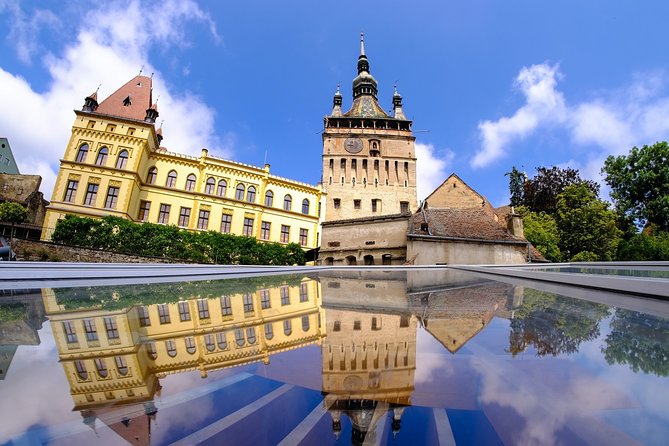
- The Clock Tower anchors the tour: You see Sighișoara’s best-known landmark and learn about its clock mechanism, historical objects, and 64-meter height.
- The Covered Staircase is part of the experience: The 164 wooden steps are memorable, but they make sensible footwear and steady mobility important.
- The guide adds local context: Peter, Charles, Carol, and other guides have been praised for clear English, patience, humor, and strong knowledge of Sighișoara and Romania.
- The tour goes beyond Dracula: Vlad the Impaler’s birthplace is included, but the focus also reaches guilds, churches, architecture, burial customs, and daily life.
- It is best early in your stay: The route gives you a useful map of the citadel before you return to explore museums, towers, and restaurants on your own.
- Expect a walking tour, not a ticketed attraction package: Entrance fees, food, drinks, and souvenir photographs cost extra.
Starting in Piața Muzeului at 11:00
The meeting point is in Piața Muzeului, in front of the Monastery Church, at Piața Muzeului 5. The booking information also lists number 6 as a possible starting or finishing point, so check your confirmation carefully and arrive at the square a little early.
The tour begins at a useful spot in the old citadel. You are not dropped at a remote parking area or asked to find a hotel lobby. From the square, the guide can introduce the town’s medieval center before leading you into its streets and monuments.
The scheduled departure is 11:00, with daily operation listed. That timing works well for a morning visit, although you should confirm the exact date and availability when booking. The tour lasts two hours, and several guides have shown flexibility when guests had questions, train connections, or physical limitations. One guide even adjusted the route so a couple could finish on time and skip the hill climb they had already completed.
That sort of flexibility matters on a short tour. Two hours can feel tight if every stop receives the same treatment, but the guide appears to adapt the emphasis to the group. If you care most about architecture, Vlad Dracul, church history, or Romanian culture, say so at the beginning.
More Sighisoara days out:
- Small Group Tour to Viscri Church Sighisoara Town Rupea Fortress
★ 5.0 · 225 reviews - 2-Day Medieval Transylvania with Brasov,Sibiu and Sighisoara Tour from Bucharest
★ 4.5 · 145 reviews - From Brasov: Sighisoara and Viscri UNESCO Day Tour
★ 4.8 · 86 reviews
The citadel market place and Sighișoara’s old streets
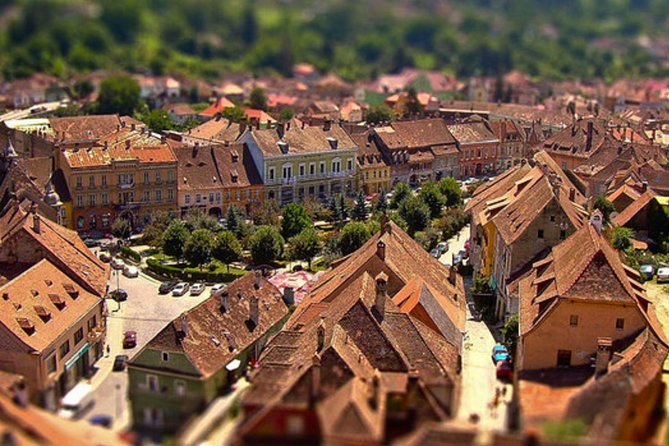
The first part of the walk takes you through the citadel’s market place and surrounding lanes. This is where Sighișoara works its visual charm: colored houses, cobbled streets, narrow passages, and buildings that still suggest the town’s medieval role as a fortified Transylvanian center.
A guide is especially useful here because the facades can blur together when you explore alone. The tour connects houses and public spaces to the people who lived and worked in them. You get a sense of the German-speaking Saxon community, the craft guilds, and the practical reasons the town developed such heavy defenses.
I would not expect a long stop at every building. The value is in seeing the center as a connected place rather than a series of isolated photo spots. You learn how the square, towers, churches, and houses fit together.
The route is also a good introduction to Sighișoara’s scale. The citadel is compact enough to cover on foot, but its slopes and stairways make the walk more demanding than a level city stroll. Wear shoes with a firm grip, and do not bring a large bag. Oversize luggage and large bags are not allowed.
Dracula’s birthplace, with the legend put in context
The House of Vlad Dracul is one of the citadel’s most famous addresses. It is presented as the birthplace of Vlad the Impaler, the historical figure who helped inspire the Dracula character. The building now functions as a restaurant and museum connected with Sighișoara’s past.
This stop is useful because it separates fact from popular fiction. The Dracula connection draws people here, but the town’s actual story is more interesting when you see Vlad as part of medieval Romanian history rather than only as a horror character.
The guide can give the building a proper setting within the town. Several tours have been praised for explaining that there is much more to Vlad’s story than the familiar legend. That is the sort of added context you would miss if you simply photographed the facade and moved on.
Entrance fees are not included, so check whether you want to go inside specific attractions during or after the walk. The tour itself includes guided sightseeing, not admission to every site named along the route.
The 64-meter Clock Tower
The Clock Tower is Sighișoara’s main visual marker and one of the clearest examples of how the town’s defenses also became civic symbols. At 64 meters, it dominates the citadel and gives the town its familiar profile.
The visit covers the tower’s clock mechanism and historical artifacts. If you choose to enter, remember that the admission fee is extra. The attraction is worth considering because it adds an indoor museum element to a route that otherwise takes place on streets and stairways.
The tower also helps you read Sighișoara from above. The advertised view is panoramic, so you can expect a broader sense of the citadel and its position within the surrounding area. The tour may not leave unlimited time for a long museum visit, so ask the guide how the stop fits into the two-hour schedule.
I like having the Clock Tower early in a Sighișoara visit because it gives you a reference point. Later, when you wander on your own, you can orient yourself by the tower instead of repeatedly checking a map.
More walking tours:
- City Tour Sighisoara Legends & Landmarks A Walk Through Time
★ 5.0 · 11 reviews - Bucharest: City Highlights Guided Walking Tour
★ 4.9 · 1,482 reviews - Bucharest Highlights Walking Tour
★ 5.0 · 469 reviews - Free walking tour of Brasov in English
★ 4.9 · 302 reviews
The Covered Staircase and the climb to School Hill
The Covered Staircase is one of the tour’s most distinctive sections. Built in the 17th century, the wooden passage has 164 steps and was designed to protect schoolchildren from difficult weather as they climbed toward the school and church.
The staircase is not just a quaint walkway. Its design shows how the town adapted to daily needs in a hilly setting. The guide can explain why such a covered route mattered, and the structure becomes much more memorable once you understand its purpose.
The climb takes effort. If you have limited mobility, this tour is specifically not considered suitable. Even for fit walkers, the stairs can be tiring, especially in warm weather or when the wooden surfaces are damp. Take your time and tell the guide if you need a pause.
At the top, School Hill leads to the Church on the Hill. One practical point is that the route is not merely a quick loop around the lower citadel. It asks you to climb, and that climb is central to the experience.
The Church on the Hill and the German Cemetery
The Church on the Hill is the tour’s most atmospheric stop. It is a Gothic church with medieval frescoes and a notable interior, giving you a chance to see a quieter side of Sighișoara after the busy central streets.
The church matters not only for its architecture but also for what it says about the town’s religious and cultural past. A good guide can point out details that are easy to overlook in a dim or unfamiliar interior. Since the tour includes an English-speaking guide but does not include entrance fees, confirm any admission cost before entering.
Nearby, the German Cemetery adds an unusually personal layer to the walk. Instead of treating Sighișoara as a preserved stage set, the cemetery shows the people and families who shaped the town over generations. The route uses graves and family names to explain local demographics and social history.
This was one of the most praised parts of the experience. The cemetery helped one guest understand the town in a new way, rather than seeing it as a collection of old buildings. I agree with that approach. A place becomes more meaningful when you connect its architecture to the people who lived, worshipped, worked, and were buried there.
Guild towers and the logic of medieval defense
Sighișoara’s towers were tied to the craft guilds that helped defend the citadel. The Butchers’ Bastion and Tower introduce that system, showing how a town’s trades were linked to its security.
The Tailors’ Tower and Furriers’ Tower continue the story. These are not random bits of old masonry. They reveal how the citadel divided defensive duties among working communities. The guide helps you see the towers as part of an organized plan, not just as picturesque ruins.
The Tin Moulders’ Tower adds another piece to that pattern. You will not need to memorize every date or guild name to enjoy the walk. The useful takeaway is that Sighișoara’s medieval economy, social groups, and defenses were closely connected.
This section is particularly good for people who enjoy military history, urban planning, or the practical side of old towns. It also gives the tour more substance than a standard route focused only on colorful houses and Dracula references.
Venetian House and the House with the Deer Antler
The Venetian House offers a change of architectural mood. Its Renaissance styling and unusual story show that Sighișoara was not sealed off from wider European influences. The building helps broaden the tour beyond the idea of a purely medieval town.
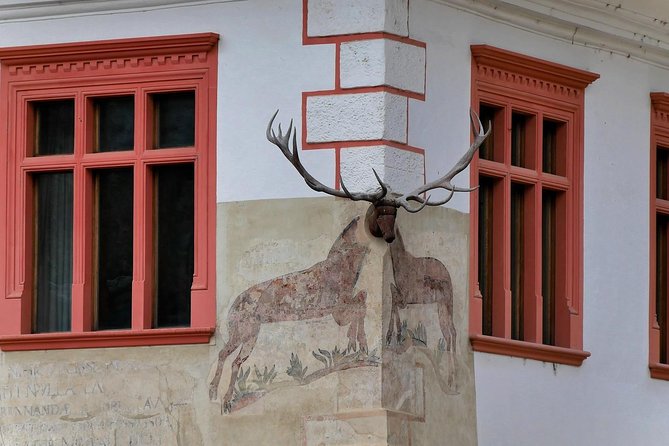
The final stop is the House with the Deer Antler, recognized by the antlers fixed to its facade. It is an odd and memorable finish, the kind of small detail that gives a walking tour personality.
These buildings are valuable because they reward close attention. You are asked to look up, inspect facades, and notice the details that a hurried walk would miss. Bring a camera, but keep it secondary to listening. The point is not only to collect images. It is to understand why these particular buildings survived in the town’s visual memory.
What the guides do best
The strongest part of this experience is the guiding. The people leading it are described as local, friendly, clear in English, and willing to discuss subjects beyond a fixed list of monuments.
Peter receives especially warm praise for using old photographs, explaining everyday life, and connecting Sighișoara with Romanian history and culture. Charles is praised for his command of architecture and for adjusting explanations to the group. Carol is noted for detailed stories and a friendly manner, while Andrea and Jacob also made strong impressions.
The most useful quality is patience. Guides have answered many questions, found places to sit or stand in shade, avoided large groups when possible, and adapted the route when guests had time or mobility concerns. Some walks have lasted a little longer than two hours when the conversation and sightseeing required it, though you should not assume extra time is guaranteed.
This is not a silent photo walk. You will get the most from it if you enjoy asking questions. If you already know a great deal about Transylvania, tell the guide what interests you so the conversation can move beyond basic facts.
Price, inclusions, and practical value
At $45 per person, the tour is not the cheapest way to see Sighișoara. But the price covers a live English-speaking specialist for two hours, and the route includes most of the citadel’s key sights, from the Clock Tower and Dracula’s birthplace to the hill church, cemetery, and defensive towers.
The value is strongest for a first visit. Without context, Sighișoara can become a pleasant sequence of old streets and attractive buildings. With a guide, the guild towers, staircase, cemetery, and church become connected parts of one story.
You still need to pay for food, drinks, attraction entrance fees, and souvenir photographs. That makes the final cost higher if you want to enter several sites. A private tour is listed with a supplement of EUR 20 per person, which may suit couples or families who want a more personal pace.
The booking terms are helpful if your plans may shift. You can cancel up to 24 hours ahead for a full refund and reserve now while paying later. Bring a passport or ID card, and leave large luggage at your accommodation.
Who should take this Sighișoara walk?
I would choose this tour for a first day in town, especially if you want a clear introduction before exploring independently. It suits history fans, architecture lovers, families whose children enjoy stories, and anyone who wants the Dracula connection explained without letting it take over the whole visit.
It is also a good fit if you like conversational guides. The strongest accounts describe guides who listen, respond to specific interests, and share details about Romanian traditions and everyday life.
I would think twice if you dislike stairs or need a fully accessible route. The climb to School Hill and the 164-step Covered Staircase are major parts of the walk, not optional decoration. You should also be comfortable walking on cobblestones and carrying only a small bag.
Should you book City Tour Sighișoara?
Yes, if you want the town explained rather than merely photographed. The route covers the famous sights, but its real strength is the connection between them: Vlad’s birthplace, the clock, the hill church, the cemetery, guild defenses, and the houses all become pieces of Sighișoara’s story.
Book it early in your stay, wear sensible shoes, bring identification, and keep your schedule slightly flexible. If you want a private experience, the EUR 20 per-person supplement may be worthwhile. If stairs are a problem, choose another way to see the citadel, since this tour’s best moments require climbing.
FAQ
Where does the tour begin?
The meeting point is Piața Muzeului 5, in front of the Monastery Church. Piața Muzeului 6 is also listed as a possible starting or finishing point, so check your booking details.
What time does the tour depart?
The listed departure time is 11:00. Availability and starting times should be checked when booking.
How long does the tour last?
The scheduled duration is two hours.
Is the tour offered every day?
Yes. The activity is listed as operating daily.
What language is the tour in?
The tour is conducted in English by a live English-speaking guide.
Are entrance fees included?
No. Entrance fees are not included in the $45 price.
What should I bring?
Bring a passport or ID card. Wear practical shoes, and avoid bringing oversize luggage or large bags.
Is the tour suitable for people with mobility impairments?
No. The tour is not considered suitable for people with mobility impairments because the route includes uphill walking and the 164-step Covered Staircase.
Just added around Sighisoara
- Sighisoara Heritage Tour-The place of birth of Vlad Dracula★ 5.0 · 3 reviews
- Transylvania’s Trail: Sibiu, Bran Castle, Brasov, Sighisoara★ 4.6 · 3 reviews
- Székely Land countryside and Sighisoara one day trip★ 5.0 · 3 reviews
- 4 Days Private Tour in Transylvania Brasov Sighisoara Sibiu★ 5.0 · 3 reviews
- Private Day Tour Sighisoara and Viscri from Brasov with Hotel Pick Up/ Drop Off★ 5.0 · 3 reviews
- CJ05 – Mysteries of Transylvania: Bran Castle & Sighisoara★ 4.8 · 3 reviews
- From Brasov: Corvin Castle and Sibiu (Optional Sighisoara)★ 4.6 · 3 reviews
- Day Trip to Sighisoara Rupea Fortress Viscri from Brasov★ 4.8 · 3 reviews
City Tours, compared.


Bucharest Panoramic Sightseeing – Private City Tour
Read our review →
SB01 – City Tour Sibiu: Exploring the Heart of Transylvania
Read our review →
Black Sea and Constanța City – Private Tour from Bucharest
Read our review →Browse the lists this tour appears in