
Reviewed · CITY TOURS
Bucharest: City Highlights Guided Walking Tour
Bucharest reveals itself one layer at a time. I like the way this two-hour walk links medieval Bucharest with its Communist past, and I especially like the route along Calea Victoriei, the boulevard once called the Little Paris of the East. The guide, Claudiu, has earned praise for explaining the city clearly and shaping the walk around your interests.
The main consideration is value. At $45 per person, this costs more than some longer city walks, and two hours can only cover a taste of Bucharest. You also cover about 3.5 kilometers and 4,600 steps, so this is not a good fit if you have limited mobility or a low level of fitness.
In This Review
- Key points at a glance
- Why this two-hour Bucharest walk works
- Starting at the Statue of the She-wolf
- Old Princely Court and Church: Bucharest before the boulevards
- From the former palace square to Revolution Square
- Calea Victoriei and the idea of Little Paris
- Stavropoleos Church and the History Museum area
- Crossing the Dambovita into the Civic Center
- Finishing at Constitution Square and the Palace of Parliament
- What $45 buys you in two hours
- Who should book this walk
- How to get the most from the experience
- Should you book it?
- FAQ
- Where does the tour start?
- Where does the tour finish?
- How long does the walking tour last?
- How far do you walk?
- What language is the tour conducted in?
- Is entry to the Palace of Parliament included?
- Can I visit the inside of the Palace of Parliament?
- What should I bring?
- Can I bring luggage or a large bag?
- Is the tour suitable for wheelchair users?
Key points at a glance
- Start at Bucharest’s 0 kilometer: Meet beside the Statue of the She-wolf in Roma Square, on Lipscani Street.
- See the city’s main historical layers: The route moves from the Old Princely Court to royal buildings, Communist offices, and the enormous Palace of Parliament.
- Calea Victoriei is the architectural centerpiece: This historic boulevard brings together some of Bucharest’s best-known buildings.
- The 1989 Revolution gets real attention: Revolution Square helps explain how Romania’s Communist government fell.
- Claudiu offers a personal, flexible style: He has been praised for asking about interests, answering questions, and sharing details about life in Romania.
- The finish is dramatic: The walk ends in Constitution Square, directly in front of the Palace of Parliament.
Why this two-hour Bucharest walk works
Bucharest is not a city you understand from one grand monument. Its character comes from sharp changes in time and style. A medieval court sits near elegant nineteenth-century buildings. A former Communist headquarters faces a square tied to the 1989 uprising. Wide avenues built under dictatorship lead toward one of the largest administrative buildings in the world.
This tour gives you that broad frame in a short period. You will not enter every major sight, and there is little time to linger, but you will see how the center fits together. I see it as an orientation walk for your first day, or a compact history lesson if you have only a short stay.
The guide service is in English. Claudiu has been singled out for making the walk personal rather than simply reciting dates. He asked about one visitor’s interests and adjusted the route and explanations toward architecture and history. He also answered questions about his own life in Romania, which can make the city feel less like a collection of buildings and more like a lived-in place.
More City Tours in Bucharest
- Bucharest: City Highlights Guided Walking Tour
★ 4.9 · 1,482 reviews - Bucharest: 2-Hour City Highlights Bike Tour
★ 4.8 · 269 reviews - Bucharest Tuk Tuk city tour
★ 5.0 · 188 reviews
Starting at the Statue of the She-wolf
The meeting point is beside the Statue of the She-wolf in Roma Square, on Lipscani Street. The statue shows the Roman she-wolf with Romulus and Remus, a familiar symbol of Romania’s link to ancient Rome.
This is a useful place to begin because the tour starts near Bucharest’s stated 0 kilometer. In practical terms, you are getting your bearings in the historic center before walking into the Old Town. Bring your passport or ID card, as requested for the activity, and avoid bringing luggage or a large bag.
The location also places you close to Lipscani, one of the central streets in the Old Town. You can expect the first part of the walk to feel urban and compact, with history layered into streets that are now used for shops, restaurants, and everyday city life.
Old Princely Court and Church: Bucharest before the boulevards
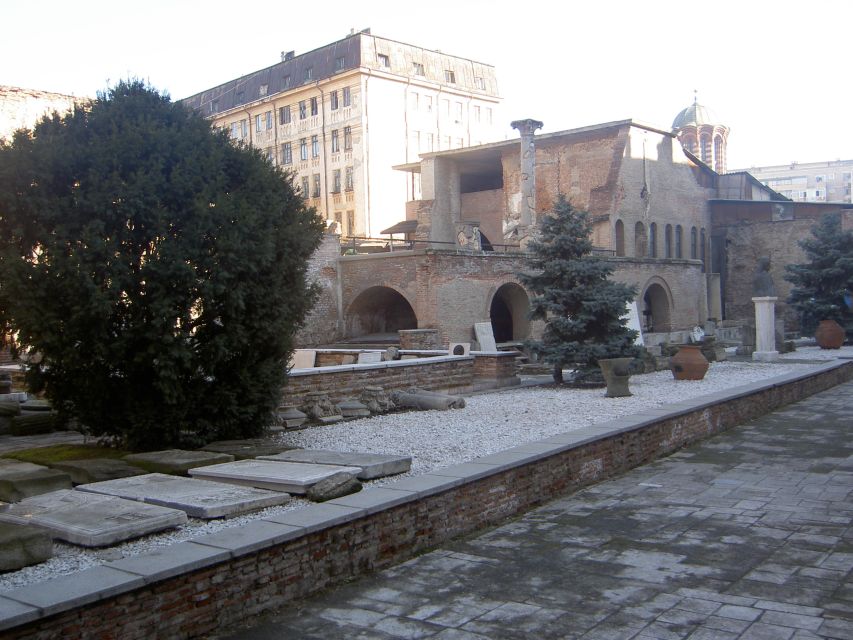
The first major historic stop is the Old Princely Court and Church. This is where the tour shifts from modern city center to the early roots of Bucharest as a seat of power.
The court is associated with the princes who ruled Wallachia, the historical region in which Bucharest grew. The church adds a more intimate sense of the past than the grand civic buildings later in the walk. I like this early stop because it gives you a useful contrast: Bucharest was not created all at once as a capital of grand avenues. It developed from older centers of rule, worship, and trade.
Your guide’s explanation matters here. Ruins and old walls rarely speak for themselves, especially when surrounded by a busy modern district. A short visit with context helps you understand why this site matters instead of treating it as another photo stop.
The drawback is time. The walk does not include a long independent visit to the court or church. If you want detailed archaeological information or a slow look at the site, you may need to return on your own.
From the former palace square to Revolution Square
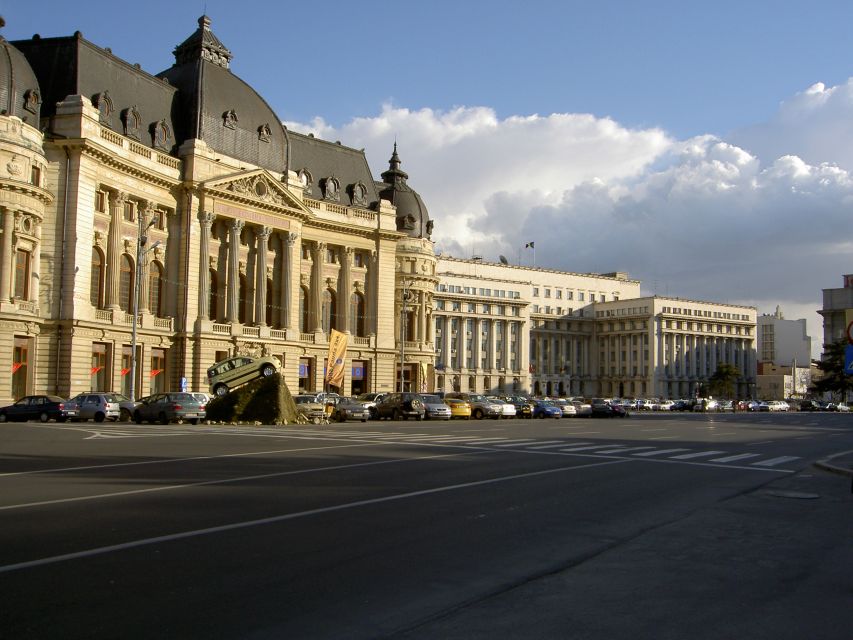
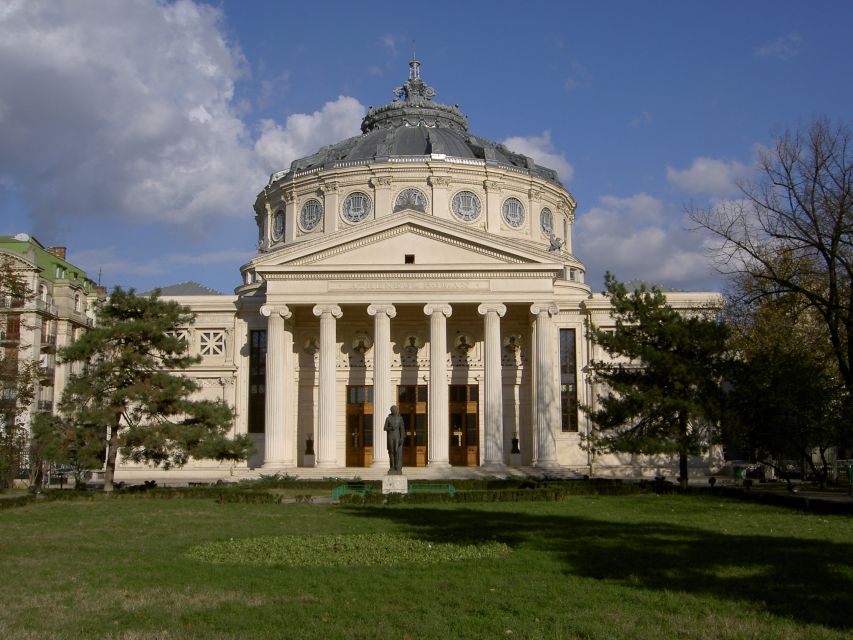
The route continues toward the former Square of the Palace, where the former Royal Palace and the Romanian Athenaeum come into view. This section introduces the period when Bucharest was shaping itself as a European capital.
The Romanian Athenaeum is one of the city’s best-known cultural buildings, while the former Royal Palace reflects the country’s royal era. You will see these places from the outside as part of the walking route. Their value lies in the way they show Bucharest reaching for a grand, Western-looking identity.
Then the story turns darker at present-day Revolution Square. The former headquarters of the Communist Party occupies a central place in the account of the 1989 Revolution, when Nicolae Ceausescu’s regime collapsed.
I find this one of the most important parts of the walk because the events are tied to a real location rather than presented as a distant chapter in a textbook. Your guide can point out how the square functioned during the uprising and help connect the political story to the buildings around you.
Do not expect a museum visit or a full account of every event from 1989. The tour is moving on foot, so the explanation must fit into a larger route. Still, for a first introduction to Romania’s recent past, Revolution Square gives the history a clear physical setting.
More Walking Tours in Bucharest
- Bucharest Highlights Walking Tour
★ 5.0 · 469 reviews - Bucharest: Ghost Stories & Romanian Mythology Walking Tour
★ 4.9 · 287 reviews - Bucharest: Guided Walking Tour with Romanian Snack
★ 4.9 · 228 reviews - Best of Bucharest | Private Walking Tour
★ 5.0 · 199 reviews
Calea Victoriei and the idea of Little Paris
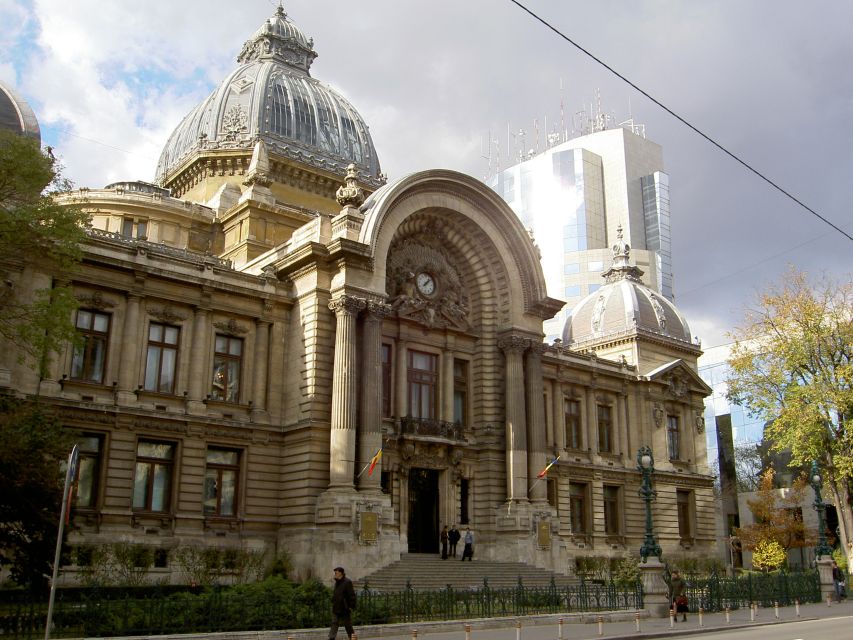
Calea Victoriei is the architectural heart of this tour. It is Bucharest’s most historic boulevard and the place where the nickname Little Paris makes the most sense.
The name points to a period when Bucharest adopted French-inspired tastes in architecture, planning, and public life. Along this route, you will see built heritage from that era and get a feel for the city’s old ambition. The boulevard is not simply a pretty street. It helps explain how Bucharest once presented itself as a modern European capital.
I like having a guide here because architecture can be easy to admire but harder to read. A building’s facade may tell you about a style, but the guide can add why that style appeared, who commissioned these buildings, and how the street fit into the city’s development.
The route is also a reminder that Bucharest’s charm is uneven. You may find elegant facades beside worn surfaces, patched buildings, and later additions. That mixture is part of the city’s appeal, but anyone expecting a perfectly preserved Parisian-style boulevard should adjust expectations. The tour presents Calea Victoriei as a real urban street with layers, not a polished open-air museum.
Stavropoleos Church and the History Museum area
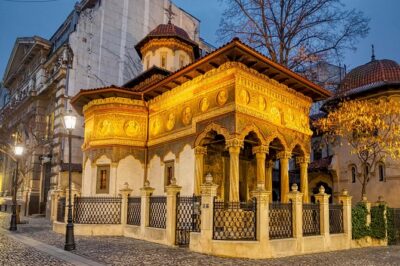
The walk includes a short stop at Stavropoleos Church, near the History Museum. This is a smaller and more intimate sight than the broad avenues and government buildings.
The church gives you another change of scale. After hearing about royal power, Communist rule, and major civic projects, you get a closer look at Bucharest’s religious and architectural traditions. The stop is brief, so the guide’s comments will help you notice more than you might during a quick independent glance.
Its location near the History Museum also keeps the tour anchored in the Old Town before the route crosses the Dambovita River. If you are interested in Romania’s past, note the museum’s location so you can decide if it deserves a separate visit later.
The tour does not include entry fees. That matters here and at the other major sights. You are paying for the guide’s time and the walking experience, not a package of museum admissions.
Crossing the Dambovita into the Civic Center
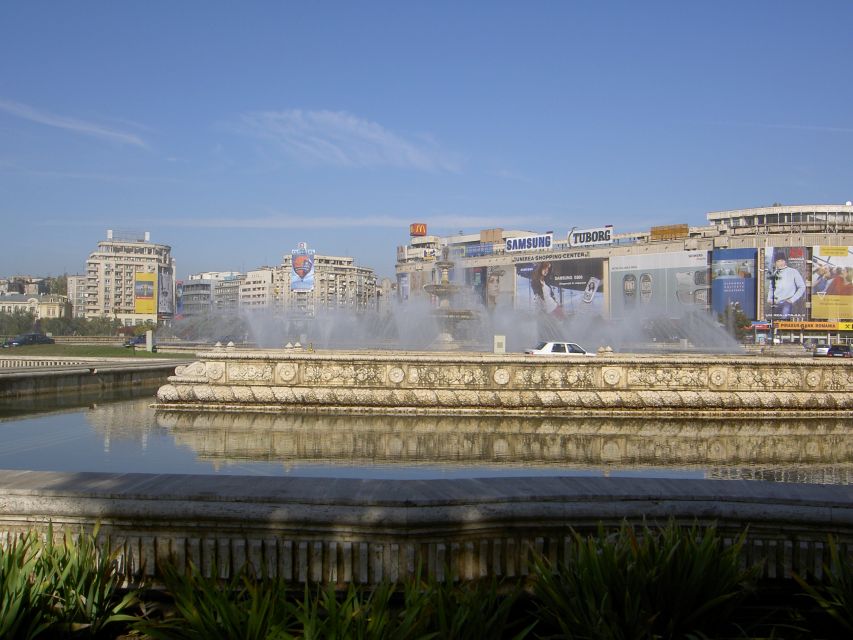
After the Old Town and Calea Victoriei, the route crosses the Dambovita River and enters the Civic Center. This is where Bucharest’s Communist-era planning becomes impossible to miss.
The Civic Center was built under Communist rule as a new administrative center. Its broad spaces and monumental scale contrast sharply with the narrow streets and older buildings of the historic core. This shift is one of the tour’s strongest features because you experience the change by walking through it.
The city’s Communist architecture can seem blunt or oversized when seen without context. With an explanation, it becomes evidence of political power and forced urban change. The route helps you compare two very different ideas of a capital: one shaped by older streets and public life, the other by central control and monumental planning.
This portion may feel less charming than the Old Town. That is not a flaw in the route. It is the point. You are seeing how much of the city was reshaped to serve the Communist state.
Finishing at Constitution Square and the Palace of Parliament
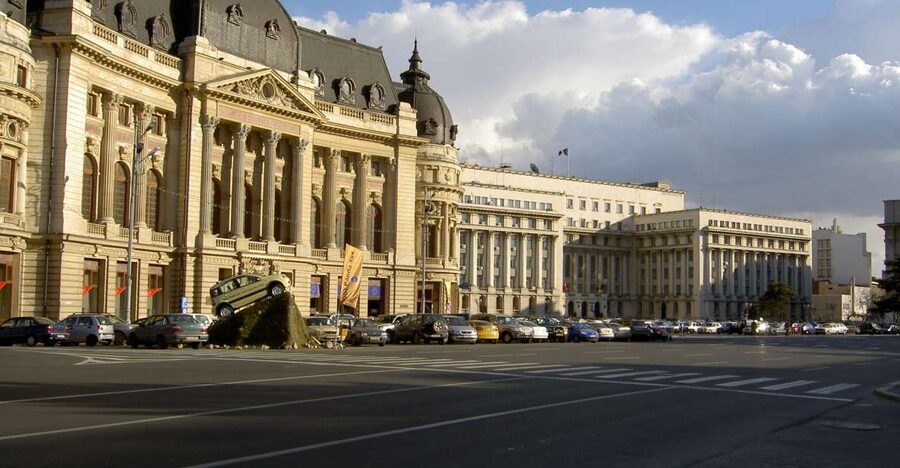
The final stop is Constitution Square, in front of the Palace of Parliament. The ending has visual force. After passing through older Bucharest and the royal and Communist centers of power, you arrive before the building that best represents the scale of Ceausescu’s redevelopment plans.
The Palace of Parliament is enormous, and Constitution Square gives you room to take in its size. The open setting also helps you understand the relationship between the building and the Civic Center around it.
The standard walking tour covers the palace from the outside. An inside visit may be arranged before or after the walk, but you must request it by message when booking, and it depends on availability. Entry is not included in the $45 price.
That optional visit can change the value calculation. If you want to see the interior, confirm it before you build your day around it. Do not assume that simply booking the walking tour guarantees entry.
Ending here is practical as well as dramatic. You can stop after the guide’s final explanation, take photographs, or continue exploring the area independently. The tour does not provide transport back to the starting point, so plan your next move from Constitution Square.
What $45 buys you in two hours
At $45 per person, this is not the cheapest way to see Bucharest. One past participant felt the price was high compared with longer walks, even while praising the quality of the experience and Claudiu’s guiding.
The value depends on what you need. If you already know Bucharest well, you may prefer to walk the route yourself and spend the money on museum tickets. If this is your first visit, the guide’s historical connections can save you time and help you understand why the city looks so mixed.
You are paying for a focused route, English-language guidance, and a person who can respond to your questions. That last part seems important here. Claudiu has been praised for explaining details carefully, taking his time, and even helping visitors see inside a couple of buildings they assumed were closed to the public. Those extra moments are not guaranteed, but they show the benefit of having a local guide rather than following a fixed audio track.
I would judge the price as fair for a private-feeling, information-heavy introduction, but less attractive if you want a long, slow sightseeing day. The tour lasts two hours, and the pace includes several stops for explanations. You will see a lot, but you will not fully visit every sight.
Who should book this walk
I would choose this tour if you want a clear first look at Bucharest’s central history, especially if you care about architecture and the transition from monarchy to Communism to post-1989 Romania.
It suits you best if you:
- Have only a short time in the city
- Want an English-speaking guide
- Prefer history explained on location
- Like seeing several eras in one continuous route
- Can comfortably walk 3.5 kilometers and about 4,600 steps
- Want the option of arranging a Palace of Parliament interior visit
It is less suitable if you use a wheelchair, have mobility impairments, or have a low level of fitness. Large bags and luggage are not allowed, and the experience is entirely based on walking.
The group size is not specified, so you should check that detail if it matters to you. Starting times also vary, and you need to check availability for the date you want.
How to get the most from the experience
Wear comfortable shoes and keep your hands free. The route moves between compact Old Town streets, major boulevards, river crossings, and broad civic spaces, so comfort matters more than dressing for a formal palace visit.
Think of the tour as a framework, not a complete Bucharest program. Afterward, you may want extra time at the Palace of Parliament, the History Museum, or the Old Princely Court and Church, depending on your interests. The tour gives you useful locations and context, but it does not replace a full visit to each site.
Ask Claudiu what interests you most at the beginning. One of the clearest strengths of this experience is the guide’s willingness to tailor explanations around architecture, history, and questions about Romanian life. A two-hour route becomes more useful when you tell the guide what you want to understand.
The booking terms also offer some flexibility. You can reserve now and pay later, and cancellation is free up to 24 hours before the start time. That is useful when your Bucharest plans may change, though you should still confirm any Palace of Parliament visit separately.
Should you book it?
Book this walking tour if you want an efficient, thoughtful introduction to Bucharest and value a guide who can connect buildings with political and personal history. The strongest elements are Claudiu’s adaptable style, the mix of Old Town and Communist-era sights, and the walk along Calea Victoriei.
Skip it if $45 feels high for a two-hour overview, or if you want extensive interior visits and time to explore each stop at leisure. For a first day in Bucharest, though, this route gives you a useful map of the city’s past, ending with the Palace of Parliament where the scale of modern Bucharest is hardest to ignore.
FAQ
Where does the tour start?
The guide waits next to the Statue of the She-wolf in Roma Square, on Lipscani Street.
Where does the tour finish?
The walk finishes at Piața Constituției 5, in Constitution Square, in front of the Palace of Parliament.
How long does the walking tour last?
The tour lasts two hours.
How far do you walk?
The route covers about 3.5 kilometers, or 2.3 miles, which is approximately 4,600 steps.
What language is the tour conducted in?
The live guided tour is conducted in English.
Is entry to the Palace of Parliament included?
No. Entry fees are not included.
Can I visit the inside of the Palace of Parliament?
An interior visit may be arranged before or after the walking tour, but you must request it by message when booking and it depends on availability.
What should I bring?
You should bring a passport or ID card.
Can I bring luggage or a large bag?
No. Luggage and large bags are not allowed.
Is the tour suitable for wheelchair users?
No. The experience is not suitable for wheelchair users, people with mobility impairments, or people with a low level of fitness.
More Walking Tours
- Walking Tour- Delightful Bucharest (Highlights, Stories, Sights)
★ 5.0 · 145 reviews - 4h Bucharest Private Tour (2h by Car and 2h Walking in Old Town)
★ 5.0 · 90 reviews - Bucharest 3-hours Walking Tour (Small Groups)
★ 5.0 · 85 reviews - Guided Walking Tour of Historical Bucharest
★ 5.0 · 84 reviews
Just added around Bucharest
- 4-Day Inside Transylvania & Transfagarasan Tour from Bucharest★ 5.0 · 3 reviews
- 10 hours Private Apiary Tour in Romania – From Bucharest★ 5.0 · 3 reviews
- Bucharest: Charm of the Belle Époque Private Tour★ 5.0 · 3 reviews
- Bran & Peles Castles through the Best Road in the World: Transfagarasan road★ 4.5 · 3 reviews
- 2-Day Small-Group Tour in Transylvania from Bucharest – Maximum 5 Persons★ 5.0 · 3 reviews
- Private Wine Tasting at Bucharest’s First Wine Bar★ 5.0 · 3 reviews
- Bucharest to Brasov – Fast Private Transfer★ 5.0 · 3 reviews
- Probably the Best Restaurant and Wine Cellar near Bucharest★ 4.5 · 3 reviews
City Tours, compared.


Bucharest Panoramic Sightseeing – Private City Tour
Read our review →
SB01 – City Tour Sibiu: Exploring the Heart of Transylvania
Read our review →
City Tour Sighisoara Legends & Landmarks A Walk Through Time
Read our review →Browse the lists this tour appears in