
Reviewed · UNESCO HERITAGE TOURS
Private 8 Day Romania UNESCO Tour
Romania rewards the long road. I like the mix of UNESCO monuments and living village traditions, especially the horse-drawn wagon ride near Sibiel and the home-cooked meals in Maramures. I also like having one private guide for the full route, which makes a complicated trip through Romania easier to manage. The tradeoff is clear: several days involve long drives, and entrance tickets, most lunches, and some dinners cost extra.
This $2,315.49 tour per person covers seven nights in double or twin rooms, private transportation, a guide, seven breakfasts, three dinners, craft visits, and a few tastings. It is a strong choice if you want Romania’s major cultural sights without arranging every hotel, transfer, and rural stop yourself.
In This Review
- Key points to know before booking
- Bucharest to Sibiu, with Cozia Monastery on the way
- Corvin Castle and Alba Iulia’s fortified center
- Cluj-Napoca and the wooden churches of Maramures
- Sapanta’s colorful cemetery and the life of Maramures
- Crossing the Carpathians into Bucovina
- Voronet, Bicaz Gorge, and Red Lake
- Sighisoara, Saschiz, and Brasov
- Bran Castle and Peles Castle before returning to Bucharest
- What the $2,315.49 price really covers
- Who will enjoy this route most
- Should you book the private Romania UNESCO tour?
- FAQ
- Where does the tour start and finish?
- How long is the tour?
- Is this a private tour?
- What accommodation is included?
- Are entrance tickets included?
- What meals are included?
- Can the tour be canceled for a full refund?
Key points to know before booking
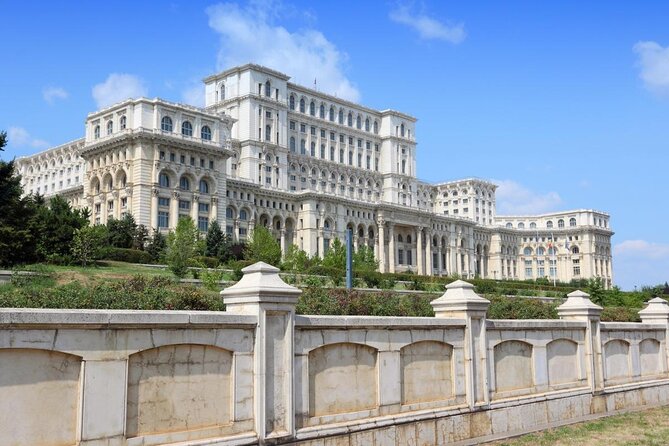
- Four distinct sides of Romania: You move from Bucharest and Wallachian monasteries to Saxon Transylvania, Maramures villages, Bucovina’s painted churches, and the Carpathian passes.
- Real village contact: Sibiel, Botiza, Ciocanesti, and Marginea provide encounters with local food, crafts, homes, pottery, weaving, and old customs.
- UNESCO highlights with variety: The route includes medieval towns, wooden churches, painted monasteries, fortified churches, and Sighisoara’s citadel.
- A private format: Only your group takes part, with a guide accompanying you throughout the trip.
- Extra costs matter: Entrance fees run about 85 euros, while lunches and most dinners are not included.
- A demanding but rewarding route: The schedule covers a large part of Romania in eight days, so expect sightseeing days mixed with substantial time on the road.
Bucharest to Sibiu, with Cozia Monastery on the way
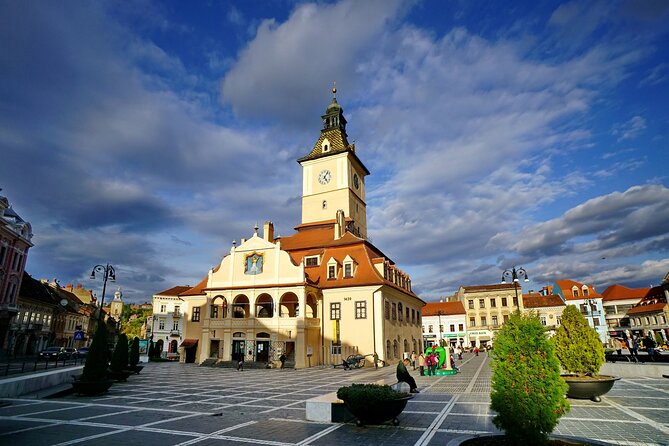
Your guide meets you at your Bucharest hotel at 9:00 a.m. The opening drive begins with a panoramic look at the capital, including the Parliament Palace, Revolution Square, the Romanian Athenaeum, the former Royal Palace, Triumph Arch, and Victoriei Avenue.
This introduction gives you useful political and architectural context before you leave the city. Revolution Square is especially important because the anti-communist revolution began there in 1989. The former Royal Palace now houses the National Art Museum, adding another layer to the city’s story.
The first substantial stop is Cozia Monastery, built in the late 14th century. Its Romanian church architecture and connection with Mircea the Old, who is buried here, make it more than a quick photo stop. The visit lasts about 45 minutes and admission is included.
Sibiu provides the day’s main urban experience. Founded in 1190 by Transylvanian Saxons, it has a handsome medieval center built around the Big Square and Small Square. You walk past the old fortifications, the Staircase Tower, the Liar’s Bridge, and several churches, including the Roman Catholic and Orthodox cathedrals.
The Orthodox Cathedral of the Holy Trinity deserves a closer look for its interior frescoes and early 20th-century design. The Roman Catholic Church of the Holy Trinity is a shorter stop during the walking tour.
The day ends in Sibiel, a village outside Sibiu. A horse-drawn wagon ride through the old village provides a slower, more personal finish after the city tour. You then have a homemade dinner with traditional products and spend the night in a local guesthouse.
Practical note: This is a full first day, combining Bucharest, a monastery, Sibiu, and a rural evening. The private vehicle helps, but you should be ready for a lot of sitting before the walking begins.
More UNESCO-listed sites:
- 3 Days UNESCO Tour of Transylvania. Private tour from Bucharest
★ 5.0 · 8 reviews - From Brasov: Sighisoara and Viscri UNESCO Day Tour
★ 4.8 · 86 reviews - From Brasov: Sighisoara, Viscri, and Rupea Unesco Day Trip
★ 4.9 · 32 reviews
Corvin Castle and Alba Iulia’s fortified center
Day two turns toward Hunedoara and Corvin Castle, Romania’s largest medieval castle. Dating from the 15th century, it was once the residence of Transylvanian governors. Towers, defensive features, and its Gothic appearance give it the storybook quality many people expect from Transylvania.
The visit lasts about an hour. Admission is not included, so keep some money available for the ticket.
Next comes Alba Iulia, a city with Roman origins and a major place in Romanian national history. You see Roman remains, the Orthodox Cathedral, the Catholic Cathedral, and the large Vauban-style fortification system.
Alba Iulia works well as a counterpoint to Corvin Castle. The castle is a dramatic medieval residence, while Alba Iulia shows how Roman, religious, military, and modern Romanian history overlap in one city. You have about two hours here, enough for a guided look at the central sights without trying to cover every corner.
The night is spent in Cluj-Napoca at the four-star Napoca Hotel or a similar hotel. That shift from rural guesthouse to city lodging gives the route some welcome variety.
Cluj-Napoca and the wooden churches of Maramures
Cluj-Napoca receives a two-hour morning walking tour. The route includes Union Square, St. Michael’s Cathedral, Museum Square, the Orthodox Cathedral, the National Theatre, and the statue of Matei Corvin.
St. Michael’s Cathedral, built in the 15th century, is the city’s largest cathedral and receives an additional 30-minute visit. Cluj is the largest city in Transylvania, so this morning is more urban and more modern in feel than the village stops that follow.
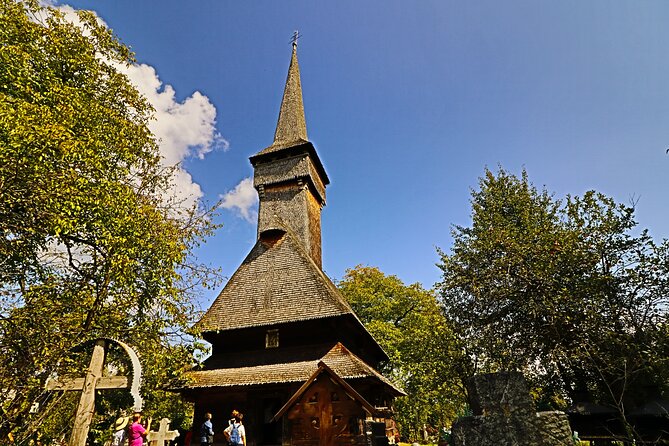
Then the road heads north to Maramures, one of Romania’s strongest areas for old wooden churches and local customs. Surdesti Wooden Church, built in 1766, is a UNESCO site. Its 54-meter tower is described as the tallest old wooden church in Europe. The visit takes about half an hour, and admission is extra.
At Desesti, the Church of the Holy Paraskeva offers another UNESCO-listed wooden church. The painted interior and timber construction show how religious art adapted to local materials and village life.
The day also includes visits with craftspeople. Depending on the arrangement, you might see a traditional weaver, wood carver, water mill, or traditional household. These stops matter because they connect the grand monuments with the skills that kept village culture recognizable.
Barsana Monastery adds a more formal religious setting. Its wooden buildings are a fine example of Maramures architecture, and you can optionally visit a local carver’s workshop.
The evening takes you to Botiza. A local household visit helps explain how people in these villages have traditionally lived, and a sheepyard visit may be possible depending on the season. Dinner and overnight accommodation are at a local pension.
This is one of the tour’s strongest sections. You are not only looking at old buildings. You are also seeing weaving, carving, farming, household traditions, and local religious life in the same region.
Sapanta’s colorful cemetery and the life of Maramures
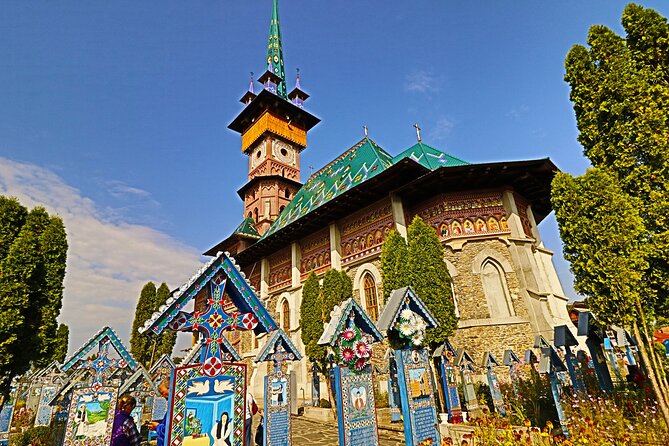
Day four begins at the Merry Cemetery in Sapanta, one of Romania’s most unusual cultural sights. Its brightly painted tombstones use humorous poems and images to describe the lives of the people buried there. The tone is frank and often playful, a sharp contrast to the solemn cemeteries you may know elsewhere in Europe.
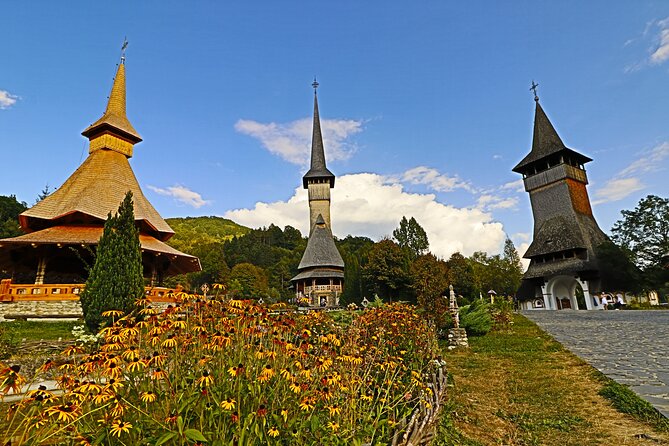
The visit lasts about 30 minutes, followed by Sapanta-Peri Monastery. Its wooden church rises roughly 78 meters and is listed as the tallest wooden church in the world. The current monastery was founded in 1997 to revive the tradition of the older Peri monastery, whose historic site is now in Ukraine.
You pass through Sighet, the largest town in the area. There is an optional stop at the Communist Prison Museum, which can add a difficult but important chapter to your understanding of Romania’s 20th-century past. Because this visit is optional, ask your guide how it fits the day’s timing.
In Dragomiresti, the Maramures Woman Museum offers a compact look at local customs and domestic life. Pay attention to the carved wooden gate at the entrance. The symbols on these gates are a useful way to understand how local identity was expressed in everyday architecture.
Bogdan Voda Wooden Church, dating from the early 18th century, brings you back to the region’s older religious art. Its frescoes were painted on wood by local artists, and admission is free.
You return to Botiza for free time, a short walk, dinner, and another night at a local pension. Two nights in rural villages are a real strength of this route. You have time to notice the setting instead of treating every village as a quick roadside stop.
A few more trips worth weighing up before you book
- Bucharest: Dracula’s Castle, Peles Castle, & Brasov Old Town
★ 4.5 · 17,858 reviews - Bucharest: Dracula Castle, Peles Castle & Brasov Old Town
★ 4.6 · 10,891 reviews - Bucharest: Dracula’s Castle, Peleș Castle & Brașov Day Trip
★ 4.5 · 5,919 reviews - Bucharest: Palace of Parliament Tickets and Guide
★ 4.3 · 3,182 reviews
Crossing the Carpathians into Bucovina
Day five crosses the Carpathian Mountains toward Bucovina, the region known for its painted monasteries. The drive is one of the scenic highlights, though it is also one of the longer road days.
Ciocanesti is a brief stop with a very particular local style. The village is known for decorated houses and painted egg traditions. An optional museum visit can add context if you want to know how these designs developed.
Moldovita Monastery dates from 1532 and was founded under Prince Petru Rares. Its fortress-like walls, towers, and preserved frescoes make it one of Bucovina’s essential stops. The exterior paintings are the main draw, but take time to look at the way the monastery’s defensive form shapes the whole visit.
At the International Lucia Condrea Egg Museum, you learn about painted egg techniques, patterns, and customs. This is a small but focused cultural stop, and it pairs well with Ciocanesti’s decorated houses.
Sucevita Monastery may be the grandest of the Bucovina monasteries on this route. Towers, buttresses, high walls, and watch roads give it the appearance of a fortified compound. Its painted decoration rewards patience, especially if religious art interests you.
The final stop is Marginea, where a local family workshop produces black pottery using traditional methods. This is the kind of visit that gives the day a human scale. Instead of seeing only finished monuments, you get a glimpse of how a regional craft is made and passed along.
Admission fees at Moldovita, the egg museum, and Sucevita are not included. Plan for several small payments during the Bucovina portion.
Voronet, Bicaz Gorge, and Red Lake
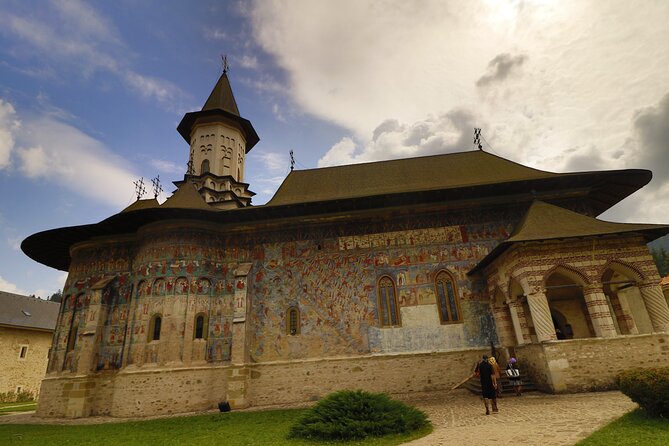
Voronet Monastery opens day six. Founded in 1488 by Stephen the Great, it is famous for its blue background color and its carefully preserved Last Judgment fresco. The intense blue is the feature most people remember, but the full painted program is what makes the church important.
The route then turns back across the Carpathians. Red Lake and Bicaz Gorge provide a change from churches, citadels, and town squares. Bicaz Gorge is one of Romania’s most dramatic natural sights, with a narrow mountain passage and striking roadside scenery.
The stop at Red Lake lasts about 30 minutes, as does the stop at the gorge. These are short visits, so do not expect a long mountain walk. They work best as scenic pauses between the cultural centers.
The day ends in Sighisoara, where you have about an hour before the next morning’s fuller walking tour. This overnight placement is useful because Sighisoara’s historic center is best enjoyed without trying to rush through it late in the day.
Sighisoara, Saschiz, and Brasov
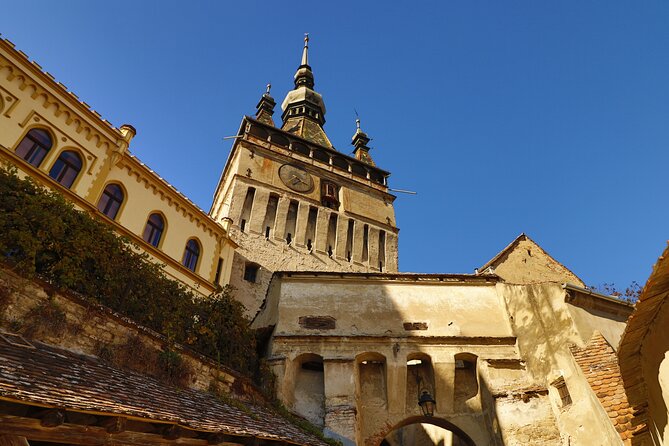
Sighisoara’s citadel is one of the finest preserved medieval towns in Europe. Built in the 13th century by German Saxon settlers, it is also a UNESCO site. The two-hour walking tour covers the medieval streets and key historic areas, giving you time to absorb the town’s scale and atmosphere.
Saschiz follows, with a tasting of homemade jams, chutney, and syrup at a local producer’s shop. This is a modest stop, but it brings food into the story and gives you a chance to sample products made in the surrounding countryside.
Prejmer’s fortified church dates from the 13th century. It shows how worship and defense were combined in medieval Transylvania. The church is a UNESCO site, and admission is extra.
Brasov offers the final major city walk. Its medieval center includes Council Square, the Black Church, the White and Black Towers, Weaver’s Bastion, and Ecaterina’s Gate. The Black Church is Romania’s largest Gothic cathedral, while Weaver’s Bastion helps explain the city’s defensive system.
The old center is compact enough to explore on foot, but the day remains busy. Sighisoara, Saschiz, Prejmer, and Brasov make for a concentrated run of historic places.
Bran Castle and Peles Castle before returning to Bucharest
The final morning brings the famous Bran Castle, often called Dracula’s Castle. Built in the 14th century, it controlled access into Transylvania and later became linked to the Dracula legend. The historical fortress and the popular myth are not the same thing, so the visit is most satisfying if you treat the legend as a modern layer over an older defensive building.
You then continue to Sinaia for Peles Castle, the former summer residence of Romania’s kings. This is one of the most polished stops on the route, with a royal setting and elaborate architecture. The visit lasts about 90 minutes, the same length as Bran Castle.
Both castle admissions are extra. Since these are popular sights, ask your guide about the visit sequence and timing on the day.
The tour returns to Bucharest at about 4:00 p.m., with drop-off at a Bucharest hotel or the airport. If you are flying out that evening, confirm your departure time carefully before relying on the airport transfer. The stated arrival time leaves some margin, but airport plans should never be too tight.
What the $2,315.49 price really covers
The price makes the most sense for a couple or small private group that values convenience and a dedicated guide. You receive seven nights in double or twin rooms, private car or minibus transport, seven breakfasts, three dinners, the Sibiel wagon ride, craft visits, and the jam, chutney, and syrup tasting.
The guide is a major part of the value. A single person accompanies you throughout the route, answers questions, and handles the transitions between cities, villages, churches, and hotels. A private format also means the experience is limited to your own group, rather than built around a large coach schedule.
Budget separately for about 85 euros in entrance tickets. Lunches, most dinners, tips, and services not listed are also extra. The three included dinners are especially useful on the rural nights, when a local pension meal is part of the experience rather than just a way to fill up.
I would compare this price with the cost of eight days of rental car driving, fuel, hotels, parking, route planning, and separate guides. If you prefer complete independence, the package may feel restrictive. If you want the route’s many moving parts handled for you, the price is easier to justify.
Who will enjoy this route most
I would recommend it to first-time visitors who want a broad introduction to Romania in one trip. It suits people who care about architecture, religious art, medieval towns, local crafts, food, and rural customs more than nightlife or long stays in one city.
It is also a good match for couples, families, friends, or small groups who want privacy. The tour covers a great deal of ground, so you should be comfortable with long drives, frequent hotel changes, walking tours, and several days with more than one major stop.
This is not the right choice if you want a slow holiday based in Bucharest, Brasov, or Sibiu. It is also less suitable if you dislike religious sites, historic buildings, or rural accommodation. The reward comes from variety, not from lingering in one place.
Should you book the private Romania UNESCO tour?
Book it if you want Romania’s best-known cultural regions linked into one carefully planned journey. The strongest features are the two rural village nights, the private guide, the wooden churches of Maramures, Bucovina’s painted monasteries, and the balance between major sights and working craft traditions.
Think twice if the extra entrance fees and long drives will bother you. You should also confirm the hotels, vehicle type, dinner arrangements, and the exact plan for airport drop-off before paying.
For the right person, this is more than a castle checklist. It gives you medieval cities, religious art, mountain roads, village kitchens, wooden gates, painted eggs, black pottery, and a clearer sense of how Romanian traditions continue outside the main tourist centers.
FAQ
Where does the tour start and finish?
The tour starts at 9:00 a.m. with pickup at your hotel in Bucharest. It ends in Bucharest at about 4:00 p.m., with drop-off at a hotel or the airport.
How long is the tour?
The experience lasts approximately eight days and includes seven nights of accommodation.
Is this a private tour?
Yes. Only your group participates, and a private guide accompanies you throughout the tour.
What accommodation is included?
Seven nights in double or twin rooms are included. One night is at the four-star Napoca Hotel in Cluj-Napoca or a similar hotel, while rural nights are spent at local guesthouses or pensions.
Are entrance tickets included?
Many entrance tickets are not included. The estimated total for tickets is about 85 euros, with additional charges listed for sites such as Corvin Castle, the Maramures wooden churches, the Bucovina monasteries, Prejmer, Bran Castle, and Peles Castle.
What meals are included?
Seven breakfasts and three dinners are included. Other meals and services not specifically listed are extra.
Can the tour be canceled for a full refund?
Yes, if you cancel at least three full days before the experience start time. Cancellations made less than three full days in advance are not refunded, and late changes are not accepted.
Just added around Bucharest
- 10 hours Private Apiary Tour in Romania – From Bucharest★ 5.0 · 3 reviews
- 4-Day Inside Transylvania & Transfagarasan Tour from Bucharest★ 5.0 · 3 reviews
- Bucharest: Charm of the Belle Époque Private Tour★ 5.0 · 3 reviews
- Bran & Peles Castles through the Best Road in the World: Transfagarasan road★ 4.5 · 3 reviews
- 2-Day Small-Group Tour in Transylvania from Bucharest – Maximum 5 Persons★ 5.0 · 3 reviews
- Private Wine Tasting at Bucharest’s First Wine Bar★ 5.0 · 3 reviews
- Bucharest to Brasov – Fast Private Transfer★ 5.0 · 3 reviews
- Probably the Best Restaurant and Wine Cellar near Bucharest★ 4.5 · 3 reviews
UNESCO Heritage Tours, compared.
UNESCO TOUR :Sighisoara ,Viscri and Rupea Tour from Brasov
Read our review →
Day trip from Iasi to the UNESCO Painted Monasteries in Bucovina
Read our review →
Sighisoara, Viscri UNESCO & Rupea Fort – Private Tour from Brasov
Read our review →
Private tour Transylvania: UNESCO Gems and Legend of Dracula
Read our review →
3 Days UNESCO Tour of Transylvania. Private tour from Bucharest
Read our review →Browse the lists this tour appears in