
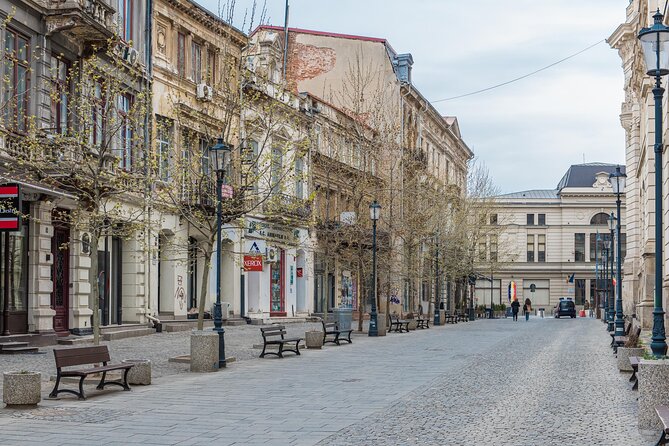
Reviewed · GUIDED
Explore Bucharest Step by Step With A Local Guide
Bucharest’s story unfolds on foot. This three-hour walk links the city’s 1989 revolution, grand avenues, old churches, historic inns, and the vast Palace of Parliament area in one compact route. I like the clear beginning at Revolution Square and the finish at Constitution Square, where the scale of modern Bucharest becomes hard to miss. I also like the small group limit of 10, which gives you a better chance to ask questions than on a large city tour.
At $16.87 per person, the price is easy to justify if you want an introduction rather than a museum-heavy day. The main consideration is that this is primarily an outdoor walking experience, with no listed admission to interior attractions. The route can also run longer than the advertised three hours, since guides such as Doina have been praised for continuing beyond the scheduled time.
In This Review
- Key points to know before you book
- Why this short Bucharest walk works
- Revolution Square and the sound of 1989
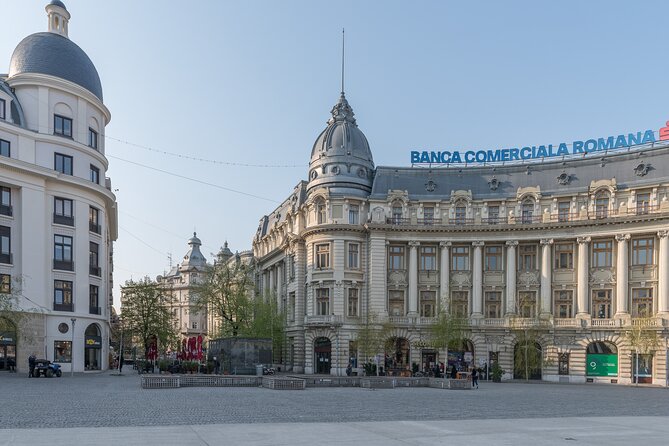
- Calea Victoriei, Bucharest’s historic showpiece
- The University of Bucharest in ten focused minutes
- Macca Villacrosse Passage and a touch of old Bucharest
- Stavropoleos Monastery, a quiet pause in the center
- Hanul cu Tei and Bucharest’s old inns
- Manuc’s Inn, where commerce shaped the city
- Constitution Square and the Palace of Parliament
- What the guide adds to the route
- Price, pace, and who will get the most from it
- Weather, cancellation, and practical planning
- Should you book this Bucharest tour?
- FAQ
- Where does the Bucharest walking tour begin?
- Where does the tour end?
- What time does the tour start?
- How long does the tour last?
- How much does the experience cost?
- Is the tour offered in English?
- How many people can join the tour?
- Are admission tickets included?
- What happens if the weather is poor?
Key points to know before you book
- Revolution Square opens the story: You begin where Ceaușescu gave his final speech in December 1989, the moment before Romania’s communist regime began to collapse.
- Eight stops cover several sides of Bucharest: The route moves from political history to elegant Calea Victoriei, religious buildings, old commercial passages, and the Palace of Parliament district.
- The group is capped at 10 people: That is a useful size for a walking tour, especially when you want to hear a guide clearly and ask about local life.
- The tour ends at Constitution Square: You finish face to face with the Palace of Parliament, one of the city’s most imposing sights.
- Local guidance is the main value: Doina and Dorin are praised for their energy, detailed explanations, and willingness to show more than the basic route.
- The tour is good for families: A stroller was handled without trouble on one visit, though the walk remains an outdoor city route with changing surfaces and busy public spaces.
Why this short Bucharest walk works
Bucharest can feel scattered at first. Its grand boulevards, nineteenth-century buildings, Orthodox churches, communist-era monuments, and Old Town lanes do not always form an obvious pattern on a map. This route helps you connect them.
You begin at 10:00 a.m. in Revolution Square and finish at Constitution Square. That direction matters. The morning starts with Romania’s recent political past, then moves through older layers of the city before bringing you to the enormous administrative project that shaped modern Bucharest.
I see this as a first-day orientation walk. You will not enter every landmark, and three hours is not enough for a full study of Bucharest. But you get a useful framework for deciding where to return later. At this price, the guide’s interpretation is more important than admission tickets, and the tour puts that emphasis in the right place.
The small maximum of 10 people is another practical advantage. A guide can point out details without shouting across a crowd, and you can ask for help with restaurants, shops, or nearby facilities. Doina is praised for knowing local owners and helping with practical needs, including finding a restroom. That may sound minor, but it matters when you are walking with children or trying to get oriented on your first morning.
A few more trips worth weighing up before you book
- Bucharest: Dracula’s Castle, Peles Castle, & Brasov Old Town
★ 4.5 · 17,858 reviews - Bucharest: Dracula Castle, Peles Castle & Brasov Old Town
★ 4.6 · 10,891 reviews - Bucharest: Dracula’s Castle, Peleș Castle & Brașov Day Trip
★ 4.5 · 5,919 reviews
Revolution Square and the sound of 1989
The tour begins at Revolution Square, or Piața Revoluției. This is not simply a broad city plaza. It is the place where Nicolae Ceaușescu delivered his final speech on December 21, 1989.
The speech began as a public show of support for the communist government. Instead, the crowd turned against him. The popular revolt that followed led to the end of Romania’s communist regime. A local guide can give the square a sense of sequence: the speech, the break in control, and the events that changed the country.
Allow about 20 minutes here. That is enough time for an explanation and questions, though you will want to listen closely. The square’s importance is political and historical rather than scenic, so a guide’s storytelling gives the stop its weight.
I like starting here because it prevents Bucharest from becoming just a parade of attractive buildings. You begin with the country’s recent past, then see the city with more context. If you have little knowledge of Romanian history, this is one of the most useful parts of the walk.
Calea Victoriei, Bucharest’s historic showpiece
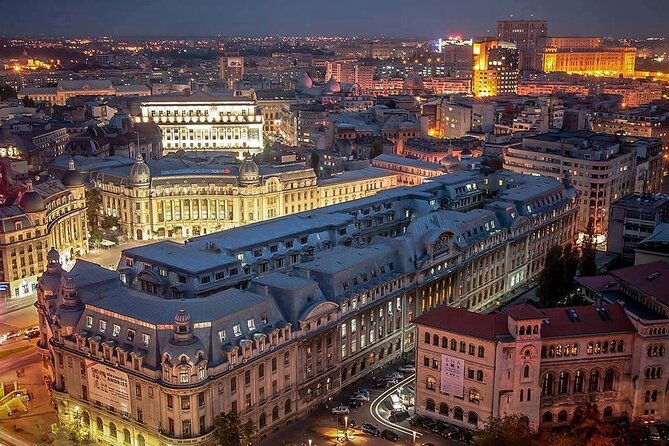
From Revolution Square, the route continues along Calea Victoriei, one of Bucharest’s oldest roads and one of its most important avenues today. It was also the first street in Bucharest illuminated with candles at night, beginning in July 1814.
The detail about candle lighting gives the avenue a human scale. Before modern street lighting, a well-lit road signaled importance, safety, and civic ambition. Today, Calea Victoriei links major buildings and city sights, making it a natural route for understanding Bucharest’s central core.
The scheduled stop is about 20 minutes. Expect exterior viewing and explanation rather than a long building-by-building tour. The guide’s role is to help you notice how the avenue fits into the city’s development.
This part will suit you if you enjoy architecture and urban stories. It may feel brief if you want to enter major buildings or stop for photographs at every facade. Still, the short timing keeps the route moving and leaves room for the Old Town sights ahead.
The University of Bucharest in ten focused minutes
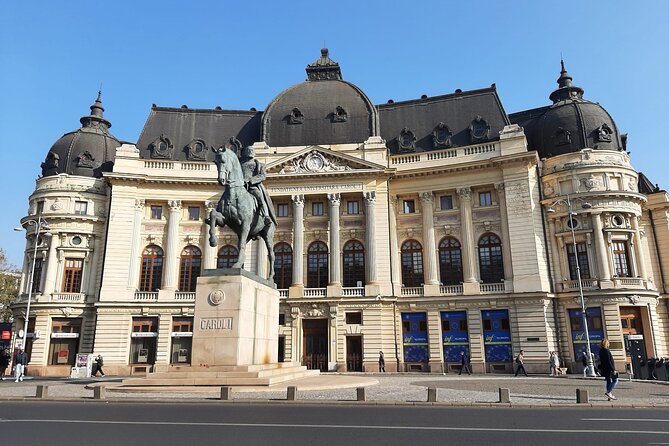
The University of Bucharest is next, with about 10 minutes set aside. The building is described as one of the city’s emblematic structures, so this is a quick exterior stop rather than a campus visit.
Ten minutes can be enough when the guide gives you the key points and you know what to look for. It also keeps the tour from getting bogged down in academic detail. You will have time to see the building, hear why it matters, and continue toward the older commercial quarter.
I would treat this stop as part of the broader city picture, not a major destination by itself. It works best for people who like seeing how public institutions shape a capital city. If your main goal is interiors, exhibitions, or long architectural visits, you will need separate time after the walk.
A completely different kind of day out around Bucharest:
- Bucharest: Palace of Parliament Tickets and Guide
★ 4.3 · 3,182 reviews - Bucharest: Day Trip to Dracula Castle, Peles Castle & Brașov
★ 4.4 · 3,049 reviews - Bucharest to Dracula Castle, Peles Castle and Brasov Guided Tour
★ 4.5 · 2,933 reviews - Bucharest: Palace of Parliament Tickets and Guided Tour
★ 4.4 · 1,877 reviews
Macca Villacrosse Passage and a touch of old Bucharest
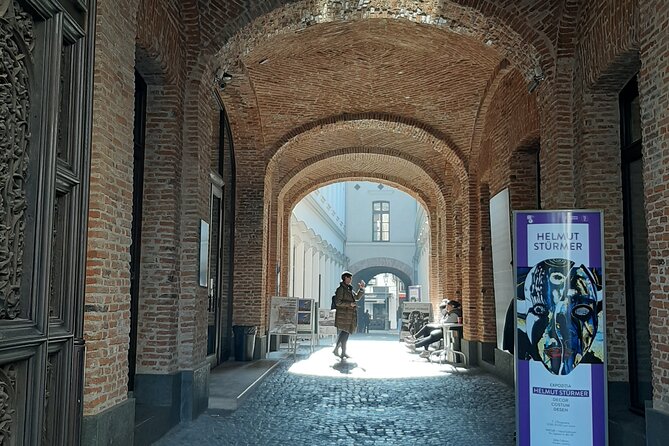
Macca Villacrosse Passage takes you into a different mood. It is a covered passage in the Old Town, described as a small version of Milan’s Vittorio Emanuele gallery.
The comparison gives you a quick visual idea: a compact arcade rather than a huge shopping hall. The passage is scheduled for 10 minutes, so you can look up, take in the details, and hear how it fits into Bucharest’s commercial past.
This is the kind of stop that can be easy to miss when walking alone. You may pass through without understanding why it matters. With a guide, the route gains a little more texture, linking a pleasant architectural detail to the city’s older trade and social life.
Do not expect a long break here. Ten minutes is enough for a look, but not necessarily for lingering over coffee or shopping. Save that for a return visit if the passage catches your interest.
Stavropoleos Monastery, a quiet pause in the center
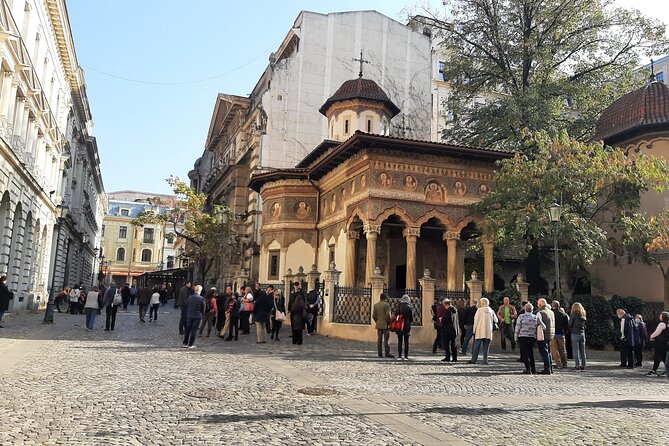
Stavropoleos Church, also called Stavropoleos Monastery, was built in the eighteenth century by a Greek monk. The route allows about 15 minutes.
This is one of the more distinctive stops because it brings religious architecture into a walk otherwise shaped by political and commercial landmarks. The church is an Eastern Orthodox monastery, and its presence in central Bucharest gives you a chance to see a more intimate side of the city.
I would slow down here. The stop is not long, but it breaks up the avenue and Old Town sections with a place of worship and reflection. The guide can explain the building’s origin and its place in Bucharest without requiring a full religious tour.
Because the visit details do not list an interior admission or a guaranteed entry, plan on guided exterior viewing unless your guide says otherwise. Dress and behave respectfully around the church, and keep the schedule in mind if services or other activity affect access.
Hanul cu Tei and Bucharest’s old inns
Hanul cu Tei is presented as the only historic inn in Bucharest to have kept its original shape exactly as it was at its beginning. The stop lasts roughly 10 minutes.
That claim makes this more than a quick photo stop. An inn was a place for trade, lodging, and social contact, so it helps explain how the center functioned before modern hotels and commercial streets took over. The preserved form gives you a physical link to that older city.
The stop is short, and you should not expect a full historical reconstruction or an extended interior visit. Its value comes from seeing the building in relation to the other Old Town passages and inns. Taken together, these stops show that Bucharest was not built only from grand government projects. It also grew through courtyards, trade, lodging, and everyday movement.
Manuc’s Inn, where commerce shaped the city
Manuc’s Inn, or Hanul lui Manuc, is described as the oldest operating hotel building in Bucharest and as the most important commercial complex in the middle of the nineteenth century. The tour allows around 10 minutes here.
This is another place where a guide adds context. You can look at the building, but the larger question is why inns mattered. They provided a base for merchants and a place where goods, news, and people crossed paths. Manuc’s Inn helps turn the Old Town from a collection of picturesque buildings into a working commercial center.
The stop may leave you wanting more time. Ten minutes is enough for an introduction, not a detailed exploration. If you are interested in the inn, note it as a place to revisit after the tour. The same advice applies to any stop that catches your attention: use the walk to mark return visits rather than trying to see everything at once.
Constitution Square and the Palace of Parliament
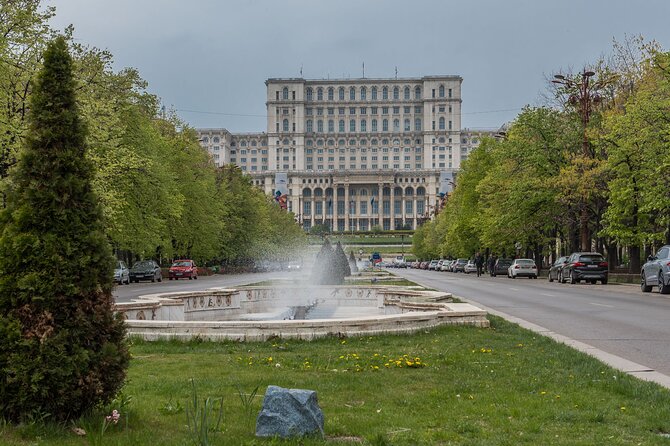
The final stop is Constitution Square, or Piața Constituției. The square faces the Palace of Parliament, described as the second-biggest administrative building in the world.
This is a powerful ending because the scale changes so sharply. Earlier stops focus on streets, passages, churches, and historic inns. Here, you confront a huge administrative structure and a broad civic space. The contrast helps you understand how much Bucharest’s built environment reflects the country’s communist period.
The tour allows about 15 minutes. That is enough for an explanation and exterior views, but not for a palace interior visit. No admission is listed, so you should not book this experience expecting a guided tour inside the building.
I like the route’s final position here. Constitution Square gives you room to process what you have seen, from the 1989 revolt at the start to the grand state architecture at the finish. It also leaves you in a useful part of the city for continuing on your own, although the experience itself ends at the square.
What the guide adds to the route
The strongest part of this experience is the guide’s role. Doina is praised for being friendly, enthusiastic, helpful, and willing to continue beyond the planned time. She is also described as able to answer questions well and connect visitors with local shop and restaurant owners.
Dorin is also praised for bringing energy to the route and showing as much of the city as possible. The most useful pattern is clear: the guide is not simply pointing at buildings and reading dates. You can expect an active explanation of the history behind the stops, along with extra churches, buildings, and attractions along the way.
That enthusiasm can be a benefit, especially if you want a strong introduction to Bucharest. It can also mean the three-hour estimate is flexible. One reported walk lasted about four hours, with the guide continuing to explain the city. If you have another appointment immediately afterward, leave extra time rather than treating the end time as exact.
Price, pace, and who will get the most from it
At $16.87 per person, this is a low-cost way to get a structured introduction to central Bucharest. Since the listed stops have free admission, you are paying mainly for the route, the local explanation, and the convenience of seeing several important areas in one morning.
That is good value if you are new to the city, have only a short stay, or prefer history explained on the street. It is less useful if you want paid interiors, museum time, or a relaxed café-based visit. The walk covers eight stops, so the pace is purposeful.
The 10-person limit keeps the experience personal without making it private. Most people can participate, and the tour is near public transportation. A stroller was used successfully by a family with a small child, though you should still expect a normal city walk rather than a specially adapted route.
The tour is offered in English. It begins at Revolution Square and ends at Constitution Square, so you should plan your later movement from the finishing point rather than expecting to return to the start.
Weather, cancellation, and practical planning
This experience requires good weather. If poor weather causes cancellation, you are offered another date or a full refund. You can also cancel for a full refund up to 24 hours before the 10:00 a.m. start time.
For practical planning, wear comfortable walking shoes and bring water, especially if the guide extends the route. Since restroom access was helped by local connections on one visit, it is still sensible to use facilities before starting rather than depend on an unscheduled stop.
Keep your morning open. The official duration is approximately three hours, but the guide may continue if the group is interested. That extra time is valuable, but only if your schedule allows it.
Should you book this Bucharest tour?
I would book this walk if you want a low-cost first look at Bucharest, a local guide who explains the city rather than simply naming buildings, and a route that connects communist history with older streets and religious sites.
You should choose something else if your priority is entering the Palace of Parliament, spending long periods inside churches, or taking a slow photography walk. This experience is built around outdoor orientation and storytelling.
For most first-time visitors, the route makes sense. You begin with the events of 1989, move along Calea Victoriei, pass through the University area and Old Town, then finish before the Palace of Parliament. Add the small group size, English guidance, free cancellation up to 24 hours ahead, and a price under $17, and you have a practical introduction with unusually strong value.
FAQ
Where does the Bucharest walking tour begin?
The tour begins at Revolution Square, or Piața Revoluției, in Bucharest.
Where does the tour end?
The experience ends at Constitution Square, or Piața Constituției, facing the Palace of Parliament.
What time does the tour start?
The start time is 10:00 a.m.
How long does the tour last?
The tour lasts approximately three hours, though the guide may continue longer. One reported experience lasted about four hours.
How much does the experience cost?
The listed price is $16.87 per person.
Is the tour offered in English?
Yes. The experience is offered in English and includes a mobile ticket.
How many people can join the tour?
The group has a maximum of 10 participants.
Are admission tickets included?
The listed stops have free admission. No paid interior admission is listed for the Palace of Parliament or the other stops.
What happens if the weather is poor?
The experience requires good weather. If it is canceled because of poor weather, you are offered a different date or a full refund.
Just added around Bucharest
- 10 hours Private Apiary Tour in Romania – From Bucharest★ 5.0 · 3 reviews
- 4-Day Inside Transylvania & Transfagarasan Tour from Bucharest★ 5.0 · 3 reviews
- Bucharest: Charm of the Belle Époque Private Tour★ 5.0 · 3 reviews
- Bran & Peles Castles through the Best Road in the World: Transfagarasan road★ 4.5 · 3 reviews
- Private Wine Tasting at Bucharest’s First Wine Bar★ 5.0 · 3 reviews
- 2-Day Small-Group Tour in Transylvania from Bucharest – Maximum 5 Persons★ 5.0 · 3 reviews
- Bucharest to Brasov – Fast Private Transfer★ 5.0 · 3 reviews
- Probably the Best Restaurant and Wine Cellar near Bucharest★ 4.5 · 3 reviews
Guided, compared.
Bucharest to Dracula Castle, Peles Castle and Brasov Guided Tour
Read our review →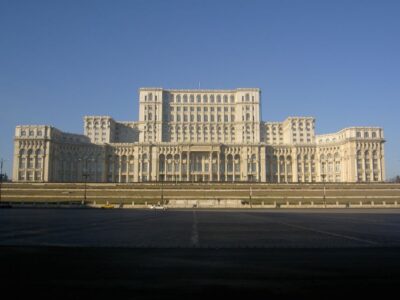

Palace of Parliament in Bucharest – fast-track tickets and guide
Read our review →
Dracula Castle, Peles Castle & Brasov Guided Tour
Read our review →