
Reviewed · CITY TOURS
Bucharest City Tour 2 hours – by Car with a Private Guide
Bucharest tells its story from a car window. This private two-hour tour links the city’s communist monuments, royal streets, village houses, and Revolution sites without making you wrestle with public transport. I like the private car and flexible route, and I like that fuel, parking, tolls, and taxes are already covered. The main catch is time: two hours gives you a strong introduction, but not long visits inside every attraction.
I also like the personal touch promised by an English-speaking guide and driver. Nicolas, the guide named in the tour information, is praised for humor, family stories from life under communism, and a stop at his favorite éclair shop. At $123.91 per person, the price makes the most sense for a small group that values convenience and private attention.
In This Review
- Key things to know before booking
- Why this two-hour drive works in Bucharest
- The Palace of Parliament and the cost of megalomania
- Traditional Romania at the National Village Museum
- The December 1989 Revolution at the Senate Palace
- The Ceauşescu Mansion and private life at the top
- The Arch of Triumph and Romania’s national story
- The Romanian Athenaeum and central Bucharest
- Royal streets, Revolution buildings, and the historic center
- What the private guide adds
- Price, timing, and what you receive
- Who should book this Bucharest tour?
- FAQ
- How long is the Bucharest City Tour?
- Is the tour private?
- Is pickup available?
- Is the guide English-speaking?
- Are gasoline, parking, tolls, and taxes included?
- Are food and drinks included?
- Can the itinerary be changed?
- Does the tour include entrance tickets?
- Is the tour suitable for first-time visitors?
- What is the cancellation policy?
- Should you book it?
Key things to know before booking
- The Palace of Parliament anchors the communist story, with a look at the scale and cost of Nicolae Ceauşescu’s grand project.
- The National Village Museum changes the mood, offering traditional homes, mills, and wooden churches from across Romania.
- The route includes the December 1989 Revolution sites, including the former Communist Party Central Committee building.
- You can see Ceauşescu’s former private home, known as the Ceauşescu Mansion, where the dictator and his family lived from 1965 to 1989.
- The private format helps you fit the tour around your day, with pickup from an address you provide and possible itinerary changes after the tour begins.
- The two-hour limit requires sensible expectations, since some stops may be viewing points rather than full museum visits.
Why this two-hour drive works in Bucharest
Bucharest is a city of sharp contrasts. One street may show ornate nineteenth-century architecture, while the next recalls decades of communist rule. A short car tour is useful here because the major sights are spread across different parts of the city.
You are not simply moving between postcard stops. The route connects royal Bucharest, traditional rural Romania, the Ceauşescu years, and the uprising that ended communist rule in December 1989. A guide can explain those links while you travel, rather than leaving you to piece them together from isolated monuments.
The private setup matters most if you have only a morning, afternoon, or stopover in the city. You can request pickup at your address, choose from available tour times, and travel only with your own friends or family. That avoids waiting for a large group and gives you room to ask questions.
Still, two hours goes quickly. You should think of this as a guided orientation, not a full museum day. The route contains enough material for several hours of independent sightseeing, so ask your guide at the start which stops deserve more time for your interests.
More City Tours in Bucharest
- Bucharest: City Highlights Guided Walking Tour
★ 4.9 · 1,482 reviews - Bucharest: 2-Hour City Highlights Bike Tour
★ 4.8 · 269 reviews - Bucharest Tuk Tuk city tour
★ 5.0 · 188 reviews
The Palace of Parliament and the cost of megalomania
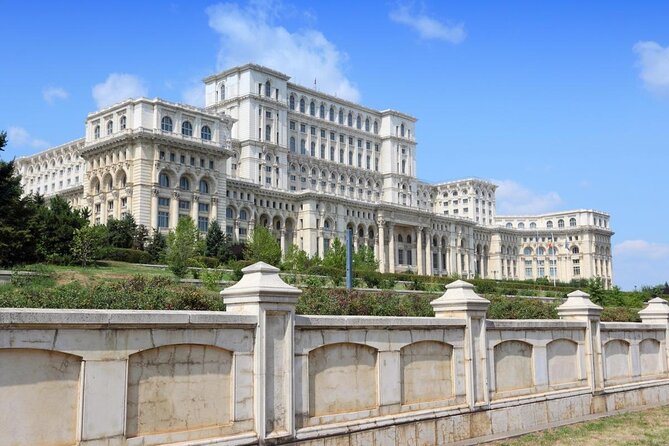
The Palace of Parliament, also called the People’s House, is the tour’s most dramatic stop. It is described as the world’s second-largest administrative building after the Pentagon, an astonishing fact that helps explain why the structure feels less like a normal government building and more like a city-sized statement of power.
The important story is not only the building’s scale. Your guide can place it within the communist system led by Nicolae Ceauşescu, where grand construction projects demanded huge resources while ordinary people faced hardship. The building’s immense rooms and heavy ornament show what happens when political power has no practical brake.
You may feel physically small here, and that is part of the point. The architecture was designed to project authority. It also offers a direct lesson in how a totalitarian government can reshape a capital to serve one leader’s image.
A short driving tour cannot promise a full interior visit. The supplied information does not say that admission is included or that an interior tour is guaranteed. If entering the building is important to you, confirm the arrangements before booking, and do not assume the $123.91 covers admission.
Even from outside, the Palace of Parliament gives the tour a strong beginning. It turns an abstract lesson about communism into something concrete, oversized, and difficult to ignore.
Traditional Romania at the National Village Museum
The National Village Museum provides a needed change of pace. Instead of monumental concrete and political power, you see examples of traditional Romanian homes and rural buildings gathered in one setting.
The houses are made from materials including wood, adobe, and stone. The collection also includes features such as mills and wooden churches. Together, these buildings show how Romanian communities shaped practical homes and working environments from local materials.
I like this stop because it prevents the tour from treating Romania only as a twentieth-century political story. The museum points to older customs, local craftsmanship, and village life. It also gives you a way to understand the country beyond Bucharest’s boulevards and government buildings.
The stop is especially useful for first-time visitors who want cultural context but have no time for a longer trip through rural Romania. You will not see every region in depth during a short visit, but the museum offers a compact look at the variety of Romanian building traditions.
The outdoor setting may also make this a more relaxed part of the route. However, the two-hour schedule means your time here may be limited. If traditional architecture is your main interest, tell the guide early so the timing can reflect that.
The December 1989 Revolution at the Senate Palace
The former Central Committee building is one of the route’s most important historical locations. It later became associated with the Senate Palace, but its key role came during the final days of Ceauşescu’s rule.
This is where the December 1989 Revolution began in Bucharest. The building was the headquarters of the Romanian Communist Party’s Central Committee, and it became the place from which Ceauşescu fled as public pressure and revolt brought his rule to an end.
The value of this stop lies in the connection between place and event. You are not looking at an anonymous government office. You are seeing the setting where the old political order began to collapse.
Your guide can also discuss the questions left behind by the regime, including the dictator’s fortune, the state security service, and claims about offshore accounts. These subjects remain tied to the larger question of how power and wealth operated under communism.
This stop may feel less visually impressive than the Palace of Parliament, but it carries more immediate human drama. I would pay close attention to the guide here. The building itself cannot explain the fear, courage, and confusion of the Revolution without someone supplying the story.
A few more trips worth weighing up before you book
- 4h Bucharest Private Tour (2h by Car and 2h Walking in Old Town)
★ 5.0 · 90 reviews - 2h Bucharest Private Tour by Car
★ 5.0 · 10 reviews - 2-Hour Luxury Picnic in Cluj-Napoca Romania
★ 4.5 · 7 reviews
The Ceauşescu Mansion and private life at the top
The Ceauşescu Mansion was the private home of Nicolae and Elena Ceauşescu and their children, Nicu, Zoia, and Valentin, from 1965 until 1989.
That detail gives the site a different angle on the regime. The Palace of Parliament shows public power and official display. The mansion focuses on the family behind that power and the private world they maintained during a period of strict control.
You may find the contrast striking. Ordinary Romanian life under communism is represented elsewhere by shortages, restrictions, and political pressure. Here, the focus is on the residence of the country’s ruling family. A guide can help you consider what that difference meant without reducing the story to decoration alone.
The available tour information does not confirm that admission to the mansion is included. It also does not promise a full interior visit during the two-hour drive. If you want to go inside, ask whether the stop is a viewing point or a booked entry.
Even a short exterior visit can add useful context. It links the grand public projects to the people who ordered them and helps explain why the Revolution carried such force.
The Arch of Triumph and Romania’s national story
Bucharest’s Arch of Triumph rises 27 meters and recalls the better-known arch in Paris. The monument has changed over time before reaching its present design, so it is not just a piece of grand city scenery.
Its meaning is tied to Romania’s fight for freedom and national unity. With good timing and access, you may be able to see exhibits connected with the First World War, the heraldry of major boyar families, the arch itself, and the Great Union of 1918.
The possible exhibits make this more than a quick photograph. They connect military history, aristocratic families, national symbols, and the formation of modern Romania. Still, the information says you may see these displays with some luck, so you should not build your whole plan around entering them.
The arch is a good example of why a private car helps. You can see an important monument without spending a large part of your short visit working out transport connections. If the stop is brief, the guide’s explanation will be as valuable as the monument itself.
The Romanian Athenaeum and central Bucharest
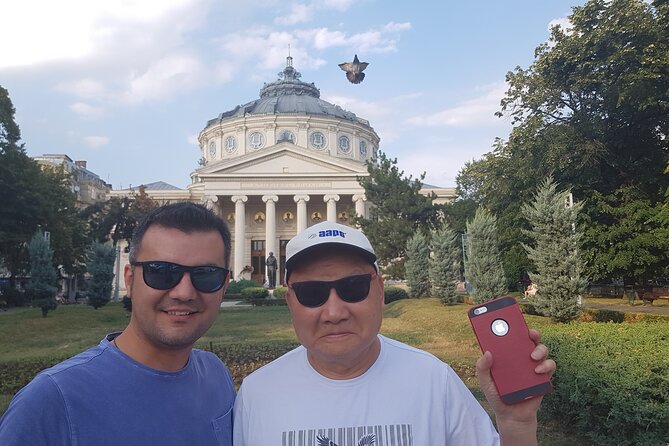
The Romanian Athenaeum is often treated as one of Bucharest’s clearest cultural symbols. Its inclusion gives the tour a welcome look at music, architecture, and national identity after the heavier communist sites.
The building is also listed among European heritage landmarks, which helps explain its importance beyond a standard sightseeing photo. Even if you only view it from outside, it gives you a strong sense of the city’s formal cultural life.
The Athenaeum works best when paired with the surrounding central district. This part of Bucharest brings together old boyar houses, churches, luxury shops, cafes, restaurants, museums, and government buildings. You can also see the Royal Palace, the Central University Library, Cantacuzino Palace, and the Palace of the National Military Circle.
The area rewards a slower walk, but this tour is designed for a drive. You may pass more than you can inspect. I would use the guide to identify the buildings you should return to later, especially if your schedule allows another independent outing.
Royal streets, Revolution buildings, and the historic center
The central route gathers many layers of Bucharest in a small area. The former Post Palace, now the National History Museum, the CEC Palace, the Lady’s Church, and old inns all help show the city before and after communism.
You will also see the Royal Palace and the Senate Palace, along with statues, hotels, restaurants, and cultural buildings. The appeal is not one single sight. It is the way political, religious, commercial, and royal buildings occupy the same urban space.
This is likely the part of the tour where you will want to keep your eyes moving. Look for changes in architecture and scale. Some buildings suggest wealth and ceremony, while others recall administration, religion, or political control.
A car gives you a quick overview, but it cannot replace walking in this district. Treat this section as a useful preview. Mark the places that catch your eye, then return on foot if you have time.
What the private guide adds
The guide is central to the value of this experience. A private English-speaking guide and driver is available throughout the tour, so you can ask questions as the route unfolds instead of listening to a fixed speech meant for strangers.
Nicolas is specifically associated with a warm, funny style. His explanations have included stories about historic sites, personal family experiences under communism, and a stop at a favorite éclair shop. That kind of local food suggestion can be more useful than another generic souvenir recommendation.
The éclair stop is not presented as a standard part of every itinerary, so treat it as a possible personal touch rather than a guaranteed inclusion. Food and drinks are not included in the tour price.
The private arrangement also gives you flexibility. You can request changes to the daily route even after the tour starts, although practical limits will apply in a two-hour window. If you care most about communist history, ask for more time at the Palace of Parliament, the Revolution site, and the mansion. If you prefer architecture, request more attention to the Athenaeum and central Bucharest.
Price, timing, and what you receive
At $123.91 per person, this is not the cheapest way to see Bucharest. The price is easier to justify when several people share the private vehicle and guide, especially since the tour includes gasoline, parking, road tolls, and taxes.
You are also paying for time saved. Pickup is offered, you can choose a suitable departure time, and your group does not have to coordinate public transport between widely separated sights. For a first visit or a tight schedule, that convenience has real value.
The price does not include food or drinks. The information also does not confirm entrance fees for the Palace of Parliament, National Village Museum, Ceauşescu Mansion, Arch of Triumph exhibits, or other attractions. Ask exactly what you will enter before you finalize your plans.
The tour is offered in English and is private for your group only. Group discounts may be available, which makes the per-person price more attractive for families or friends traveling together.
Who should book this Bucharest tour?
I would choose this tour if you are visiting Bucharest for the first time and want a fast, guided introduction. It suits people staying only briefly, families who prefer a private vehicle, and anyone who wants the communist story explained in context rather than read from plaques.
It also suits you if you want flexibility. You can provide a pickup address, choose a time that fits your day, and discuss route changes with the guide.
I would hesitate if you want long museum visits, extensive walking, or a slow look at each building. Two hours is simply not enough for every interior and exhibit. In that case, use this as an orientation and reserve separate time for the places that interest you most.
Free cancellation is available if you cancel at least 24 hours before the start time. Changes or cancellations within 24 hours are not refunded, so keep that deadline in mind.
FAQ
How long is the Bucharest City Tour?
The tour lasts approximately two hours.
Is the tour private?
Yes. Only your group participates, and the private car is reserved for you, your friends, or your family.
Is pickup available?
Yes. Pickup is offered, and you should provide the time and address where you want to be collected.
Is the guide English-speaking?
Yes. The tour includes a licensed English-speaking guide and driver.
Are gasoline, parking, tolls, and taxes included?
Yes. The tour includes gasoline, parking, road tolls, and all taxes.
Are food and drinks included?
No. Food and drinks are not included.
Can the itinerary be changed?
The tour allows flexibility for changes to the daily itinerary, including changes after the tour has started.
Does the tour include entrance tickets?
The provided information does not confirm that attraction admission is included. Ask the provider about entry fees and interior visits before booking.
Is the tour suitable for first-time visitors?
Yes. It is designed as a short introduction to Bucharest and is particularly suited to first-time visitors or people with limited time.
What is the cancellation policy?
You can receive a full refund by canceling at least 24 hours before the experience starts. Cancellations or changes made less than 24 hours before the start time are not refunded or accepted.
Should you book it?
Book this private Bucharest tour if you want efficient sightseeing with a human guide, especially on a short visit. The strongest feature is the route’s range: a communist mega-building, a Revolution site, a dictator’s home, traditional Romanian houses, a national monument, and central city architecture all fit into one compact introduction.
The main tradeoff is depth. You will see more than you can fully explore, and admission details need checking. For a small group that values convenience, flexibility, and Nicolas’s personal storytelling style, the price can be fair. For a slower, museum-focused visit, book longer stays at the individual sights instead.
Just added around Bucharest
- 4-Day Inside Transylvania & Transfagarasan Tour from Bucharest★ 5.0 · 3 reviews
- 10 hours Private Apiary Tour in Romania – From Bucharest★ 5.0 · 3 reviews
- Bucharest: Charm of the Belle Époque Private Tour★ 5.0 · 3 reviews
- Bran & Peles Castles through the Best Road in the World: Transfagarasan road★ 4.5 · 3 reviews
- 2-Day Small-Group Tour in Transylvania from Bucharest – Maximum 5 Persons★ 5.0 · 3 reviews
- Private Wine Tasting at Bucharest’s First Wine Bar★ 5.0 · 3 reviews
- Bucharest to Brasov – Fast Private Transfer★ 5.0 · 3 reviews
- Probably the Best Restaurant and Wine Cellar near Bucharest★ 4.5 · 3 reviews
City Tours, compared.

Bucharest Panoramic Sightseeing – Private City Tour
Read our review →
SB01 – City Tour Sibiu: Exploring the Heart of Transylvania
Read our review →
City Tour Sighisoara Legends & Landmarks A Walk Through Time
Read our review →Browse the lists this tour appears in