Reviewed · PRIVATE
Private -RedPatrol Tour of Bucharest with a Romanian Vintage Car
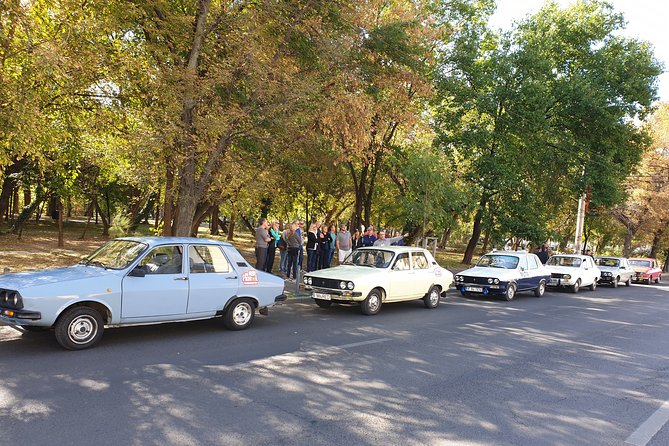
Old cars make old stories personal. RedPatrol’s private Bucharest tour lets you ride, and possibly drive, a restored Dacia from the 1970s or 1980s while visiting places tied to Romanian Communism. I like the private format, which gives you a flexible start time and a guide focused on your group. I also like the chance to hear personal accounts, including the kind of commentary praised from guide Serban.
The main drawback is the car itself. A classic Dacia has no air-conditioning, power steering, ABS, GPS, or automatic transmission, so comfort and driving ease are not modern-car strong points. Still, for a three to three-and-a-half-hour look at Bucharest’s Communist past, this is an unusually hands-on way to see the city.
In This Review
- Key points at a glance
- Why a Communist-era Dacia changes the tour
- Revolution Square, where the story begins
- Casa Radio, Bucharest’s unfinished ghost palace
- Academia Română and the Socialist Academy
- The Palace of Parliament and the scale of power
- Apartment blocks, government quarters, and everyday Bucharest
- Ceaușescu’s private house
- The unification monument and a changing national story
- House of the Free Press and the Communist media machine
- The guide and the value of personal stories
- Is $120.68 per person a fair price?
- Who should book this Dacia tour?
- Should you book the RedPatrol Bucharest tour?
- FAQ
- How long does the RedPatrol Bucharest tour last?
- Is hotel pickup available?
- Can I choose the starting time?
- Can I drive the Dacia myself?
- What type of car is used?
- Does the Dacia have air-conditioning or automatic transmission?
- Are children and pets allowed?
- What is included in the price?
Key points at a glance
- Drive a restored Dacia 1300 or 1310: You can take the wheel yourself or use the included private driver.
- See Bucharest through its Communist past: Revolution Square, Casa Radio, the Palace of Parliament, the former Communist press palace, and Ceaușescu’s private house all appear on the route.
- Hear personal stories, not just dates: Guide Serban has been praised for clear storytelling and firsthand memories of Communism.
- Get door-to-door service: Pickup and drop-off are available from addresses throughout Bucharest.
- Expect a real vintage-car experience: The cars are heated in winter, but they do not have air-conditioning or modern driving aids.
- Best for adults and older children: RedPatrol does not allow children under 10 or pets.
Why a Communist-era Dacia changes the tour
You can see Bucharest’s major sights from a regular minibus. You can also ride through them in a Dacia that looks and feels like part of the period being discussed. That difference matters.
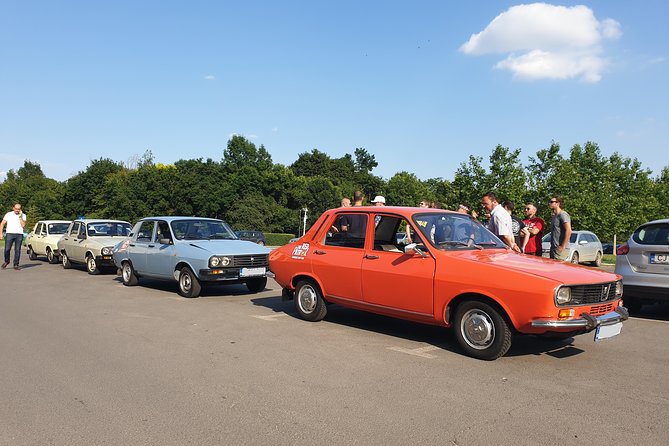
The Dacia 1300 and 1310 were classic Romanian cars of the 1970s and 1980s. RedPatrol uses fully restored cars that meet current traffic safety regulations, but the restoration does not turn them into modern vehicles. You still get the old-fashioned gear change, firm controls, and limited equipment.
If you choose to drive, bring your driving license and ID card. You should also wear comfortable clothes suitable for driving. If you prefer to watch the city and listen, a private driver is included, so you do not have to manage traffic and sightseeing at the same time.
The car creates a useful connection between the sights. You are not simply being shown a former government building and told that it mattered. You are moving through Bucharest in a type of car associated with the period, which gives the ride a physical sense of time and place.
There is a practical tradeoff. The lack of air-conditioning may matter on a hot summer afternoon, especially if you are not used to older cars. Winter is less of a concern because the vehicles are heated.
A few more trips worth weighing up before you book
- Bucharest: Dracula’s Castle, Peles Castle, & Brasov Old Town
★ 4.5 · 17,858 reviews - Bucharest: Dracula Castle, Peles Castle & Brasov Old Town
★ 4.6 · 10,891 reviews - Bucharest: Dracula’s Castle, Peleș Castle & Brașov Day Trip
★ 4.5 · 5,919 reviews
Revolution Square, where the story begins
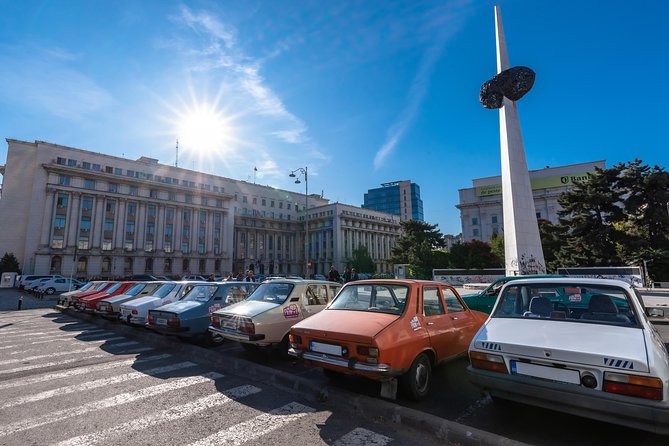
The tour opens at Revolution Square, described as the place where Communism began and ended in Romania. You have about 30 minutes here, enough time for a guided introduction and photographs without rushing through the stop.
This is a smart starting point because it frames the rest of the tour. Instead of treating Communist Bucharest as a collection of isolated buildings, the guide can place the city’s political story before you move into its grand avenues, apartment blocks, and former state institutions.
I would pay close attention here to the guide’s explanation of the transition from Communist rule. The value is not only in seeing a square. It is in learning how the city’s public spaces connect with the events that changed Romania.
Because admission is free, this stop adds context without adding a ticket cost. It also gives you an early chance to ask questions and tell the guide what interests you most, an advantage of having a private group.
Casa Radio, Bucharest’s unfinished ghost palace
Casa Radio receives about 20 minutes. The stop focuses on the Communist ghost palace, with time for stories and pictures. Admission is not included, and the visit is presented as an exterior exploration rather than a standard museum entry.
Casa Radio is useful because it shows a different side of Communist construction. The Palace of Parliament is enormous and finished. Casa Radio represents the unfinished, abandoned, or repurposed side of the same period. Its presence helps you understand that the era left behind more than monumental buildings.
This is a photo stop, but it should not be treated as a quick backdrop. Ask your guide why the building was created, what role it was meant to play, and how it fits into Bucharest’s wider building program. The supplied tour details promise stories here, which is important because the building itself cannot explain its place in the city.
The 20-minute timing keeps the stop moving. If you want long architectural photography sessions, this may feel brief. For a broad city tour, it is a sensible amount of time.
Academia Română and the Socialist Academy
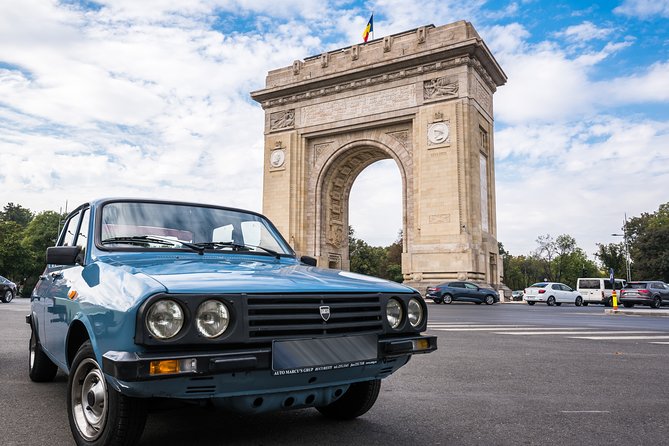
The former Socialist Academy building at Academia Română gets about 10 minutes. The guide provides a short presentation and time for pictures.
This is one of the quicker stops, so you should think of it as a visual and historical pause rather than a full visit. The building adds another piece to the picture of how education, research, and official institutions were organized under Socialism.
The short timing also helps balance the tour. You see several Communist-era sites without spending the entire afternoon at one location. If architectural detail is your main interest, use this moment to ask for the building’s specific role and look closely at the design before the car moves on.
A completely different kind of day out around Bucharest:
- Bucharest: Palace of Parliament Tickets and Guide
★ 4.3 · 3,182 reviews - Bucharest: Day Trip to Dracula Castle, Peles Castle & Brașov
★ 4.4 · 3,049 reviews - Bucharest to Dracula Castle, Peles Castle and Brasov Guided Tour
★ 4.5 · 2,933 reviews - Bucharest: Palace of Parliament Tickets and Guided Tour
★ 4.4 · 1,877 reviews
The Palace of Parliament and the scale of power
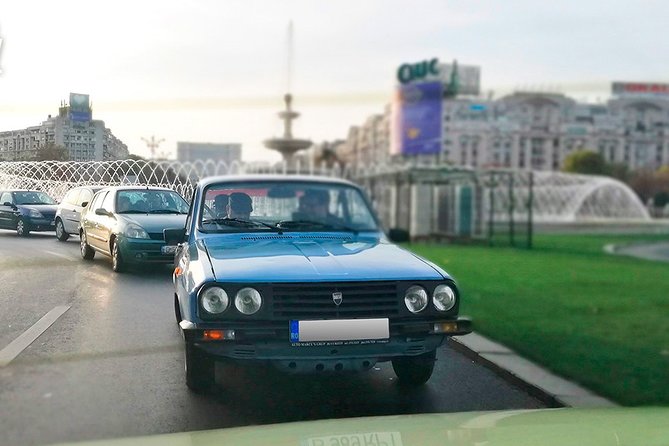
The Palace of Parliament gets roughly 30 minutes. The tour presents it as the world’s second-largest administrative building, and the stop is focused on the building and its setting rather than an included interior visit. Admission is not included.
This is likely the biggest visual moment of the route. The building’s scale is difficult to miss, but size alone does not explain why it matters. Your guide’s job is to connect the structure with the political power, planning, and public image of the Communist state.
You should check your expectations before booking. This experience is not described as a full guided interior tour of the Palace of Parliament. You are getting a presentation and a photo opportunity as part of a wider private route.
That approach suits you if you want context and an exterior view without committing to a separate building visit. If you specifically want to tour the interior, you will need to arrange that independently and confirm timing so it does not conflict with the car tour.
Apartment blocks, government quarters, and everyday Bucharest
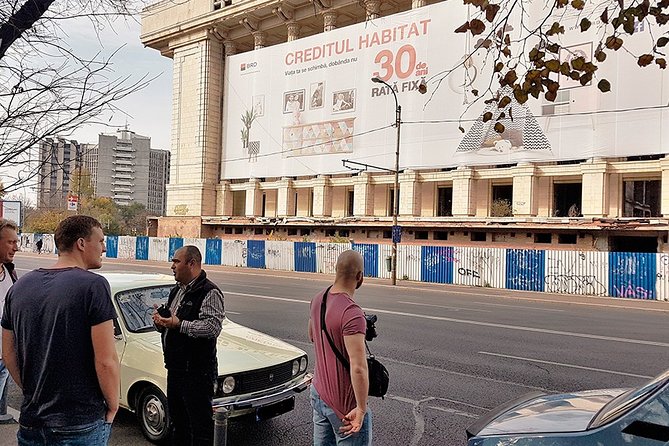
Between the named stops, the Dacia travels through Communist apartment-block districts and residential quarters. You also pass the area around the Romanian Government and residential areas built in the early 20th century.
These driving sections may be the most useful part for understanding Bucharest as a lived-in city. A monumental palace tells you about official ambition. Apartment blocks show how that ambition affected ordinary urban life. The route allows you to compare grand public buildings with the residential fabric around them.
The tour also includes a panoramic ride through one of Bucharest’s older boulevards. That matters because the experience is not limited to isolated photo stops. You spend time moving through the city, seeing how different periods sit beside one another.
A private vehicle is especially helpful here. You can ask the guide to point out changes in building style, district planning, and the relationship between state buildings and housing. You are not tied to a large group’s questions or a fixed audio recording.
Ceaușescu’s private house
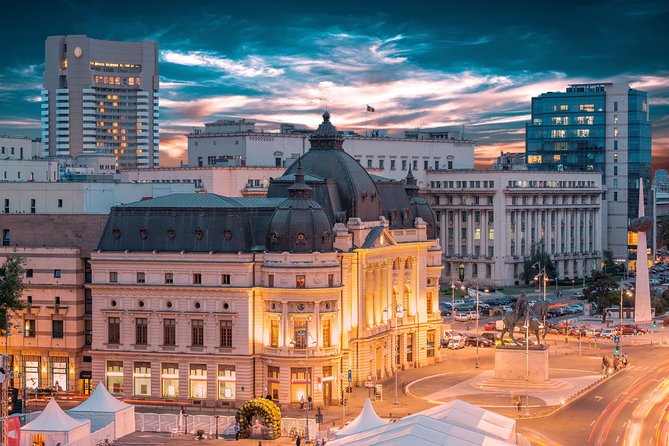
The former private residence of Nicolae Ceaușescu receives about 15 minutes. The guide gives a brief presentation, and admission is not included.
This stop shifts the focus from public power to private life. After seeing government buildings and state institutions, you get a place connected directly with Romania’s former leader and his household.
The visit is brief, so do not expect a long interior tour as part of this experience. The supplied details describe a presentation rather than included entry. If you want to go inside, confirm separately before building your day around it.
Even as a short stop, the house adds contrast. Public monuments can feel abstract. A private residence gives the story a more human scale, though the guide’s explanation remains essential for understanding why the site belongs on a Communist Bucharest route.
The unification monument and a changing national story
The route includes a presentation of Romania’s unification monument. This is another short interpretive stop rather than a separately timed admission visit.
Its value comes from contrast. The tour is centered on Communism, but Bucharest’s public spaces also express ideas about national unity and identity. Seeing this monument within the same journey helps you compare the messages different governments and periods placed in the city.
Since the exact stop timing is not listed, you should treat it as part of the moving route. The private format gives you a chance to ask for a concise explanation instead of letting the monument pass without context.
House of the Free Press and the Communist media machine
The House of the Free Press receives about 20 minutes, and admission is included. The stop explores the area around the Communist press palace.
This building helps explain how information was managed during the Communist period. The tour does not simply show government offices and residences. It also includes the place associated with the press, adding an important piece to the political story.
The included admission makes this one of the clearer value points in the itinerary, although the supplied details do not specify how much of the building you enter or what rooms are visited. Expect a guided exploration of the area and time for the guide’s explanation.
Afterward, the tour continues along one of Bucharest’s oldest boulevards in a full car ride. This gives you a final chance to enjoy the Dacia itself, rather than treating the vehicle as a shuttle between monuments.
The guide and the value of personal stories
The strongest praise centers on the guide’s commentary. Serban has been singled out for strong storytelling, and personal experiences of Communism have been described as adding depth to the tour.
That kind of personal connection can make a major difference in Bucharest. Buildings and dates are easy to find. What you cannot get as easily is a local explanation of how the period is remembered and how its presence still shapes the city.
Because this is a private tour, you can ask direct questions. You might want to ask about daily life, the purpose of a particular building, or why some Communist projects remain unfinished. The format gives the guide room to respond rather than deliver a fixed speech to a busload of people.
I would book this for the interpretation as much as for the car. The Dacia is the hook, but the stories are what turn the drive into a useful introduction to Bucharest.
Is $120.68 per person a fair price?
The listed price is $120.68 per person. That is not the cheapest way to see Bucharest, but you are paying for more than transport.
The price includes hotel pickup and drop-off in Bucharest, a professional local guide in your car, a private driver if you do not want to drive, bottled water, a tour newspaper, and a personalized gift. You also get a restored classic vehicle and a private itinerary lasting about three to three-and-a-half hours.
For one person, the per-person cost may feel high. For a small private group, the value improves, especially if a group discount applies. You are avoiding a generic group route and gaining the freedom to choose a start time that works for you.
I see the strongest value for couples, families with older children, and small groups who care about the Communist-era angle. If you only want a quick city overview, a standard walking tour may cost less and cover more general sights. If you want a themed route, private attention, and a memorable vehicle, the price is easier to justify.
Food and drinks are not included, though bottled water is provided. Plan to eat before or after the tour rather than expecting a meal stop.
Who should book this Dacia tour?
You should consider it if you want:
- A private experience rather than a fixed group excursion
- A focused introduction to Communist Bucharest
- The option to drive a restored Romanian classic
- Hotel pickup and drop-off within Bucharest
- Personal commentary and time for questions
- A mixture of major monuments, lesser-known buildings, apartment districts, and panoramic city driving
This is less suitable if you need modern-car comfort or want a full interior tour of every major building. The Dacia has no air-conditioning, ABS, GPS, power steering, or automatic gearbox. Children under 10 and pets cannot participate.
The tour is offered in English. Most people can take part, but anyone who drives must bring a valid driving license on the day of the tour, along with an ID card.
RedPatrol requires good weather. If weather causes a cancellation, you are offered another date or a full refund. You can also cancel for a full refund up to 24 hours before the start time. Changes or cancellations inside that window are not accepted.
Should you book the RedPatrol Bucharest tour?
I would book this if you want Bucharest’s Communist past explained through places, personal stories, and a car from the same era. The combination of Revolution Square, Casa Radio, the Palace of Parliament, Communist housing, Ceaușescu’s former home, and the House of the Free Press gives you a strong thematic route in a short time.
The key decision is comfort. If you want air-conditioning, automatic transmission, and a quiet ride, choose another city tour. If you can accept an old-fashioned car in exchange for character, private service, and a more personal look at Romania’s recent past, this is a distinctive and well-priced choice for a small group.
FAQ
How long does the RedPatrol Bucharest tour last?
The experience lasts approximately three to three-and-a-half hours.
Is hotel pickup available?
Yes. Pickup and drop-off are available from all addresses in Bucharest.
Can I choose the starting time?
Yes. The private format lets you choose a start time that works for your group.
Can I drive the Dacia myself?
Yes, you can drive if you bring your ID card and a valid driving license on the tour date. A private driver is included if you prefer not to drive.
What type of car is used?
RedPatrol uses fully restored Dacia 1300 or 1310 classic cars from the 1970s and 1980s.
Does the Dacia have air-conditioning or automatic transmission?
No. The cars do not have air-conditioning, ABS, GPS navigation, power steering, or automatic gear drive. They are heated during winter.
Are children and pets allowed?
Children under 10 and pets are not allowed to participate.
What is included in the price?
The experience includes Bucharest hotel pickup and drop-off, a professional local guide, the restored Dacia, a private driver if needed, a tour newspaper, a personalized gift, and bottled water. Food and drinks are not included.
Just added around Bucharest
- 10 hours Private Apiary Tour in Romania – From Bucharest★ 5.0 · 3 reviews
- 4-Day Inside Transylvania & Transfagarasan Tour from Bucharest★ 5.0 · 3 reviews
- Bucharest: Charm of the Belle Époque Private Tour★ 5.0 · 3 reviews
- Bran & Peles Castles through the Best Road in the World: Transfagarasan road★ 4.5 · 3 reviews
- Private Wine Tasting at Bucharest’s First Wine Bar★ 5.0 · 3 reviews
- 2-Day Small-Group Tour in Transylvania from Bucharest – Maximum 5 Persons★ 5.0 · 3 reviews
- Probably the Best Restaurant and Wine Cellar near Bucharest★ 4.5 · 3 reviews
- Bucharest to Brasov – Fast Private Transfer★ 5.0 · 3 reviews
Private, compared.
Castles of Transylvania: Private Day Trip from Bucharest
Read our review →
Dracula’s Castle, Peles Castle and Brasov – Private Day Trip from Bucharest
Read our review →
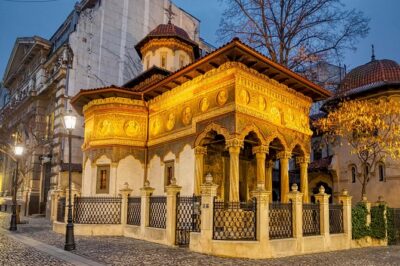
Bucharest Panoramic Sightseeing – Private City Tour
Read our review →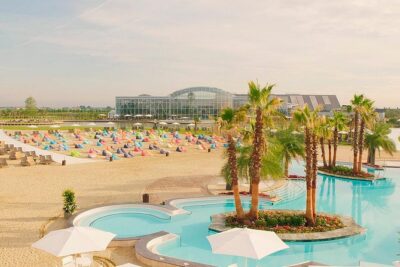
THERME “Take It Easy” Pack: Full Spa Access + Private Transfers
Read our review →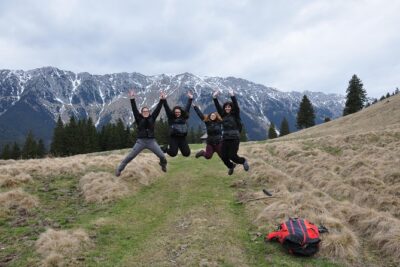
Piatra Craiului National Park Private Hiking Tour from Brasov
Read our review →
4h Bucharest Private Tour (2h by Car and 2h Walking in Old Town)
Read our review →