

Reviewed · WALKING TOURS
Bucharest Walking Tour with a Native Italian Speaking Guide
Bucharest rewards a closer look. This 2.5-hour walk links Orthodox churches, princely ruins, elegant avenues, and the scars of the 1989 revolution. I like the small group limit of 15 people, which should make it easier to hear the guide and ask questions. I also like the focus on stories and humor, especially from experienced guides such as Giuseppe Spadaro and Filippo DiCataldo. The main drawback is simple: you see the Parliament building only from outside, and the tour covers a lot of ground in a fairly short time.
The route is a useful first introduction rather than a slow architectural study. You begin in the old center at Stavropoleos Monastery and finish at Constitution Square, moving through Bucharest’s medieval core, Belle Époque avenues, and communist-era monumental zone. Since the tour is offered in Italian, it makes particular sense for Italian-speaking visitors who want history explained naturally instead of pieced together from signs and guidebooks.
In This Review
- Key points to know before booking
- Why this walk works as a first look at Bucharest
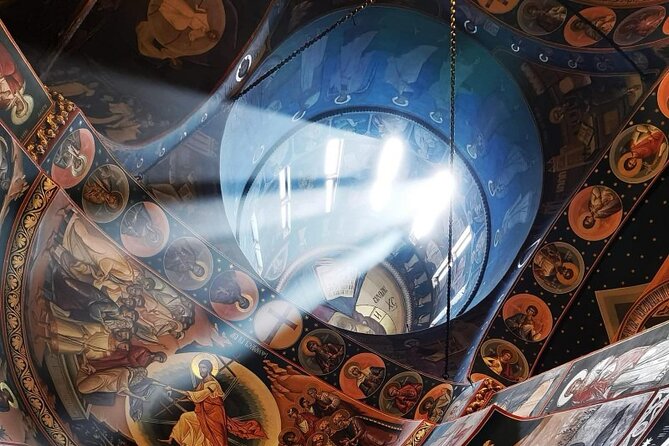
- Stavropoleos Monastery begins the story with quiet detail
- Curtea Veche connects Bucharest to its princely past
- Lipscani shows the old center after dark and in daylight
- BNR Palace and Macca-Villacrosse reveal Belle Époque Bucharest
- Calea Victoriei broadens the view
- Revolution Square puts 1989 at the center
- Constitution Square closes with communist scale
- The $36.76 price: where the value lies
- Timing, meeting point, and walking demands
- Who will get the most from this tour
- Should you book the Bucharest walking tour?
- FAQ
- How long does the Bucharest walking tour last?
- What time does the tour start?
- Where does the tour begin?
- Where does the tour finish?
- Is the tour conducted in Italian?
- How many people can join the tour?
- Are entrance tickets included?
- Can I cancel for a refund?
Key points to know before booking
- Italian-speaking guidance from certified local professionals: Giuseppe Spadaro and Filippo DiCataldo are named among the guides, with long experience in Romania.
- A city story told through sharp contrasts: Medieval courts, ornate churches, grand banks, nightlife streets, and communist power all appear within one route.
- Revolution Square receives real attention: The guide explains the final events of Nicolae Ceaușescu’s dictatorship and the bloody 1989 uprising.
- The Parliament is an exterior visit: You see Europe’s largest administrative building from Constitution Square, but no interior entry is included.
- The route lasts about 2 hours 30 minutes: Listed stops account for about 130 minutes, leaving time for walking between sights and brief transitions.
- Good value at $36.76 per person: There are no entrance fees included because the planned stops are viewed from public areas, but the guide supplies the context.
Why this walk works as a first look at Bucharest
Bucharest can feel hard to read at street level. One block gives you a small Orthodox church, the next gives you an ornate nineteenth-century facade, and a few minutes later you are facing a giant communist-era building. This tour gives those changes a clear order.
I like that the route does not treat Bucharest as a single-style city. It moves from the old princely center to Lipscani and Calea Victoriei, then to Revolution Square and Constitution Square. That path lets you see how power, commerce, religion, and modern city life have shifted over time.
The guide is central to the experience. The strongest praise for Giuseppe and Filippo focuses on clear explanations, humor, professionalism, and an ability to make the past feel connected to the streets around you. One especially useful detail is that Filippo DiCataldo has lived in Romania since 1991, while Giuseppe Spadaro is described as an authorized guide with extensive local experience. Those details matter because Bucharest’s recent past is not just a museum subject. It is part of the city’s living memory.
The Italian language is also more than a minor convenience. If Italian is your first language, you can follow historical names, political events, and architectural terms without losing the thread. The tour is designed for a limited number of participants, with a maximum of 15, so the setting should be more personal than a large coach excursion.
More Walking Tours in Bucharest
- Bucharest: City Highlights Guided Walking Tour
★ 4.9 · 1,482 reviews - Bucharest Highlights Walking Tour
★ 5.0 · 469 reviews - Bucharest: Ghost Stories & Romanian Mythology Walking Tour
★ 4.9 · 287 reviews
Stavropoleos Monastery begins the story with quiet detail
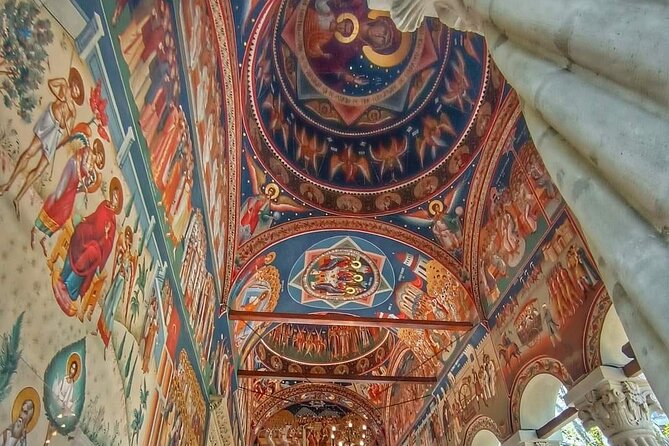
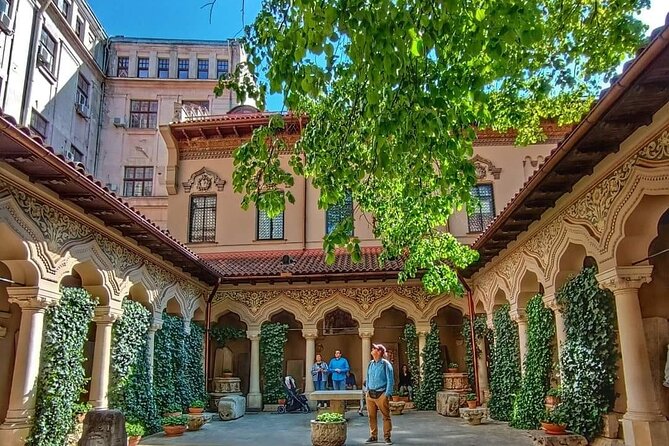
The meeting point is Strada Stavropoleos 5, at 10:00 in the morning. The first stop is Stavropoleos Monastery, a small Orthodox complex in the center of Bucharest. You have about 20 minutes here, and admission is free.
This is an excellent opening stop because the monastery shows a refined side of Romanian architecture before the route moves into the city’s larger public spaces. Its Brâncovenesc style is known for a blend of Romanian, Byzantine, Ottoman, and Western decorative influences. The walls and frescoes give the guide plenty to explain, and the compact setting should make it easier to notice details that disappear on a broad avenue.
I would treat this as a listening stop, not a rushed photo stop. The church is important for its atmosphere and decoration, while the guide provides the spiritual and artistic context. Modest clothing and a respectful tone are sensible when visiting an Orthodox religious site, even though no special dress rule is listed.
Curtea Veche connects Bucharest to its princely past
The walk continues to Biserica Sfântul Anton and Curtea Veche, another 20-minute stop. This small square contains several of the city’s oldest surviving references: the Saint Anthony Church, remains of the former princely court, and Manuc’s Inn.
Here, Bucharest’s early political and commercial life comes into focus. The princely court points to the city’s role as a seat of power, while Manuc’s Inn recalls the age of merchants, caravans, and overland trade. The inn is described as one of the last caravanserais in Eastern Europe, which gives you a useful sense of how different this part of the city once functioned.
The drawback is that ruins and old walls do not explain themselves. Without a guide, Curtea Veche can look like a scattered patch of masonry beside newer buildings. With a strong explanation, the square becomes a key link between the medieval city and today’s center.
Lipscani shows the old center after dark and in daylight
Next comes Lipscani, with about 10 minutes on the famous street. It has long been a central meeting point for trade and city life, and today it is closely tied to Bucharest’s nightlife.
Ten minutes is enough to get your bearings and hear the main story, but not enough for a detailed exploration of every lane. You will likely pass through the area as part of the wider route rather than stop for a meal or drink. That is useful if your goal is orientation, though you may want to return later when you have more time.
Lipscani also helps explain Bucharest’s mixture of old and new. Historic facades share space with bars and restaurants, and the street changes character depending on the hour. The tour gives you the context first, leaving you free to decide later if the nightlife scene suits you.
More walking tours:
- Bucharest: Guided Walking Tour with Romanian Snack
★ 4.9 · 228 reviews - Best of Bucharest | Private Walking Tour
★ 5.0 · 199 reviews - Walking Tour- Delightful Bucharest (Highlights, Stories, Sights)
★ 5.0 · 145 reviews - 4h Bucharest Private Tour (2h by Car and 2h Walking in Old Town)
★ 5.0 · 90 reviews
BNR Palace and Macca-Villacrosse reveal Belle Époque Bucharest
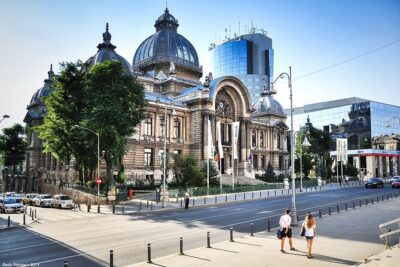
The Romanian National Bank Palace receives about 10 minutes. The building is the historic headquarters of the BNR and sits among elegant structures associated with Bucharest’s Belle Époque period.
This brief stop is valuable for architecture. After the intimate monastery and older remains, the bank shows Bucharest presenting itself as a modern European capital. The guide can help you read the surrounding facades as part of an era of wealth, institutions, and civic ambition.
Another 10 minutes takes you to Macca-Villacrosse Passage. This covered gallery has a more enclosed, decorative feel and now contains bars where people can get out of cold or heat. The passage is a pleasant contrast to the open streets, and its changing roles give the guide another chance to connect daily life with the city’s past.
Do not expect a long break here. The stop is designed for a quick look and explanation, not for sitting down with a coffee. If you want to enjoy the bars, return after the tour.
Calea Victoriei broadens the view
Calea Victoriei is the route’s longest avenue stop, with about 20 minutes. It is presented as Bucharest’s most elegant street, lined with historic buildings, high-fashion shops, and refined bistros.
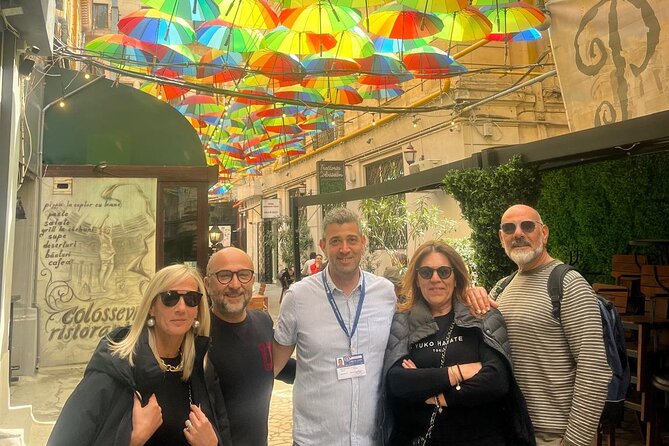
This is where the city’s grand public face becomes most visible. The avenue offers a useful change from the tight streets of the old center, and the guide can point out how architecture, commerce, and public life come together along this corridor. The tour also pauses at the well-known umbrella street for a group photograph.
That photo stop is a fun touch, but it is also a reminder that this is a social tour, not only a lecture. The guide’s humor is repeatedly praised, including the ability to hold the attention of younger or less patient members of a group. If your party includes children or anyone who tires of long historical explanations, that style may help.
The route is outdoors, so the weather matters. One October visit was described as sunny and pleasant, but the operator states that poor weather can lead to a new date or a full refund. Wear shoes suited to city walking and check the forecast before you set out.
Revolution Square puts 1989 at the center
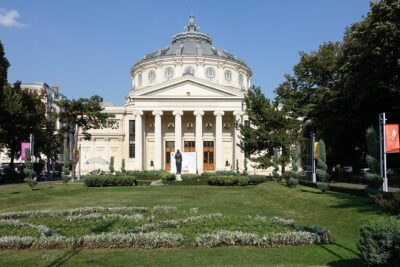
Revolution Square is one of the most important stops, with another 20 minutes. The square brings together the Romanian Athenaeum, the former Royal Palace, and the National Library, but its real importance comes from the events of December 1989.
The guide reconstructs the final moments that brought down Ceaușescu’s dictatorship and explains how the uprising became violent. This is the point where the tour shifts from old architecture to recent political memory. You are not simply looking at handsome buildings. You are standing in a place tied to the end of a regime.
I consider this one of the tour’s strongest elements. Bucharest’s communist period can be difficult to understand through sightseeing alone, and Revolution Square gives the subject a physical location. The guide’s personal experience in Romania since the early 1990s may add useful perspective, though the exact depth of each explanation can depend on which guide leads your group.
The 20-minute timing means you will receive a focused account rather than a full modern Romanian history lesson. If this subject matters greatly to you, use the tour as an introduction and reserve extra time for a museum or a return visit.
Constitution Square closes with communist scale
The final stop is Constitution Square, where the tour ends after about 20 minutes. From here, you look at the exterior of the Palace of Parliament, described as the largest administrative building in Europe and the heaviest building in the world.
The scale is the point. After churches, inns, passages, and nineteenth-century palaces, the Parliament building delivers a sharp change in mood. Its size reflects the ambitions of Ceaușescu’s regime and the enormous reshaping of central Bucharest under communism.
The guide explains the historical setting in which the building was created and introduces nearby places from Constitution Square. That context is essential. Without it, the building can seem like an oversized photo backdrop. With it, the final stop becomes the visual result of political power concentrated into stone, concrete, and monumental space.
Be clear about what is included: this is an exterior visit only. The tour does not include entry to the Parliament, and no admission tickets are listed. If you want an inside visit, you will need to arrange that separately.
The $36.76 price: where the value lies
At $36.76 per person, this is not the cheapest way to walk around Bucharest, since the route itself uses public streets and free-to-view landmarks. The value comes from the guide’s language, organization, historical explanation, and ability to connect places that might otherwise feel unrelated.
I would consider the price fair if you are visiting Bucharest for a short stay, arriving without much background, or traveling with Italian-speaking friends or family. In 150 minutes, you cover the old center, major architectural highlights, Revolution Square, and the Parliament exterior. A self-guided walk costs less, but it also asks you to research the city and keep the route moving yourself.
The limited group size improves the calculation. A maximum of 15 people is small enough to make questions practical, while still keeping the price below that of a fully private tour. Since every listed stop is free, you are paying for interpretation rather than admissions.
Timing, meeting point, and walking demands
The tour starts at 10:00 and begins at Stavropoleos Monastery. It ends at Piața Constituției, so you should not expect to finish where you started. The end point is useful if you want to continue seeing the Parliament area, but plan your next transport from Constitution Square.
The listed stop times add up to roughly 130 minutes, while the total experience lasts about 150 minutes. The remaining time is naturally used for walking between locations, gathering the group, and shifting from one part of central Bucharest to another.
Most people can participate, and service animals are allowed. The tour is near public transportation, but no specific transit route is provided. Since it is a walking activity with several outdoor stops, comfortable footwear and weather-appropriate clothing are practical choices.
Confirmation is provided at booking, and the experience uses a mobile ticket. Free cancellation is available until 24 hours before the start time. Within 24 hours, changes and refunds are not accepted. If bad weather cancels the tour, you are offered another date or a full refund. The same applies if the minimum number of participants is not reached.
Who will get the most from this tour
I would recommend it first to Italian-speaking visitors who want a human guide rather than an audio app. The Italian language is the clearest reason to choose this particular walk, and the guide profiles suggest a strong connection to Romania.
It also suits first-time visitors, couples, families, and small groups who want a quick city orientation. The humorous approach can help keep a mixed-age group involved, and the route gives you enough landmarks to decide what deserves a longer visit later.
You may want something else if you prefer museum interiors, a slower pace, or a tour focused only on communist Bucharest. The Parliament is not visited inside, Lipscani gets only a short stop, and the whole route covers many subjects in one morning. It is broad and useful, but not exhaustive.
Should you book the Bucharest walking tour?
Book it if you want Bucharest explained in Italian, especially during a short visit. The strongest reasons are the experienced guides, the small group cap, the lively anecdotes, and the route’s clear movement from medieval Bucharest to the 1989 revolution and the communist-era Parliament.
Skip it if your priority is independent wandering or interior access to major buildings. For most Italian-speaking visitors, though, $36.76 is a reasonable fee for a well-planned introduction that turns Bucharest’s unusual contrasts into a coherent story.
FAQ
How long does the Bucharest walking tour last?
The tour lasts approximately 2 hours 30 minutes.
What time does the tour start?
It starts at 10:00 am.
Where does the tour begin?
The meeting point is Strada Stavropoleos 5, București 030167, Romania.
Where does the tour finish?
The tour ends at Piața Constituției in Bucharest.
Is the tour conducted in Italian?
Yes. The experience includes a native Italian-speaking tour guide.
How many people can join the tour?
The maximum group size is 15 travelers.
Are entrance tickets included?
No entrance tickets are included. The listed stops are viewed without admission charges, and the Parliament visit is from the outside.
Can I cancel for a refund?
Yes. You can cancel at least 24 hours before the start time for a full refund. Cancellations within 24 hours are not refunded.
Just added around Bucharest
- 10 hours Private Apiary Tour in Romania – From Bucharest★ 5.0 · 3 reviews
- 4-Day Inside Transylvania & Transfagarasan Tour from Bucharest★ 5.0 · 3 reviews
- Bucharest: Charm of the Belle Époque Private Tour★ 5.0 · 3 reviews
- Bran & Peles Castles through the Best Road in the World: Transfagarasan road★ 4.5 · 3 reviews
- Private Wine Tasting at Bucharest’s First Wine Bar★ 5.0 · 3 reviews
- 2-Day Small-Group Tour in Transylvania from Bucharest – Maximum 5 Persons★ 5.0 · 3 reviews
- Probably the Best Restaurant and Wine Cellar near Bucharest★ 4.5 · 3 reviews
- Bucharest to Brasov – Fast Private Transfer★ 5.0 · 3 reviews
Walking Tours, compared.

Ghost Stories & Romanian Mythology Walking Tour
Read our review →
Walking Tour- Delightful Bucharest (Highlights, Stories, Sights)
Read our review →
Browse the lists this tour appears in