
Reviewed · WALKING TOURS
Bucharest : Highlights & Hidden Gems Walking Tour
Bucharest rewards curious walkers. This two-hour tour brings the city’s trading past, royal era, communist period, and modern identity into one compact route. I like the private, customizable format, and I like that the walk mixes major sights with passages, courtyards, and historic buildings you could easily pass without understanding. The main consideration is time: two hours gives you a useful introduction, but not enough for long interior visits.
The route is especially appealing if you want a quick orientation at the start of your stay. Guides such as Alexandra, Irina, Karim, Augustin, Zoé, and Camélia have been praised for clear explanations, warm manners, and practical help, including assistance with Parliament tickets. The English, French, and Spanish language choices also make this a good fit for mixed-language groups.
In This Review
- Six details worth knowing before you book
- Why this short Bucharest walk works
- Manuc’s Inn and Bucharest’s trading past
- Hanul Gabroveni and the city behind the facades
- BNR Palace and Bucharest’s financial story
- Stavropoleos Monastery, a quieter center
- CEC Palace and the city’s grand civic face
- Macca-Vilacrosse Passage and layers of modern Bucharest
- Royal Palace and Sala Palatului
- Cismigiu Park and a gentle finish
- What $29 buys you
- The guide can shape the whole experience
- Who should book this walk?
- Should you book the Bucharest Highlights and Hidden Gems Walking Tour?
- FAQ
- How long does the Bucharest walking tour last?
- How much does the tour cost?
- Is the tour private?
- Where does the tour meet?
- Which languages are available?
- Is the tour wheelchair accessible?
- Are food and drinks included?
- Are admission tickets included?
- Does the tour use public transport?
- Can I cancel for a refund?
Six details worth knowing before you book
- Manuc’s Inn and Hanul Gabroveni connect Bucharest to its old trading life, not just its postcard streets.
- Stavropoleos Monastery offers a quieter change of pace, with Orthodox design and a more intimate setting than the grand civic buildings nearby.
- The route links monarchy, communism, and democracy, giving you a useful framework for understanding modern Romania.
- A private group means you can ask questions freely and request changes to suit your interests.
- Cismigiu Park gives the walk a calmer finish, after the stone, traffic, and grand facades of central Bucharest.
- At $29 per person, the tour is strongest as an orientation walk, especially when you use the guide’s advice to plan the rest of your visit.
Why this short Bucharest walk works

Bucharest can feel hard to read at first. The city combines Ottoman-era trading links, French-influenced architecture, Orthodox churches, royal landmarks, communist construction, and modern street life. These layers do not always present themselves in neat order.
That is where a local walking guide earns the fee. Instead of seeing one church, one palace, and one old inn as separate photo stops, you get a thread connecting them. You can ask why a building looks the way it does, how the city changed, and which places deserve more time later.
I see this tour as a city introduction rather than a full historical examination. The pace allows roughly 20 minutes around each listed stop, though exact timing can change because the walk is private and customizable. That is enough for orientation and questions, but you should not expect a long museum visit or a detailed architectural lecture at every building.
The tour begins at Strada Franceză 60 in the Lipscani area. This is a useful central meeting point, close to Bucharest’s Old Town, the National Museum of Romanian History, and routes toward the Palace of the Parliament. Cafes, restaurants, and cultural venues are nearby, so you can easily continue exploring after the walk.
More Walking Tours in Bucharest
- Bucharest: City Highlights Guided Walking Tour
★ 4.9 · 1,482 reviews - Bucharest Highlights Walking Tour
★ 5.0 · 469 reviews - Bucharest: Ghost Stories & Romanian Mythology Walking Tour
★ 4.9 · 287 reviews
Manuc’s Inn and Bucharest’s trading past
Manuc’s Inn gives the tour a strong starting point because it helps explain how Bucharest grew. The historic inn is tied to merchants, travelers, and trade, offering a window into the city before modern boulevards and state buildings reshaped the center.
Your guide can help you read the place as more than an old courtyard. Inns like this were practical meeting points where people exchanged goods, news, and money. That makes Manuc’s Inn a useful counterweight to the grand palaces later in the walk. Bucharest was not built only by kings and governments. Commerce helped give the city its shape.
The setting is also a good place to ask for recommendations. Since the tour is private, you can tell your guide what interests you, such as architecture, food, political history, or local culture. The experience includes advice about other things to do in Bucharest, which can be more useful than a fixed list of attractions.
One practical point: the supplied route details place Manuc’s Inn among the final numbered stops, while the tour description presents it as the opening point. Because the tour is customizable, confirm the exact walking order when you meet your guide. Either way, Manuc’s Inn is an important part of the central Bucharest story.
Hanul Gabroveni and the city behind the facades
Hanul Gabroveni continues the look at Bucharest’s mercantile past. Like Manuc’s Inn, it points to a time when inns and commercial buildings played a major role in city life.
I like this stop because it adds context to the Old Town. Lipscani is easy to treat as a collection of restaurants, bars, and attractive facades. A guide can show you how the district functioned before it became a leisure quarter, and why its old buildings matter.
The stop is listed as a photo stop and guided visit lasting about 20 minutes. That wording matters. You will get time to look, listen, and ask questions, but the focus is on the exterior setting and historical explanation rather than a long formal visit inside.
The condition and appearance of central Bucharest can vary from street to street. A guide helps you make sense of that uneven character instead of judging the Old Town only by its polished corners. If you enjoy cities where different periods sit side by side, this part of the walk should be rewarding.
BNR Palace and Bucharest’s financial story
The BNR Palace brings the tour into the city’s financial development. Its presence shifts the mood from merchant inns to national institutions, showing how Bucharest grew from a regional trading center into the capital of a modern state.
This is one of the places where a guide’s explanation matters most. A grand bank building can look impressive without telling you much. With context, you can connect the building to money, state power, and the changing needs of Romania’s capital.
The BNR Palace is part of the broader route even though the numbered itinerary emphasizes other stops. If financial history or architecture interests you, mention it when booking or at the start. The private format allows some adjustment, but the available information does not promise entry into every building.
That is a recurring feature of the experience. You see important places and learn how they fit together, but you should not assume that every palace or institution includes an interior tour. The provider can help book tickets for desired visits, but admission tickets themselves are not listed as included.
More walking tours:
- Bucharest: Guided Walking Tour with Romanian Snack
★ 4.9 · 228 reviews - Best of Bucharest | Private Walking Tour
★ 5.0 · 199 reviews - Walking Tour- Delightful Bucharest (Highlights, Stories, Sights)
★ 5.0 · 145 reviews - 4h Bucharest Private Tour (2h by Car and 2h Walking in Old Town)
★ 5.0 · 90 reviews
Stavropoleos Monastery, a quieter center
Stavropoleos Monastery is likely to be one of the most memorable stops. Its Orthodox character offers a close, human-scale contrast to the larger civic buildings around it.
The monastery represents a different side of Bucharest’s past. Here, details and atmosphere matter as much as size. Your guide can explain the role of Orthodox culture in Romania and point out features you might miss if you only stop for a quick photograph.
I would give this stop your full attention. Grand palaces are easy to recognize, but a smaller religious site often rewards patient looking. Notice how the setting changes the pace of the tour. After the commercial streets and institutional buildings, Stavropoleos gives you a quieter place to think.
The visit is scheduled for around 20 minutes, so the tour does not allow unlimited time. If religious art or church architecture is a priority, ask whether you can spend longer here and shorten another stop. The customization option is most valuable when you use it clearly.
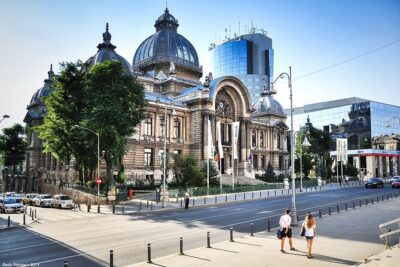
CEC Palace and the city’s grand civic face
CEC Palace is one of the route’s major visual highlights. Its ornate exterior reflects the confidence of a capital that wanted impressive public buildings and a strong civic identity.
The palace also helps explain why Bucharest is sometimes called a city of contrasts. A trading inn, an Orthodox monastery, a national bank, and a grand palace can all appear within a short walk. That mix is not a flaw to smooth over. It is the point.
Your guide can help you distinguish CEC Palace from the nearby buildings rather than reducing the stop to a quick photograph. Look at the scale, decoration, and placement. Ask what the building was designed to do and how it fits into the city’s financial and political development.
Again, plan on an exterior-focused visit unless a separate entry has been arranged. The provider offers help booking tickets for desired visits, but food, drinks, and admission costs are not included in the $29 price.
Macca-Vilacrosse Passage and layers of modern Bucharest
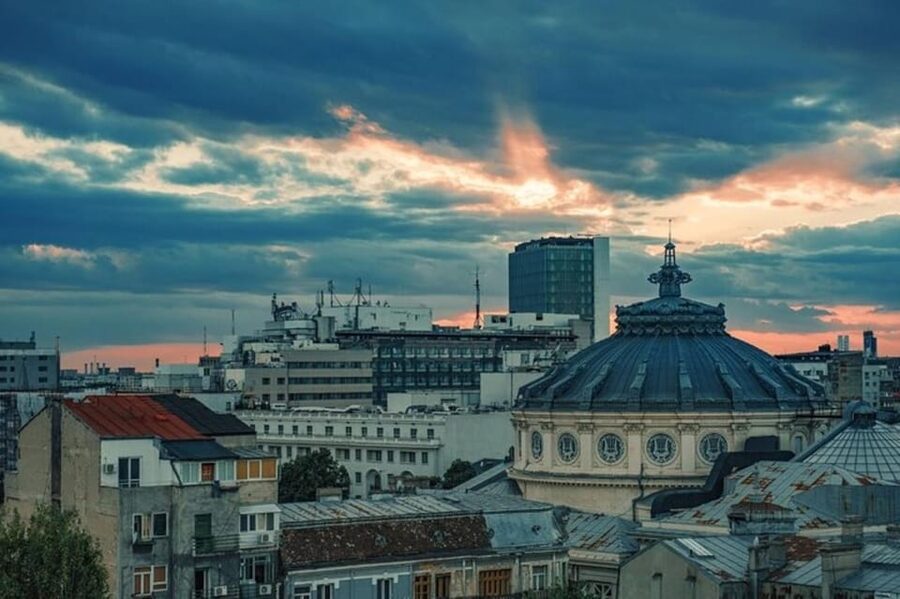
Macca-Vilacrosse Passage gives the walk a change of texture. Its covered passage and distinctive architecture make it one of the places that can be missed if you move through the Old Town without looking around.
This is a good stop for understanding Bucharest’s connection to European urban design. The passage feels different from the open streets and monumental facades nearby, and it gives you a compact lesson in how commercial spaces were designed for movement, trade, and social life.
The guide’s role here is not simply to identify the passage. Ask about the names, the building’s purpose, and how this part of the city changed across different political periods. The tour description specifically connects the walk to monarchy, communism, and democracy, and this passage helps keep those shifts tied to real places.
Allow time for photographs, but do not let the camera replace the explanation. The passage is attractive, yet its value comes from understanding its place in Bucharest’s urban story.
Royal Palace and Sala Palatului
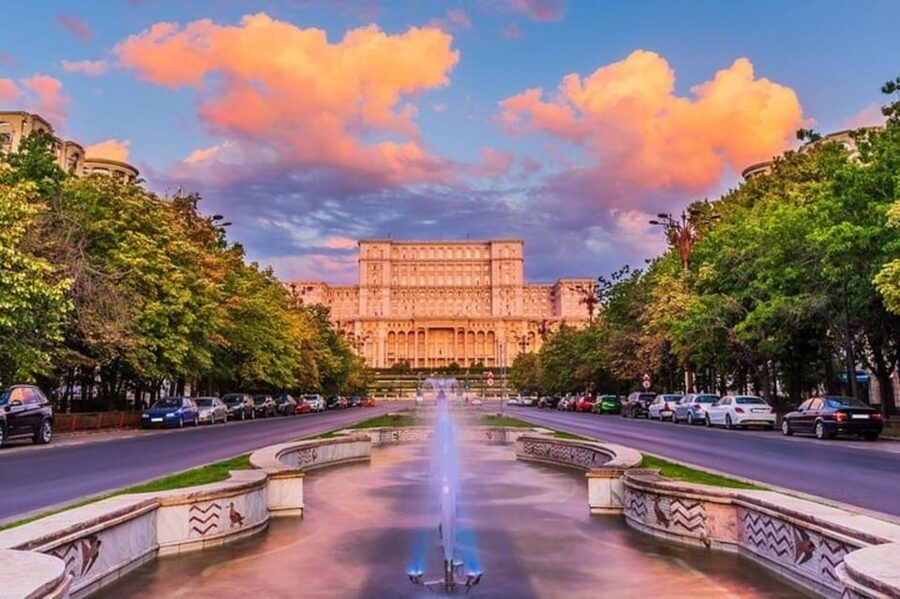
The Royal Palace brings Romania’s monarchy into view. It represents a different kind of state power from the bank and commercial buildings earlier in the tour, and it gives your guide a natural point for explaining the country’s political transformation.
The tour also takes in Sala Palatului, whose imposing Stalin-era architecture reflects the communist period. Seeing these places in the same walk helps you compare the visual language of monarchy with the heavy, state-centered style of communist construction.
This is where the tour’s historical range becomes most useful. You are not getting a single romantic version of Bucharest. You are seeing a capital shaped by different governments and different ideas about public space.
Do not expect every political detail to fit into a two-hour walk. The value is in getting the basic sequence and knowing what to investigate later. If twentieth-century history is your main interest, tell the guide at the outset so the commentary can lean in that direction.
Cismigiu Park and a gentle finish
Cismigiu Park is Bucharest’s oldest park and gives the experience a welcome final pause. After the stone streets, banks, churches, and state buildings, the park lets you reflect on the city without another grand facade demanding your attention.
The park is scheduled for about 20 minutes, including a photo stop, guided visit, and walk. That is enough to see why it matters as a public space, though not enough for a long stroll through every section.
I like the choice of ending here. It gives the tour an emotional change of pace and reinforces the idea that Bucharest is not only its monuments. Public parks are part of how a city lives day to day, and Cismigiu offers a calmer view of the capital’s character.
If you want to keep exploring afterward, ask your guide for suggestions. The experience specifically includes practical advice about other things to do in Bucharest, and the park is a natural point to decide whether you want more museums, Old Town streets, or major civic sights.
What $29 buys you
At $29 per person, the price is reasonable for a private two-hour introduction, especially if you are traveling with family or friends and can share the guide’s attention. A private tour normally costs more than a large group walk, but the ability to ask questions and adjust the emphasis adds real value.
The price is less attractive if you expect extensive access to interiors or included refreshments. Food and drinks are not included, and entry tickets are not part of the stated package. The provider can help arrange tickets for visits you want, which is useful, but budget separately for those costs.
The tour includes walking and public transport unless you select a different option. The supplied details do not spell out how much public transport is used, so ask when confirming the start time if that matters to you.
Cancellation is flexible: you can cancel up to 24 hours ahead for a full refund, and you can reserve now and pay later. The experience is wheelchair accessible, though you should still discuss your specific needs with the provider before the walk.
The guide can shape the whole experience
The strongest pattern in the available feedback is the quality of the guiding. Alexandra was praised for helping with Parliament tickets and explaining the city’s past. Augustin was described as attentive and warm, while Karim received praise for his excellent knowledge and friendly manner.
Irina was singled out for an engaging approach, a comfortable pace, and useful explanations about local culture and history. Zoé led a French-language visit that helped the group learn about Romania and Bucharest. Camélia was also praised for being an especially pleasant host.
Those details matter because a walking tour rises or falls on the person leading it. The experience has a perfect 5 rating from nine submitted ratings, which is encouraging, though still a small sample. Guide assignments can change, so I would treat the individual names as examples of the service level rather than a guarantee of a particular guide.
You can improve your odds of getting the tour you want by stating your interests clearly. Ask for more architecture, more twentieth-century politics, more Orthodox culture, or more practical city advice. The private format gives your guide room to respond.
Who should book this walk?
I would recommend it to first-time visitors who want a clear introduction before exploring alone. It also suits couples, families, and small groups who prefer conversation over a fixed, large-group script.
It is a good choice for you if you want:
- A compact introduction to the Old Town and central Bucharest
- A private guide rather than a large shared group
- A mix of trade, religion, monarchy, communism, and civic architecture
- Advice about what to do after the walk
- A tour in English, French, or Spanish
- A wheelchair-accessible experience
I would be more cautious if your main goal is entering several buildings, spending an hour inside a museum, or covering the Palace of the Parliament in detail. This is a walking overview, not an all-access architecture tour.
Should you book the Bucharest Highlights and Hidden Gems Walking Tour?
Book it if you want to get your bearings quickly and understand why Bucharest looks so varied. The route brings together Manuc’s Inn, Hanul Gabroveni, Stavropoleos Monastery, CEC Palace, Macca-Vilacrosse Passage, the Royal Palace, Sala Palatului, and Cismigiu Park in a manageable format.
The best value comes from treating the tour as your first chapter in Bucharest. Use the guide’s advice to choose later visits, ask for help with tickets if needed, and request emphasis on the subjects you care about. At $29, it is a sensible buy for a private orientation, as long as you understand that the two-hour schedule favors explanation and exterior sightseeing over lengthy interior visits.
FAQ
How long does the Bucharest walking tour last?
The tour lasts two hours. Starting times vary, so you need to check availability when booking.
How much does the tour cost?
The listed price is $29 per person.
Is the tour private?
Yes. The tour is described as private and exclusive, with no one else added to your group. The information also refers to a small-group walking format.
Where does the tour meet?
The meeting point is at Strada Franceză 60 in Bucharest’s historic Lipscani district.
Which languages are available?
Live guiding is available in English, French, and Spanish.
Is the tour wheelchair accessible?
Yes, the experience is listed as wheelchair accessible.
Are food and drinks included?
No. Food and drinks are not included in the tour price.
Are admission tickets included?
Admission tickets are not listed as included. The provider can help you book tickets for visits you want, including assistance with desired attractions.
Does the tour use public transport?
The experience includes walking and public transport, except when you select one of the alternative options. The supplied details do not specify the exact amount of public transport used.
Can I cancel for a refund?
Yes. You can cancel up to 24 hours in advance for a full refund. You can also reserve now and pay later.
Just added around Bucharest
- 4-Day Inside Transylvania & Transfagarasan Tour from Bucharest★ 5.0 · 3 reviews
- 10 hours Private Apiary Tour in Romania – From Bucharest★ 5.0 · 3 reviews
- Bucharest: Charm of the Belle Époque Private Tour★ 5.0 · 3 reviews
- Bran & Peles Castles through the Best Road in the World: Transfagarasan road★ 4.5 · 3 reviews
- 2-Day Small-Group Tour in Transylvania from Bucharest – Maximum 5 Persons★ 5.0 · 3 reviews
- Private Wine Tasting at Bucharest’s First Wine Bar★ 5.0 · 3 reviews
- Bucharest to Brasov – Fast Private Transfer★ 5.0 · 3 reviews
- Probably the Best Restaurant and Wine Cellar near Bucharest★ 4.5 · 3 reviews
Walking Tours, compared.

Ghost Stories & Romanian Mythology Walking Tour
Read our review →
Walking Tour- Delightful Bucharest (Highlights, Stories, Sights)
Read our review →
Browse the lists this tour appears in